Updated Saturday, July 25, 2026 at 09:01 AM
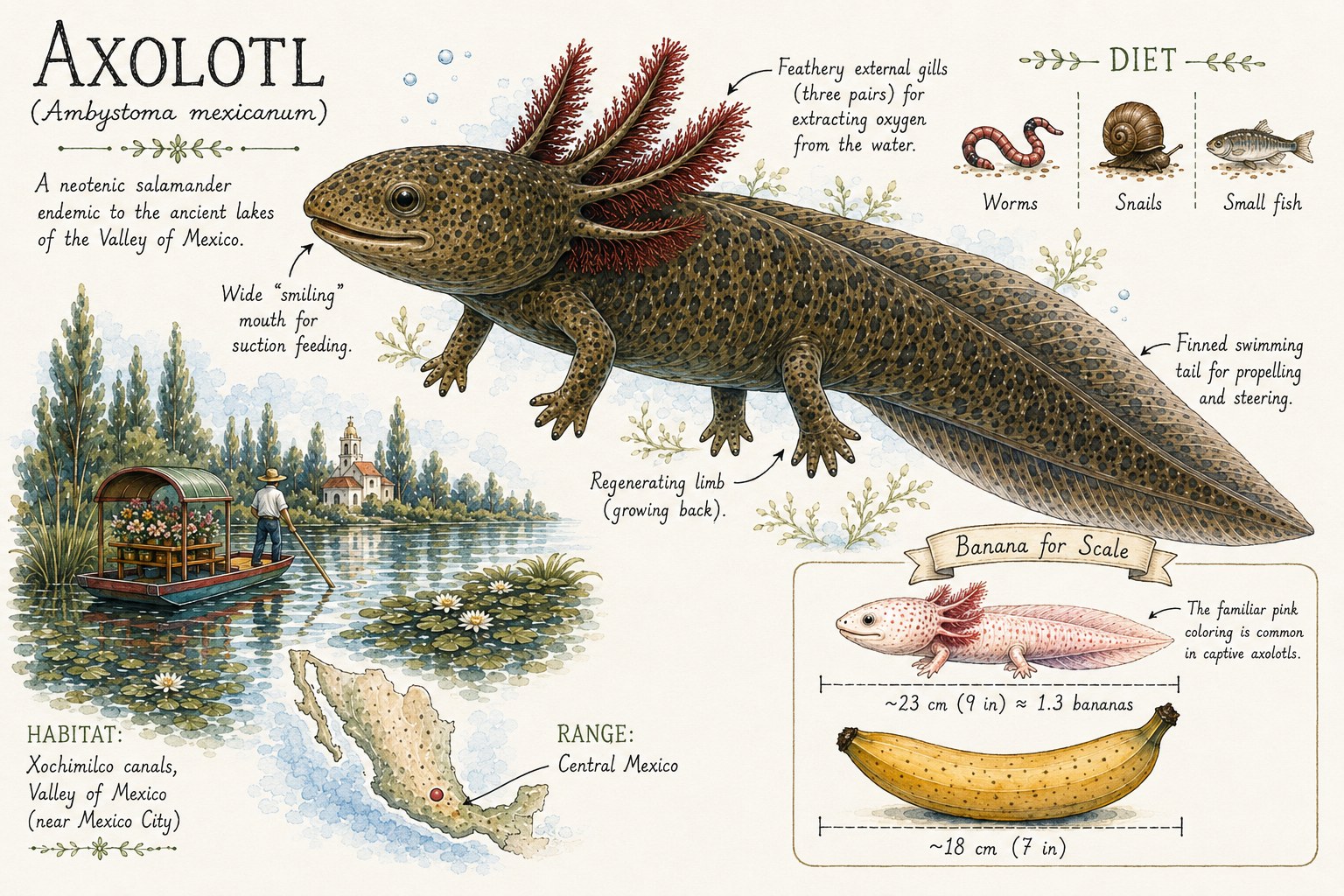 #04AxolotlAmbystoma mexicanum
Pick pilot card
Size
Average ~23 cm (9 in); reaches 30 cm (12 in). Mass ~60–110 g. Banana scale: about 1.3 bananas on average, up to ~1.7 (1 banana = 18 cm)
Habitat
Freshwater. High-altitude lake and canal system, ~2,290 m (7,500 ft) elevation; cool, quiet water with lots of vegetation
Range
Endemic to the Valley of Mexico. Historically Lakes Xochimilco and Chalco near Mexico City; Chalco was drained, so effectively only the Xochimilco canals remain
Diet
Carnivore; suction-feeds on worms, mollusks (snails), insects and other arthropods, small fish, zooplankton, and smaller axolotls
Lifespan
Typically ~5–6 years; some individuals reach 10–15 years in captivity. Wild data sparse
Conservation
Critically Endangered (IUCN, assessed 2019). Population decreasing; estimated 80%+ decline over three generations. CITES Appendix II
Wow
It regrows amputated limbs, and repairs its heart, spinal cord, and parts of its brain, without scarring, and can regenerate the same limb repeatedly
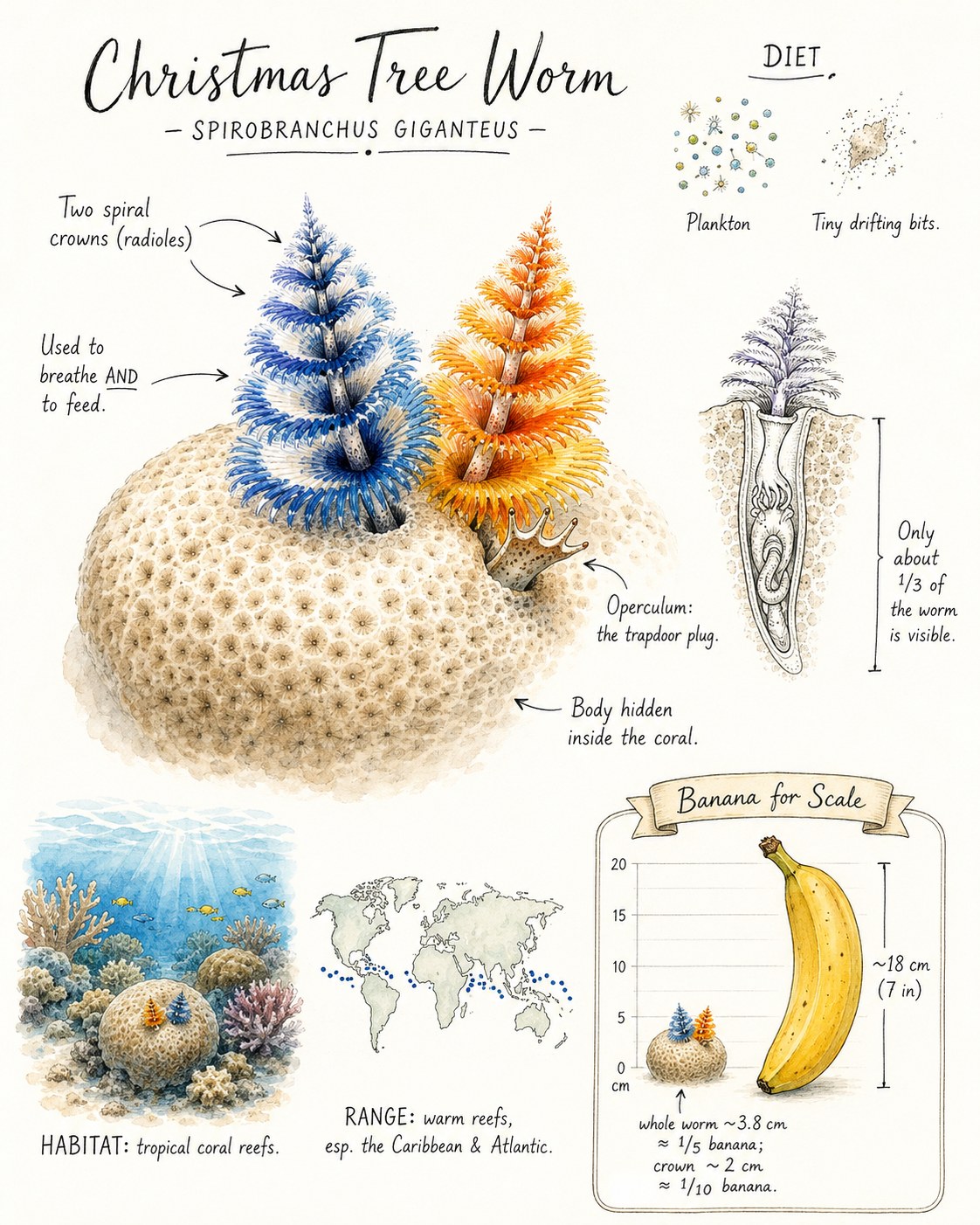 #08Christmas Tree WormSpirobranchus giganteus
say it: SPY-roh-BRANK-us jy-GAN-tee-us
Pick random pick
Size
Whole worm averages ~3.8 cm (1.5 in); the colorful crown is only ~1.5–2.5 cm; body can reach ~10 cm and bores up to ~20 cm into coral. Banana scale: the whole worm ≈ one-fifth of a banana; the visible "tree" crown ≈ one-tenth (1 banana = 18 cm)
Habitat
Strictly marine (not fresh, not brackish). Tropical coral reefs; bores a tube into the skeleton of living coral heads
Range
Warm tropical reefs. S. giganteus proper is now placed in the Caribbean and wider Atlantic; the very similar Indo-Pacific Christmas tree worms are being reassigned to related species (flagged, see fact-check)
Diet
Microscopic plankton (phytoplankton, zooplankton) and suspended detritus. Suspension feeder: cilia on the feathery crown drive a water current and sweep particles to the mouth
Lifespan
Many live 10+ years; a few exceed ~40 years. Ages estimated indirectly from the host coral's annual growth bands, so wild lifespans are hard to pin down
Conservation
Not Evaluated (IUCN) — the species has never been formally assessed. Considered widespread and common; the real concern is the health of its coral-reef habitat
Wow
The famous colorful "Christmas tree" is only about a third of the whole animal. The rest is a hidden worm burrowed deep in living coral. And it is so jumpy that a passing shadow makes the whole tree vanish into its tube in a blink
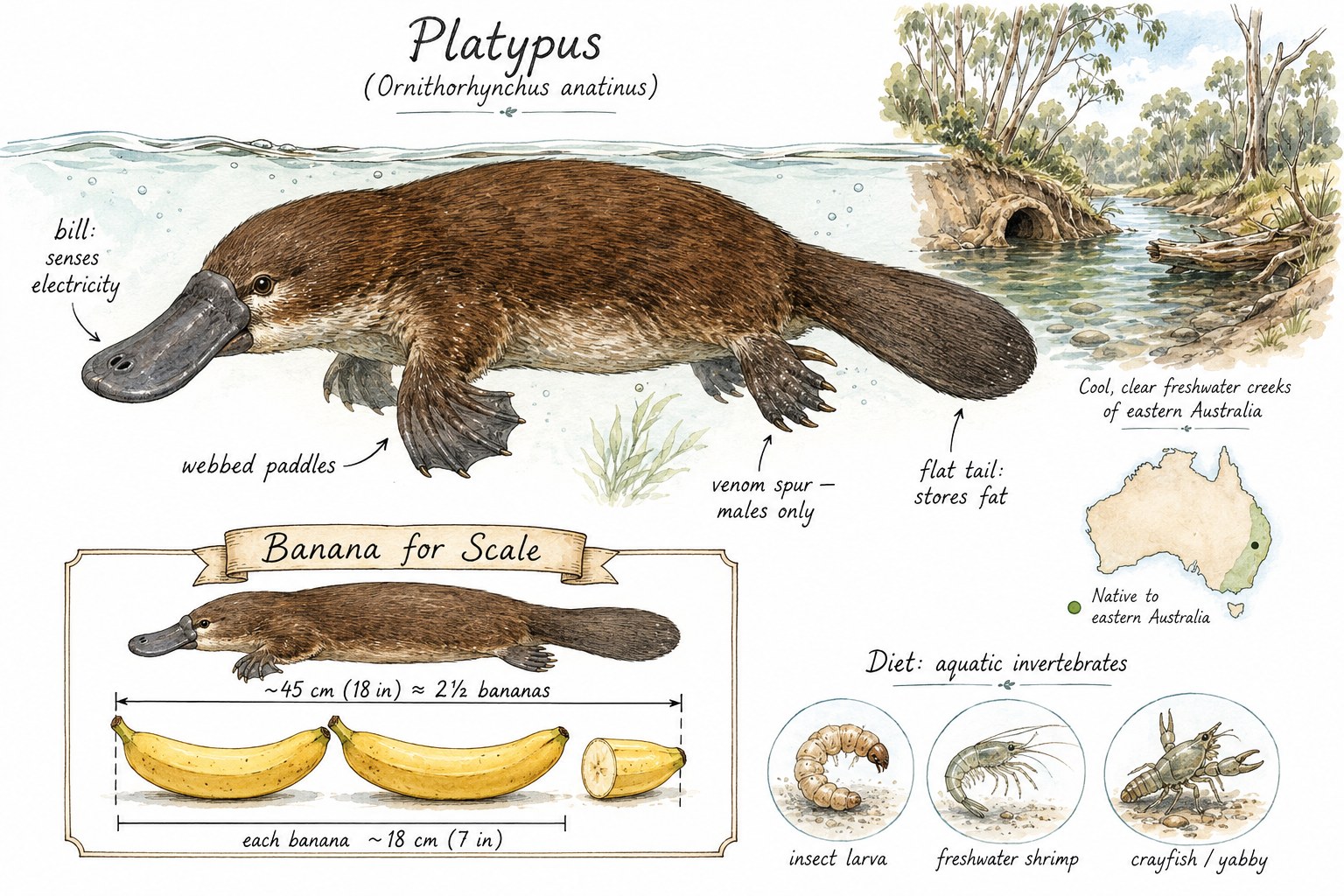 #09PlatypusOrnithorhynchus anatinus
Pick Timely hook: Australian mid-winter, the start of platypus breeding season
Size
Males typically 40–63 cm, females 37–55 cm (bill-tip to tail-tip); males 800–3000 g, females 600–1700 g. Banana scale: about 2 to 3½ bananas long (1 banana = 18 cm)
Habitat
Freshwater. Rivers, streams, and ponds with earth banks and native bankside vegetation; from tropical Queensland lowlands to cold Tasmanian and alpine streams
Range
Endemic to eastern Australia: eastern Queensland and New South Wales, much of Victoria, all of Tasmania, plus an introduced population on Kangaroo Island. Extinct in mainland South Australia
Diet
Bottom-dwelling (benthic) freshwater invertebrates: insect larvae, freshwater shrimp, small crayfish/yabbies, worms, water bugs, tadpoles. Forages ~10–12 hrs, mostly at night; sifts prey from the riverbed and stores it in cheek pouches, then chews at the surface with horny grinding plates (adults have no teeth)
Lifespan
Up to ~20 years in the wild and in captivity
Conservation
Near Threatened (IUCN, assessed 2014)
Wow
It hunts blind. Underwater it seals its eyes, ears, and nostrils shut and finds prey with its bill alone, which carries roughly 40,000 electroreceptors that pick up the faint electric fields made by a shrimp's twitching muscles, plus about 60,000 touch receptors
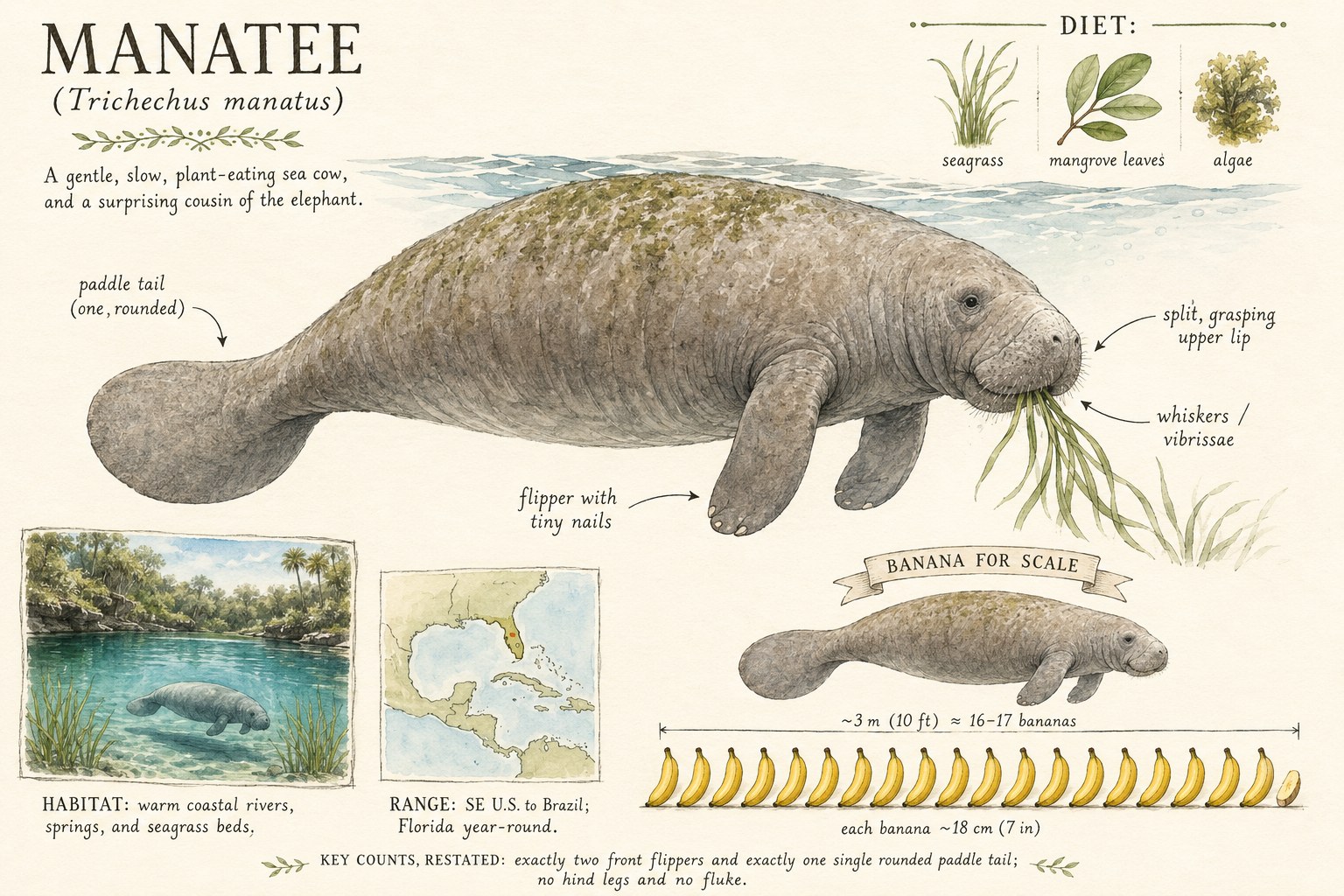 #11Manatee (West Indian / Florida Manatee)Trichechus manatus
Pick Timely hook: high summer, when Florida's manatees scatter across the Southeast
Size
Adults typically 9–10 ft (2.7–3 m); can exceed 13 ft (4 m). Weight ~1,000 lb (450 kg), up to ~3,500 lb (1,590 kg). Banana scale: a typical adult is about 15 to 17 bananas long (up to ~22 for a giant) (1 banana = 18 cm)
Habitat
Marine, brackish, and freshwater; coastal and riverine. Seagrass and eelgrass beds, estuaries, springs, rivers, and salt marsh. Needs regular access to freshwater to drink
Range
West Indian manatee: southeastern U.S. through the Gulf of Mexico, Caribbean, and Central America to northeastern Brazil. Florida subspecies is native to Florida and in summer ranges west to Texas and north to Delaware Bay and beyond
Diet
Herbivore. Seagrasses, aquatic plants, mangrove leaves, algae, and salt-marsh plants. Eats up to ~10% of its body weight a day, feeding 6–8 hours daily; grasps plants with a muscular, split upper lip
Lifespan
Can live 60 years or more; the wild potential is often around 50–60+ years. Oldest documented was Snooty, a captive manatee who reached 69
Conservation
Vulnerable (IUCN, assessed 2023) for the West Indian manatee (Florida subspecies Vulnerable; Antillean subspecies Endangered). U.S.: protected under the ESA and the Marine Mammal Protection Act
Wow
Its closest living relatives are elephants, and it shows: manatees grow "marching molars," back teeth that erupt at the rear of the jaw, creep forward, wear down, drop out the front, and get replaced for the animal's whole 60-year life. Only elephants and their kin do the same
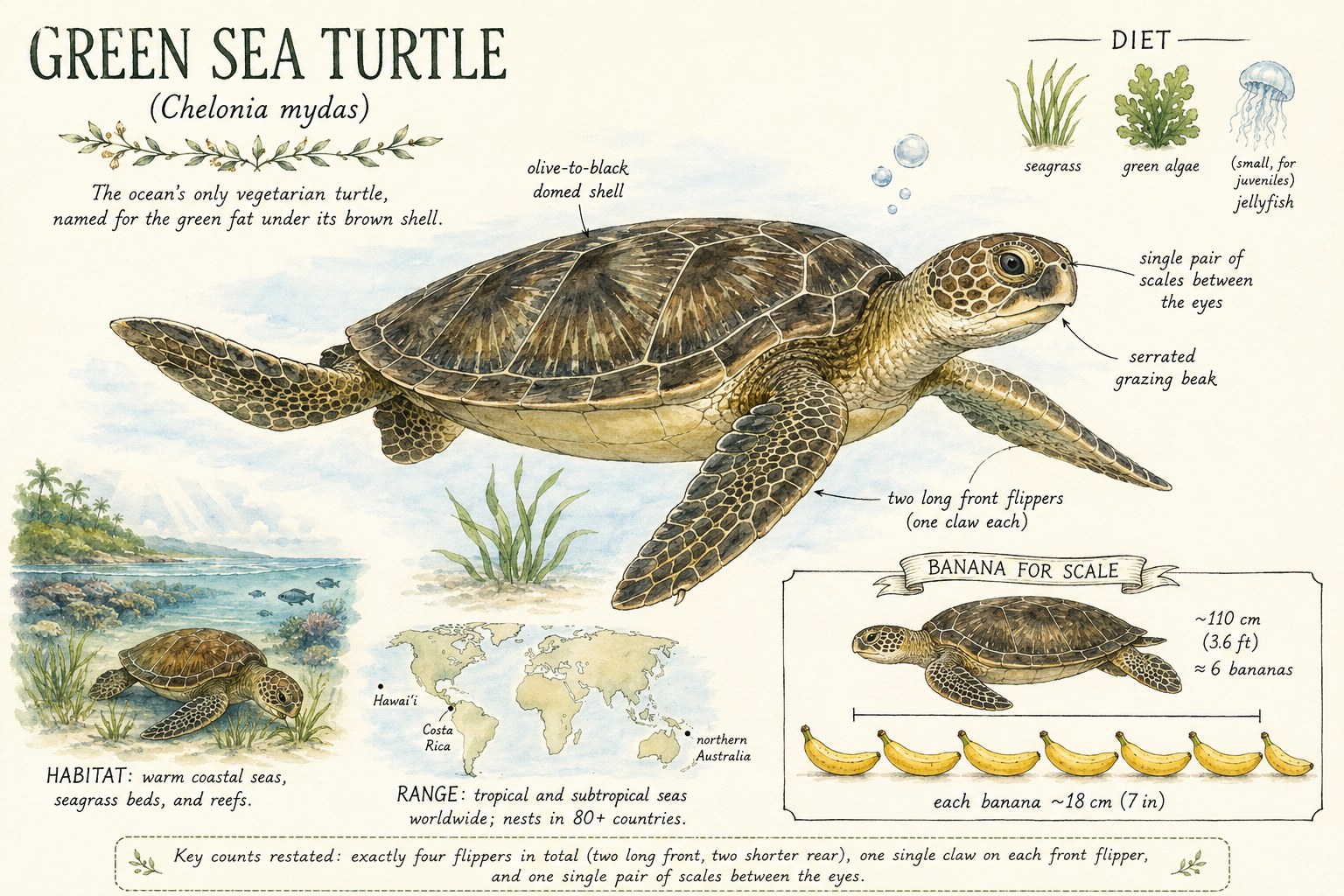 #12Green Sea TurtleChelonia mydas
kel-OH-nee-uh MY-dass
Pick Timely hook: the green turtle was just downlisted from Endangered to Least Concern on the IUCN Red List, October 2025
Size
Adult carapace (shell) ~3–4 ft (91–122 cm); weight ~250–400 lb (NOAA), up to ~500 lb / 225 kg (SEE Turtles). Largest hard-shelled sea turtle. Banana scale: about 6 bananas long (1 banana = 18 cm)
Habitat
Saltwater. Tropical and subtropical coastal seas: seagrass meadows, coral reefs, lagoons and bays. Comes ashore to nest, and (uniquely among sea turtles) hauls out to bask on land in a few places like Hawai'i and the Galápagos
Range
Worldwide in warm seas; nests in more than 80 countries. Largest rookeries include Tortuguero (Costa Rica), Raine Island (Australia), Oman, and French Frigate Shoals (Hawai'i)
Diet
Adults are herbivores: seagrasses and algae, snipped with a finely serrated (saw-edged) beak. The only sea turtle that grazes as an adult. Juveniles are omnivorous (jellyfish, small invertebrates) before switching to plants
Lifespan
Not precisely known; NOAA estimates 70 years or more. Females reach maturity slowly, around 25–35 years
Conservation
Least Concern (IUCN, assessed 2025), downlisted from Endangered at the IUCN World Conservation Congress, Abu Dhabi, October 2025, on ~28% global population growth since the 1970s. Note: U.S. ESA still lists green turtle populations as Endangered/Threatened, and some subpopulations (e.g., Southwest Pacific/Raine Island) remain at risk
Wow
A female returns to nest on the very beach where she hatched, sometimes after crossing thousands of kilometers of open ocean. The leading explanation is geomagnetic imprinting: as a hatchling she learns the unique magnetic signature of her home beach and uses Earth's magnetic field to find it again decades later
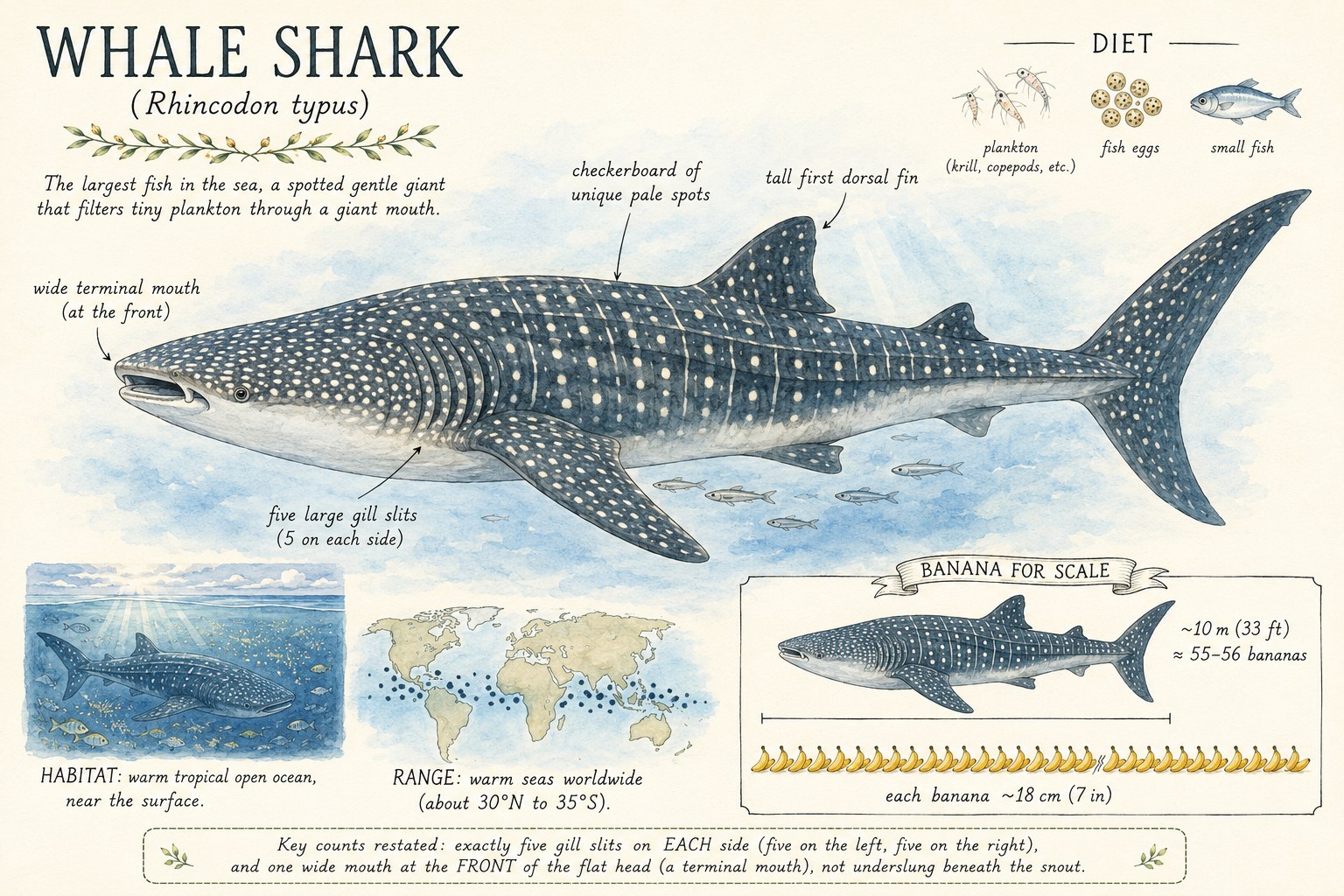 #13Whale SharkRhincodon typus
RING-koh-don TY-pus
Pick Requested pick from the batch: the world's biggest fish, chosen for contrast after two mammals
Size
Largest living fish. Typical adults ~10–12 m (33–39 ft); largest well-documented individual 18.8 m (61.7 ft). Weighs on the order of 15–20+ tons. Banana scale: a representative ~10 m adult is about 55½ bananas long (range ~55–67 for typical adults; ~104 for the 18.8 m record) (1 banana = 18 cm)
Habitat
Saltwater. Warm tropical and warm-temperate open ocean; often near the surface, comes inshore to bays, lagoons, and coasts, especially at seasonal plankton blooms. Dives recorded to ~1,900 m
Range
Circumglobal in tropical and warm seas (Atlantic, Pacific, Indian Oceans), roughly between 30°N and 35°S; gathers seasonally at known feeding aggregation sites
Diet
Filter feeder. Plankton (copepods, krill, sergestid shrimp), fish eggs and spawn, and small schooling fish (sardines, anchovies). Feeds by ram and suction filtration, straining prey against modified gill rakers; ~3,000 tiny teeth are NOT used to feed
Lifespan
Long-lived; estimates commonly ~80–130 years, though maximum longevity is genuinely uncertain and debated
Conservation
Endangered (IUCN, assessed 2016) — uplisted from Vulnerable after inferred population declines of well over 50% across three generations. Listed on CITES Appendix II and CMS Appendices I & II
Wow
Every whale shark has a unique pattern of pale spots, and to tell individuals apart scientists adapted a pattern-matching algorithm first built to map stars in Hubble Space Telescope images. A NASA astrophysicist helped rework star software to fingerprint sharks by their spots
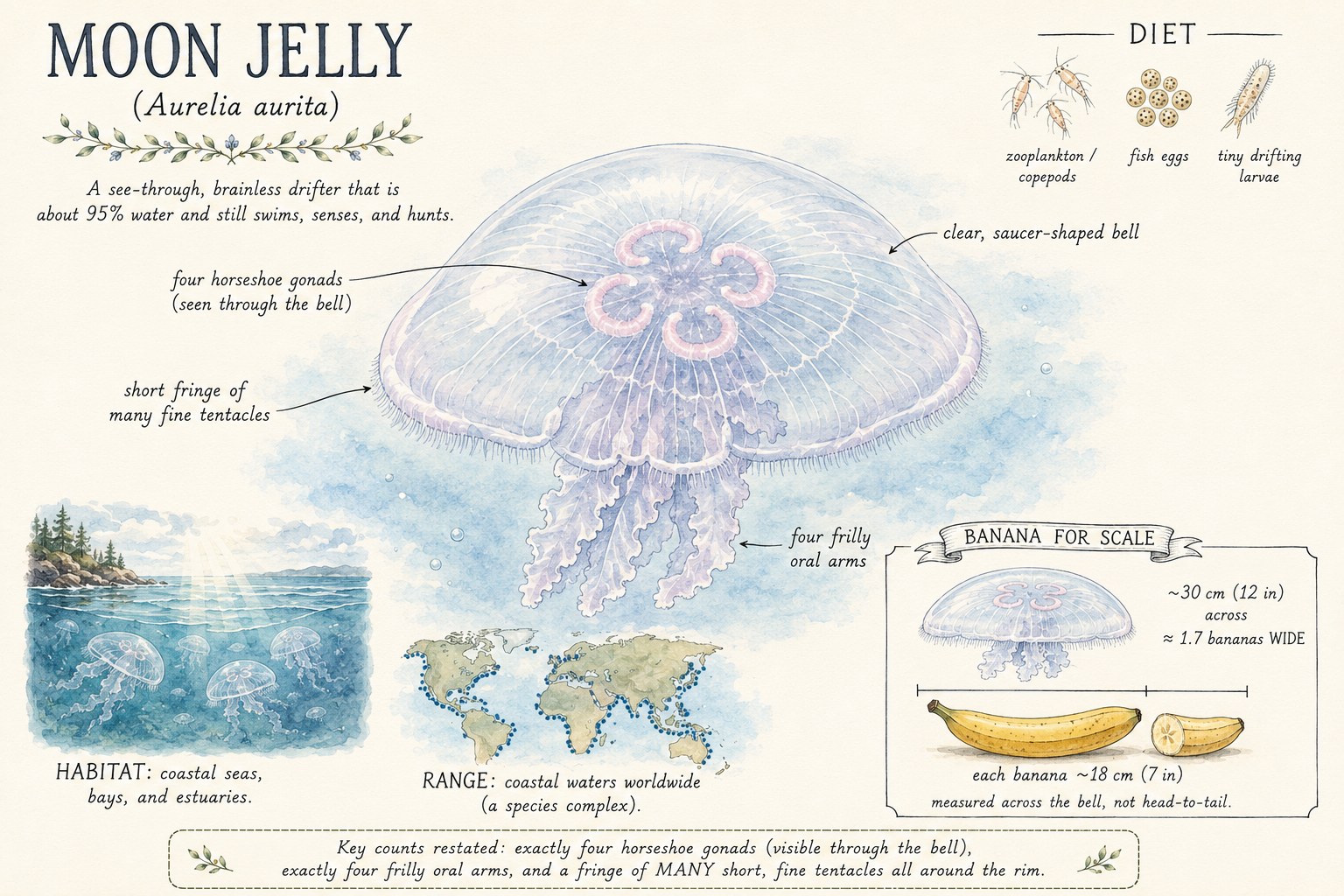 #14Moon Jelly (Moon Jellyfish)Aurelia aurita
aw-REE-lee-uh aw-RY-tuh
Pick Random pick across taxa + water type
Size
Bell (the saucer) usually about 25–40 cm (10–16 in) across; ADW gives a 10–35 cm range, largest ~30–40 cm. Banana scale: a ~30 cm (12 in) bell is about 1.7 bananas WIDE (1 banana = 18 cm); big ones near 40 cm ≈ 2.2 bananas. Measured across the bell, not head-to-tail
Habitat
Saltwater and brackish; coastal seas, bays, harbors, and estuaries. A weak swimmer that drifts with currents; tolerates a wide temperature and salinity range
Range
Nearly worldwide in coastal waters of the Atlantic, Pacific, and Indian oceans (all but the Arctic). "Cosmopolitan," but see species-complex flag
Diet
Carnivore. Zooplankton: copepods and other crustacean larvae, mollusk and fish eggs, protozoans, rotifers, tiny jellies. Catches prey on stinging cells on the short bell tentacles, traps it in mucus, and the four oral arms carry it to the mouth
Lifespan
The swimming adult (medusa) usually lives only about a year, sometimes up to two; ADW average ~12 months, wild max ~2 years. The bottom-dwelling polyp can persist for many years (recorded up to ~25)
Conservation
Not Evaluated (the IUCN has not assessed it). No IUCN Red List category, no CITES listing, no U.S. federal status. Generally abundant
Wow
It has no brain, no heart, no bones, and no blood, and it is about 95% water. With just a nerve net and eight tiny sense organs, it still swims, senses light and gravity, hunts live plankton, and clones itself
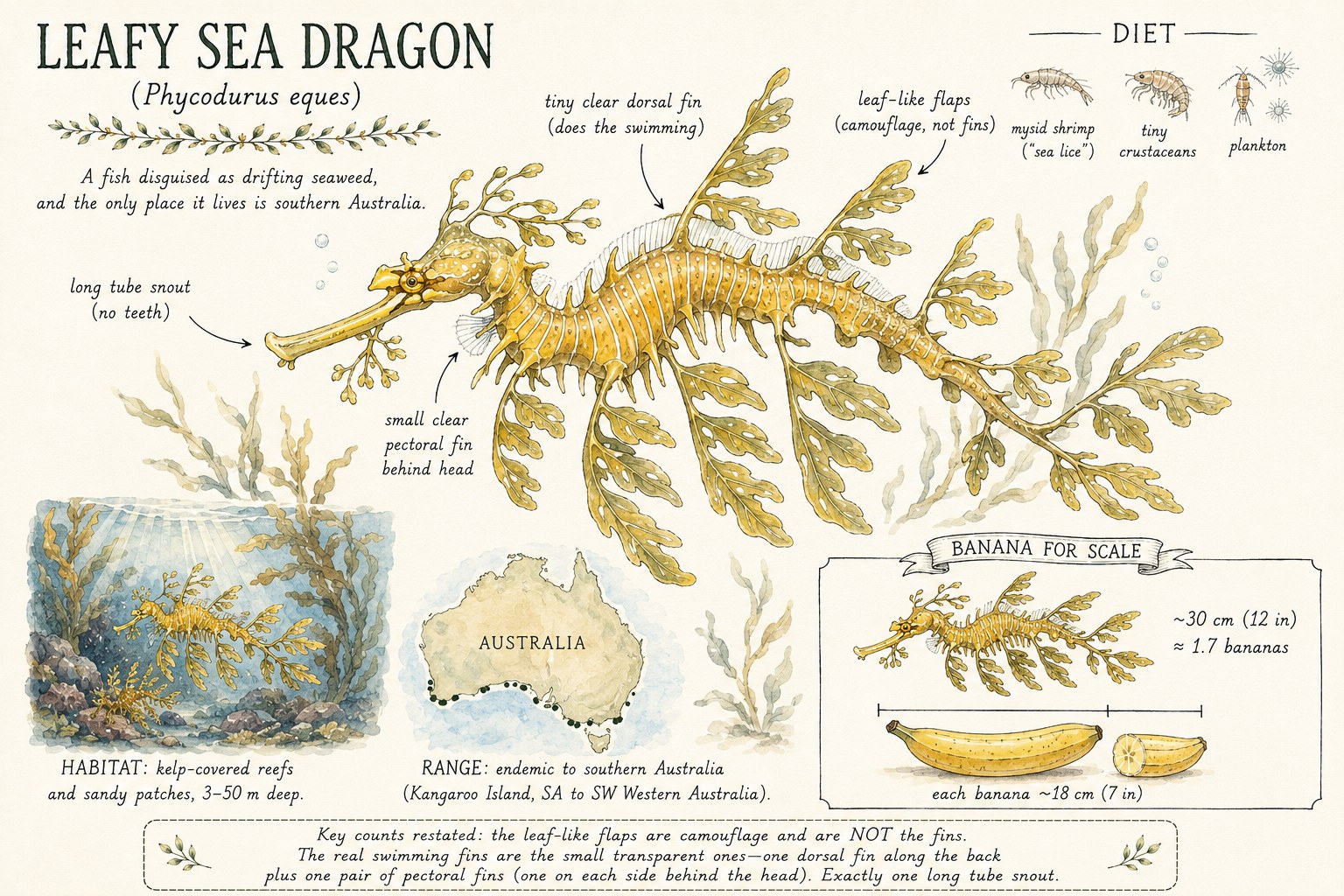 #15Leafy Sea DragonPhycodurus eques
fy-koh-DYOO-rus EK-wayss
Pick Batch / requested pick
Size
Up to about 35 cm (14 in) total length; typical adults ~20–30 cm. Banana scale: a ~30 cm adult is about 1.7 bananas (1 banana = 18 cm)
Habitat
Saltwater. Temperate kelp-covered rocky reefs and sand patches near reef, about 3–50 m deep
Range
Endemic to southern Australia. Southern coastline from Kangaroo Island, South Australia, west to south-western Western Australia
Diet
Carnivore. Tiny crustaceans, mainly mysid shrimp ("sea lice"); sucked whole through a long pipe-like snout. No teeth, no stomach, so feeds almost constantly
Lifespan
Poorly known in the wild; estimated roughly 7–10 years
Conservation
Least Concern (IUCN, assessed 2016); not evaluated by CITES. Fully protected under Australian law since the early 1990s
Wow
Its trademark leaves are a costume, not fins. The leaf-shaped flaps do no swimming at all. It moves on two sets of nearly transparent fins (a dorsal fin on the back and a pair of pectoral fins behind the head) that beat so fast and clear that a swimming sea dragon looks like drifting weed
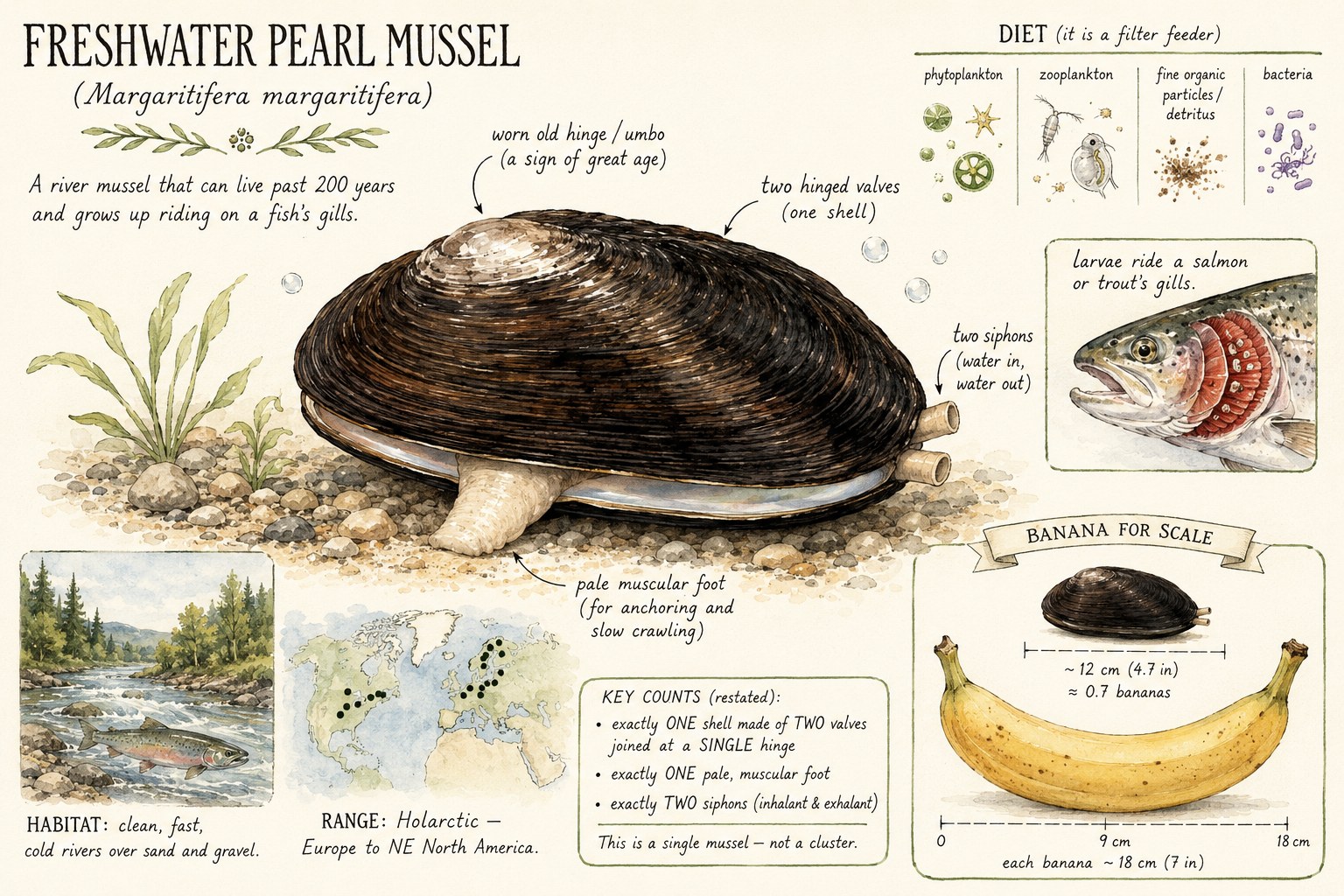 #16Freshwater Pearl MusselMargaritifera margaritifera
mar-guh-rih-TIFF-er-uh
Pick Random / rebalancing pick
Size
Shell typically ~10–13 cm (avg ~11.5 cm), up to ~17 cm long. Banana scale: a ~12 cm shell is about 0.7 bananas (1 banana = 18 cm)
Habitat
Freshwater. Clean, cold, fast-flowing, low-nutrient (low-calcium) rivers and streams; buried partly in coarse sand and fine gravel, about a third of the shell exposed
Range
Holarctic (Northern Hemisphere), both sides of the North Atlantic: Arctic and temperate western Russia and Scandinavia, through Europe (incl. Britain and Ireland), to northeastern North America (eastern Canada and New England)
Diet
Filter feeder. Draws river water in through a siphon and strains out fine organic particles: phytoplankton, zooplankton, bacteria, fungal spores, and detritus
Lifespan
Extreme. Average ~86–102 years (ADW ~93); maximum ~210–250 years (Zyuganov); oldest individual on record ~280 years. One of the longest-lived animals on Earth
Conservation
Endangered (IUCN, assessed 2017; errata version published 2018); Critically Endangered in Europe (European Red List). Not CITES-listed
Wow
One of the longest-lived animals on Earth (verified past 200 years, oldest ~280), and its larvae (glochidia) must ride on the gills of a live salmon or trout for most of a year to survive. A single adult filters about 50 litres (~13 gallons) of water a day
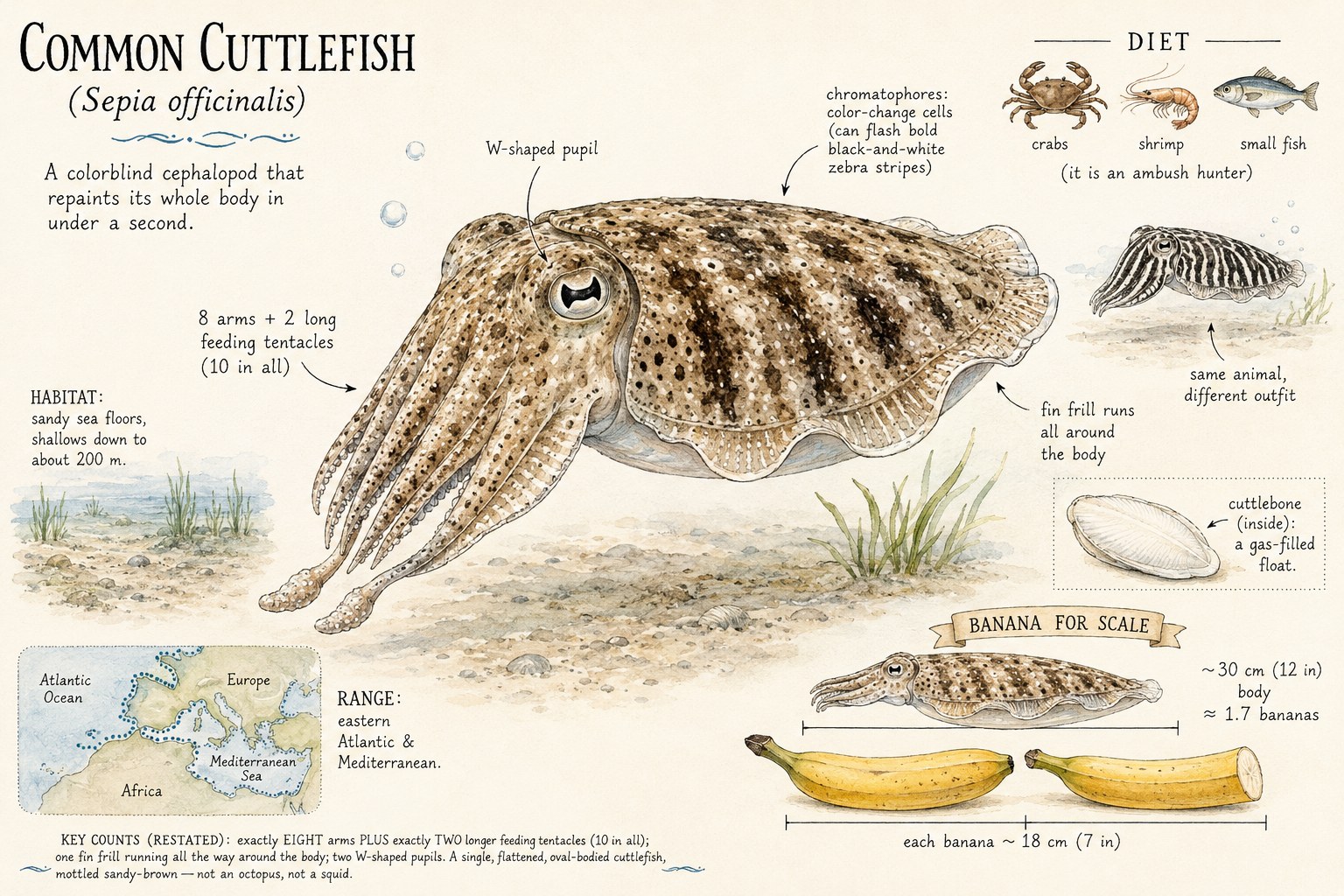 #17Common CuttlefishSepia officinalis
SEE-pee-uh off-ih-sih-NAH-liss
Pick Random / rebalancing pick
Size
Body (mantle) length typically ~25–30 cm in adults; large temperate adults reach ~45 cm, largest recorded mantle ~49–60 cm; up to ~4 kg. Banana scale: a ~30 cm body ≈ 1.7 bananas (1 banana = 18 cm); a big ~45 cm one ≈ 2.5 bananas
Habitat
Saltwater. Shallow, sandy or muddy seafloor (benthic); subtidal down to ~200 m. Migrates inshore in spring/summer, deeper (100–200 m) in autumn/winter
Range
Eastern North Atlantic (from ~England/North Sea and the Baltic south along West Africa), the English Channel, and the Mediterranean Sea
Diet
Carnivore / ambush predator. Crabs, shrimp and other crustaceans, small fish, mollusks, worms, even other cuttlefish. Camouflages, then fires two long feeding tentacles to grab prey
Lifespan
Short: about 1 to 2 years (rarely up to ~4 in captivity). Breeds once, in spring/summer, then dies (semelparous)
Conservation
Least Concern (IUCN, assessed 2012) (Barratt & Allcock; e.T162664A939991). Heavily fished but not in overall decline. No CITES or US listing
Wow
A colorblind animal that is the ocean's fastest quick-change artist: it repaints the color, pattern, and even the 3D texture of its whole body in well under a second, matching backgrounds it cannot see in color. It also runs on three hearts and blue-green blood
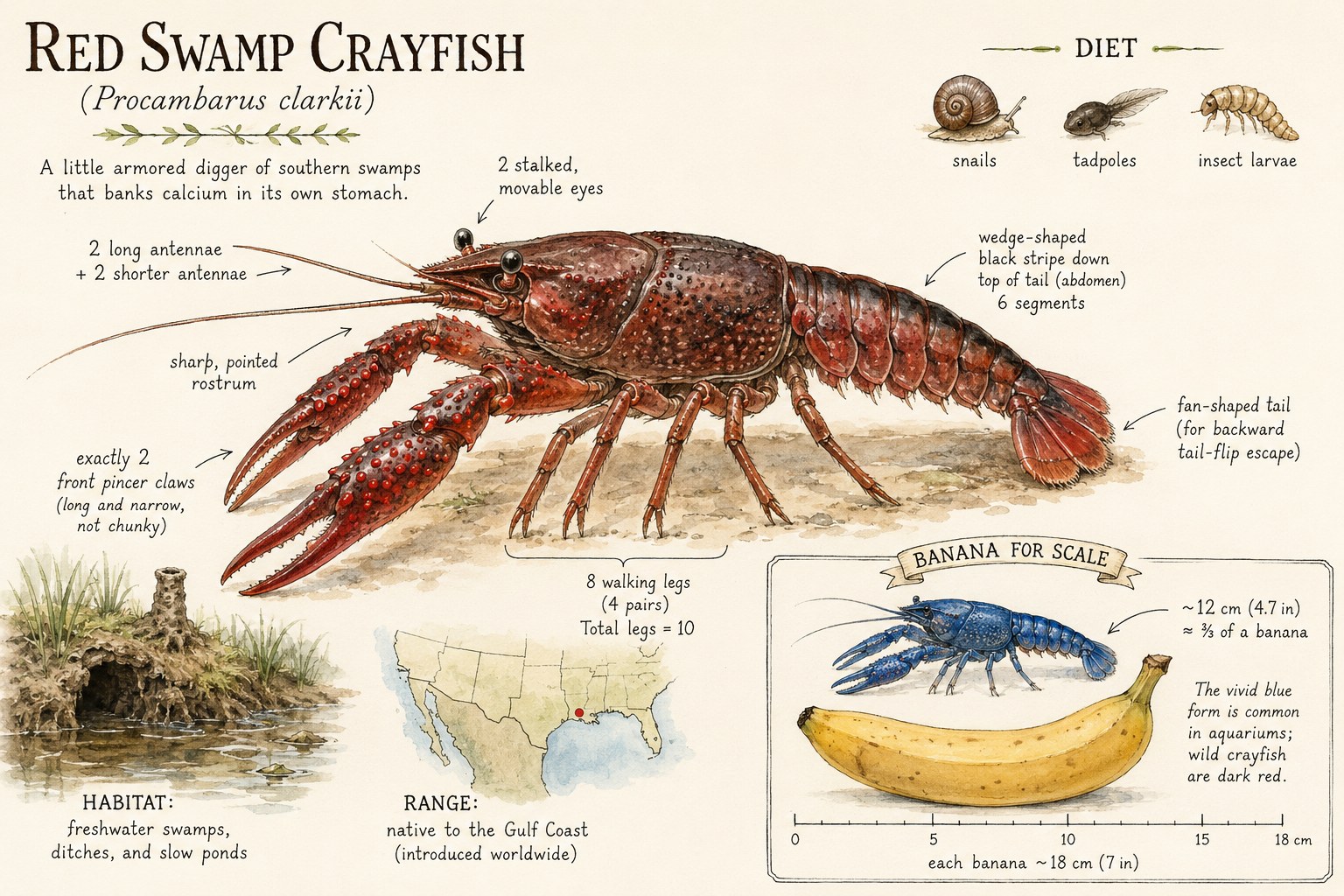 #18Red Swamp CrayfishProcambarus clarkii
pro-KAM-bair-us KLAR-kee-eye
Pick Random / rebalancing pick
Size
About 2.2–4.7 in (5.6–11.9 cm) total body length (rostrum to tail fan, claws not counted). Banana scale: a big ~12 cm adult ≈ about ⅔ of one banana (1 banana = 18 cm); a typical ~10 cm one ≈ 0.55 banana
Habitat
Freshwater. Swamps, sloughs, marshes, ditches, and slow ponds; avoids strong currents; burrows into banks and sediment
Range
Native to the south-central United States (Gulf Coast, especially Louisiana) and northeastern Mexico. Widely introduced worldwide and now one of the most invasive crayfish on Earth
Diet
Opportunistic omnivore, leaning carnivorous. Insect larvae, tadpoles, snails, worms, plant matter and detritus, plus carrion when live food is scarce
Lifespan
Typically about 2–5 years; reaches breeding age in as little as 3 months and can raise two generations a year in warm climates
Conservation
Least Concern (IUCN, assessed 2010) (id 153877). Abundant and expanding; a pest, not a species at risk. No CITES or US special listing
Wow
It banks its own calcium. Before molting, the crayfish pulls calcium out of its old shell and stores it as two little stones (gastroliths) in its stomach, then dissolves those stones to harden the new shell fast, and eats the shed shell to recycle the rest
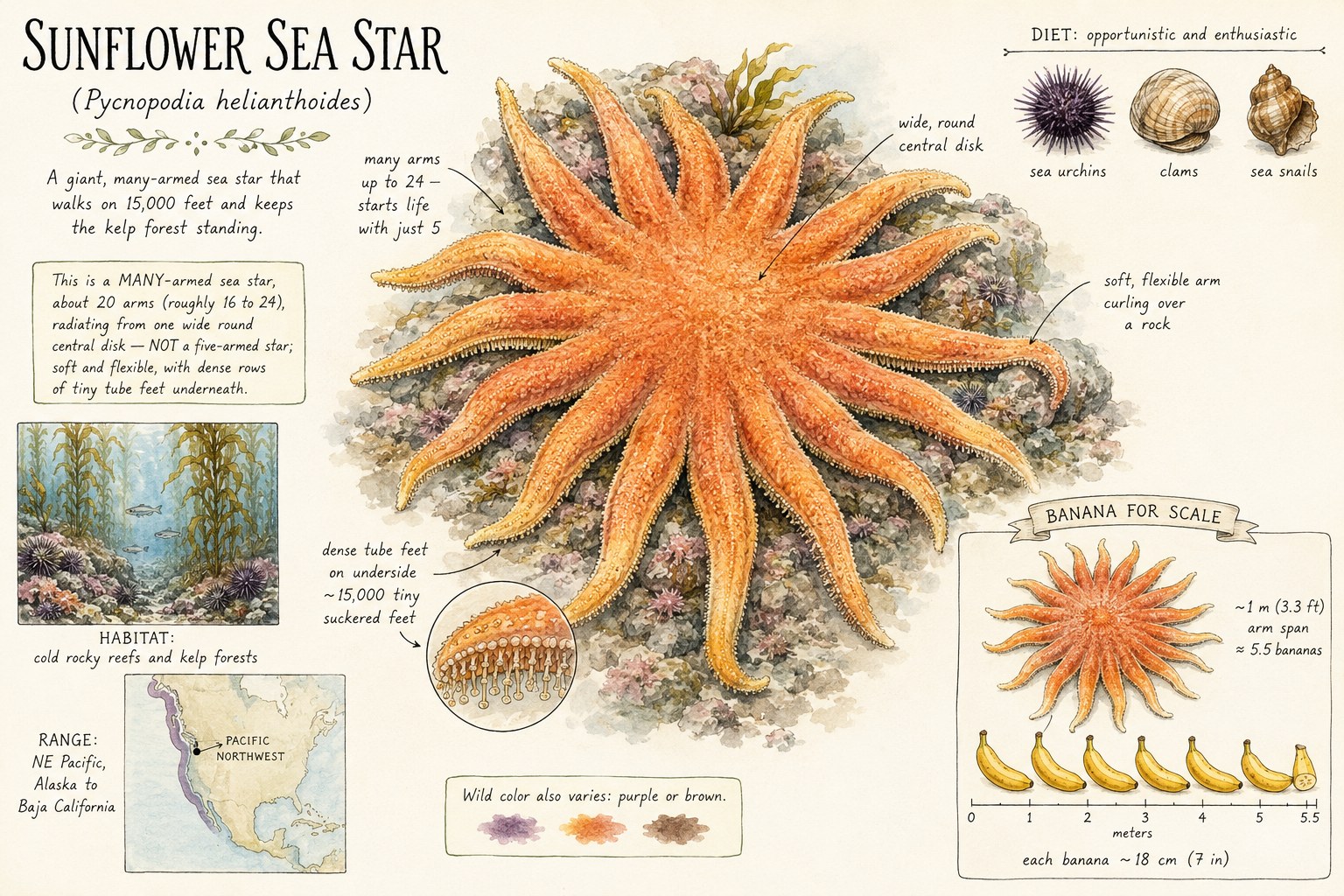 #19Sunflower Sea StarPycnopodia helianthoides
pick-noh-POH-dee-uh hee-lee-an-THOY-deez
Pick Timely / newsworthy pick
Size
Among the largest sea stars: arm span up to ~1 m (3.3 ft) tip to tip; typical disk diameter ~40–65 cm; the heaviest known sea star at ~5 kg (11 lb). Banana scale: a big ~1 m (3.3 ft) arm span ≈ 5.5 bananas (1 banana = 18 cm)
Habitat
Saltwater (marine). Cold rocky reefs, kelp forests, sand, mud, and gravel bottoms, from the intertidal zone down to ~435 m (most shallower than ~120 m)
Range
Northeastern Pacific, from the Aleutian Islands of Alaska south to Baja California, Mexico. Now nearly gone from the southern half of that range (CA/OR/Mexico)
Diet
Carnivore. Mostly sea urchins, plus clams, snails, abalone, sea cucumbers, mussels, crabs, and even other sea stars; everts its stomach to digest prey externally
Lifespan
Typically ~3–5 years reported (may be an underestimate for the largest individuals — see flags)
Conservation
Critically Endangered (IUCN, assessed 2020; amended 2021) (id 178290276). US ESA: proposed Threatened (NMFS, 2023), under review
Wow
It walks on more than 15,000 tiny tube feet and is the fastest sea star anyone has timed (~1 m per minute). And it grows extra arms: it hatches with just 5, then adds more as it ages, up to 24
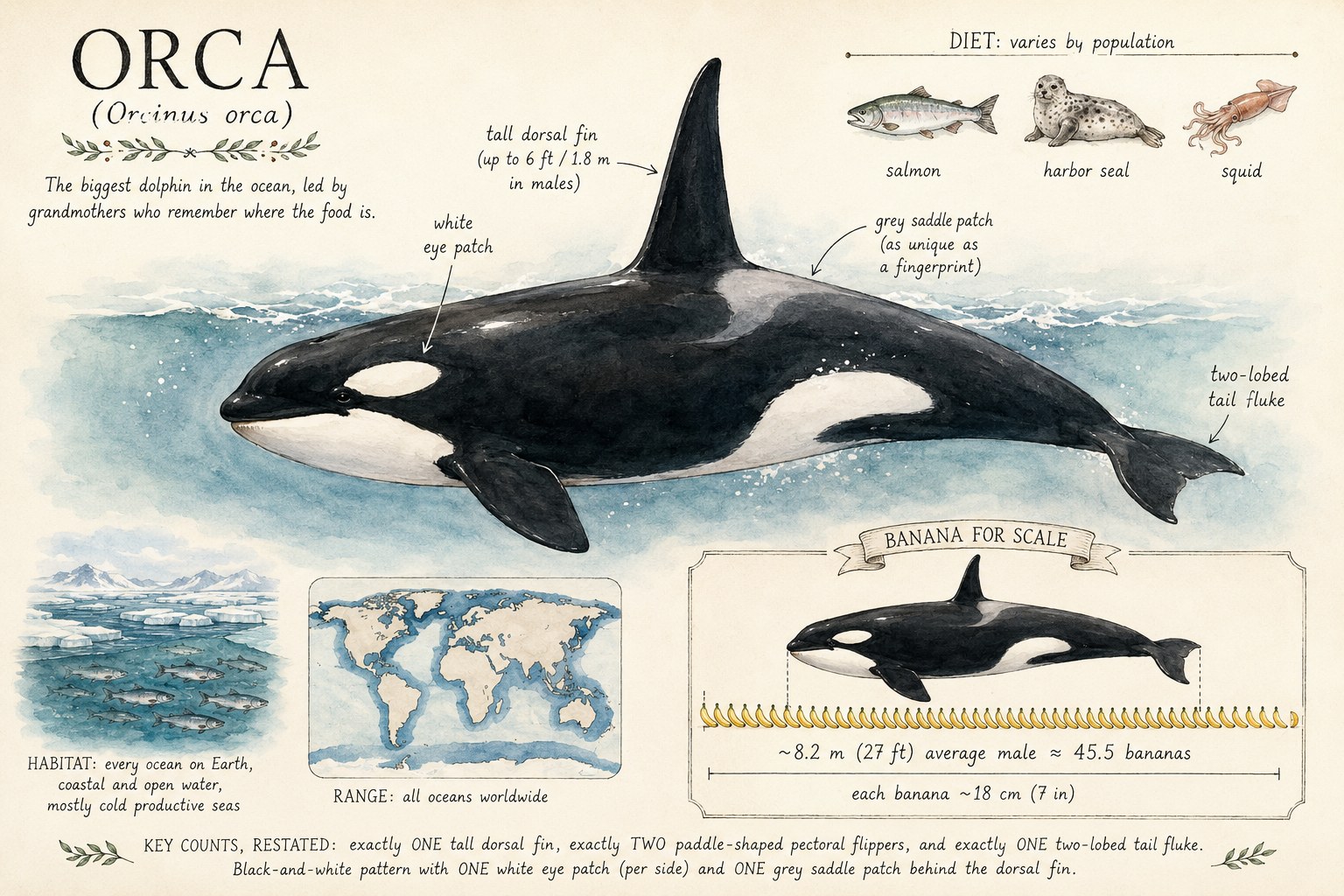 #20OrcaOrcinus orca
or-SY-nus OR-kuh
Pick Joel-queued pick
Size
Adult males average ~8.2 m (27 ft), up to a record ~9.8 m (32 ft) and ~10,000 kg (~22,000 lb); adult females average ~7 m (23 ft), up to ~8.5 m (28 ft) and ~7,500 kg (~16,500 lb). Male dorsal fin up to ~1.8 m (6 ft) tall, straight and triangular; female fin usually under ~1 m (3 ft), shorter and curved. Banana scale: an average adult male ~8.2 m ≈ 45.5 bananas (1 banana = 18 cm)
Habitat
Saltwater (marine). Every ocean on Earth, coastal and open water, from polar pack ice to the tropics; most abundant in colder, food-rich waters
Range
Worldwide, the most widely distributed of all cetaceans; populations vary widely in movement and residency by ecotype and region
Diet
Apex predator, carnivore. Diet varies sharply by population/ecotype: some (Pacific Northwest "resident" orcas) eat almost only fish, especially Chinook salmon; others ("transient"/Bigg's orcas) hunt marine mammals (seals, sea lions, other whales); "offshore" orcas feed heavily on sharks and rays. Hunts cooperatively in family groups
Lifespan
Females: average ~50 years in the wild, documented to ~80–90+; males: average ~30 years, documented to ~50–60+
Conservation
Species-wide: Data Deficient (IUCN, assessed 2017) — the global assessment (Reeves et al.) explicitly cites unresolved taxonomy (the "species" likely contains several distinct forms) as the reason a single global status can't be assigned; some regional/local populations are separately known to be declining. The Southern Resident population of the Pacific Northwest is listed Endangered under the US Endangered Species Act since 2005, a separate, national-level listing, not an IUCN category, with roughly 74–75 individuals remaining as of 2025–2026
Wow
Female orcas can live decades past their last calf, and a 2019 peer-reviewed study found postmenopausal grandmothers measurably raise their grandcalves' survival odds, some of the strongest evidence for why menopause itself may have evolved, in orcas or in us
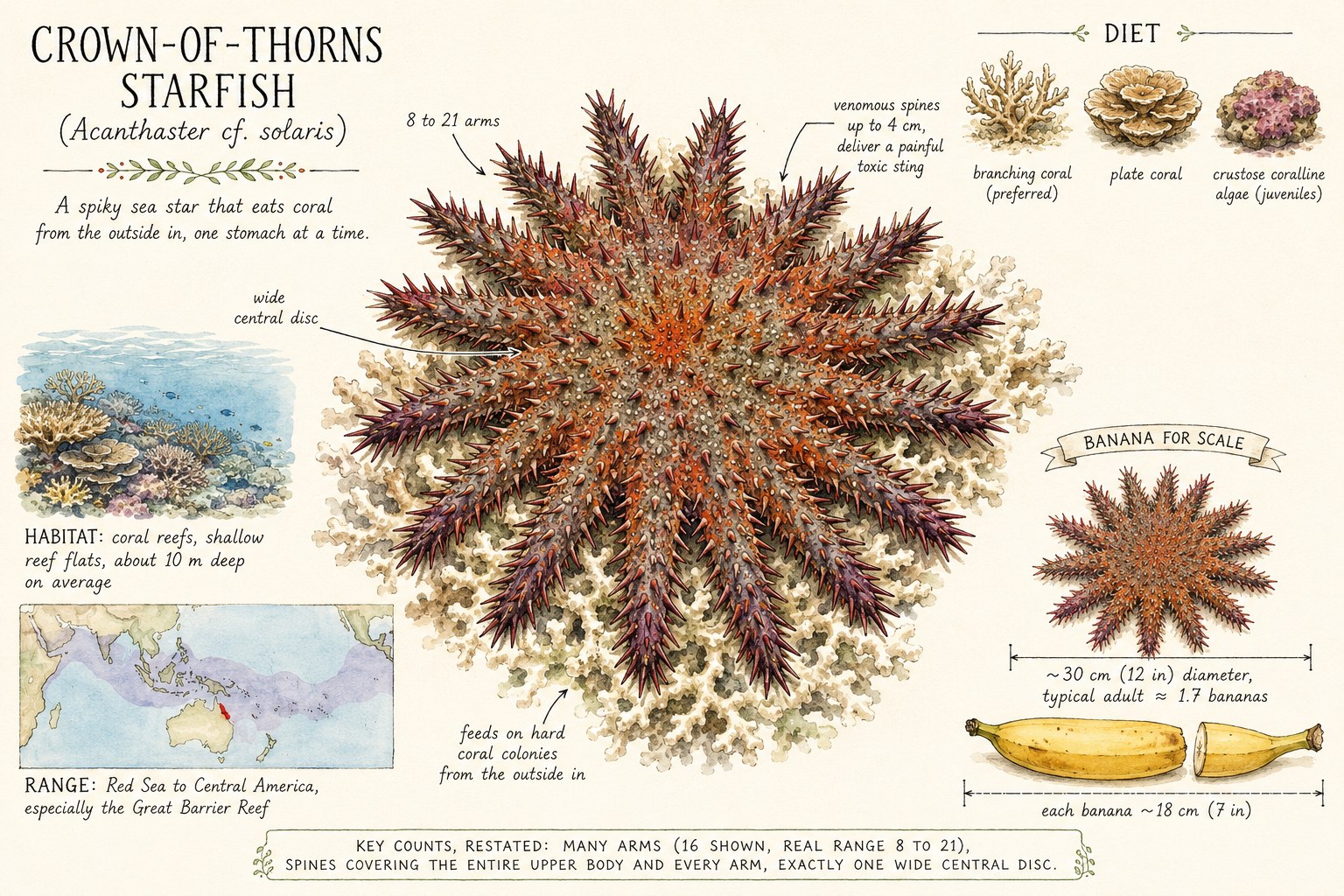 #21Crown-of-Thorns StarfishAcanthaster planci
a-KAN-tha-ster so-LAIR-iss
Pick Joel-queued pick
Size
Adults typically 25–35 cm in diameter, some individuals over 70 cm, AIMS reports up to 80 cm. Banana scale (typical adult, ~30 cm diameter): ~1.7 bananas (1 banana = 18 cm); a large 70–80 cm individual reaches ~4–4.4 bananas
Habitat
Saltwater (marine); coral reefs, shallow reef flats and backreef zones, average depth ~10 m, generally shallower than ~30 m
Range
Indo-Pacific: Red Sea and East Africa across to the western coast of Central America; especially common and studied on Australia's Great Barrier Reef
Diet
Adult: carnivore/corallivore, feeds almost exclusively on living hard (scleractinian) coral, especially fast-growing branching and plate corals (Acropora); everts its stomach onto coral tissue to digest it externally. Juveniles (first ~6 months–1 year) eat crustose coralline algae instead
Lifespan
Expected ~15–17 years in the wild (ADW gives an average of 16 years), though ADW notes the true wild lifespan is not firmly confirmed
Conservation
Not Evaluated (IUCN Red List) — never assessed; no US federal or CITES listing either. This is a native, naturally occurring reef species, not endangered, even though outbreaks are locally destructive to coral
Wow
A single large female can release more than 200 million eggs in one summer, and it's exactly that reproductive firepower, combined with good conditions for larval survival, that can turn a reef's usual handful of starfish into a coral-devouring outbreak of thousands
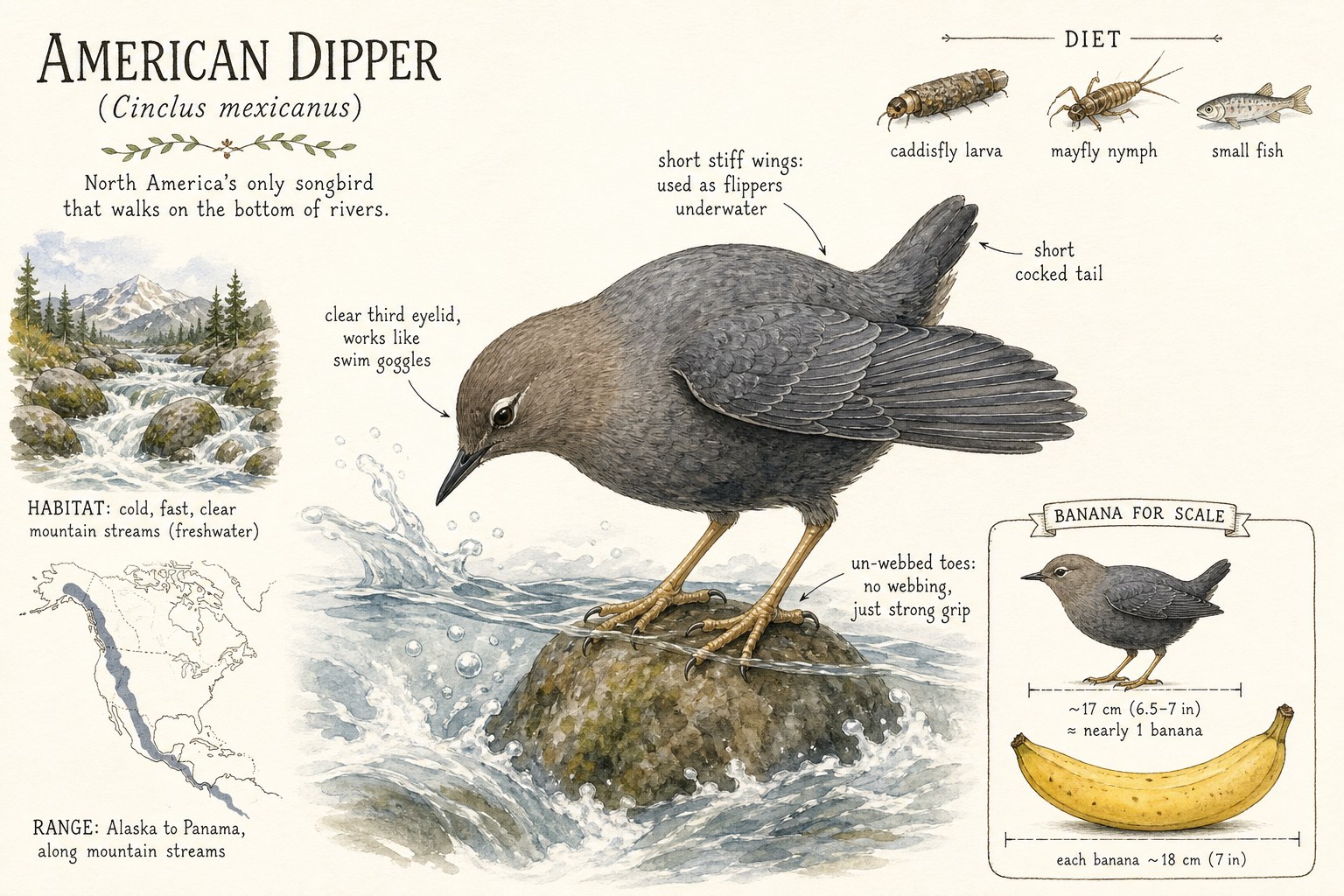 #22American DipperCinclus mexicanus
SIN-kluss mex-ih-KAY-nus
Pick random/rebalancing pick
Size
Length 16.5–18 cm (6.5–7 in) beak to tail (sources vary slightly: Wikipedia/oiseaux.net give an average of 16.5 cm, ADW gives 18 cm); wingspan ~23 cm (9.1 in); weight 46–50 g. Banana scale: ~0.95 of one banana (1 banana = 18 cm) — almost exactly one banana long
Habitat
Freshwater: fast-flowing, cold, clear mountain and coastal streams with rapids, boulders, and cascades; sometimes uses lakes/ponds in winter if ice-free
Range
Western North America and Central America: Alaska south through western Canada and the western US, through Mexico, to Panama. Not endemic, but tied to mountain-stream habitat throughout
Diet
Aquatic insect larvae (caddisfly, mayfly, stonefly, midge, mosquito), small fish, fish eggs; occasionally small crayfish, tadpoles, and aquatic plants
Lifespan
Wild average about 7 years (86 months, per Bird Banding Laboratory data); longest confirmed banding record 8 years, 1 month (South Dakota)
Conservation
Least Concern (IUCN Red List, assessed 2016 by BirdLife International, assessment ID 22708163/94152063). Global breeding population estimated at roughly 160,000 individuals
Wow
It's North America's only truly aquatic songbird: it walks along the bottom of rushing rivers, using its short wings as underwater flippers and un-webbed toes to grip rock, protected by a clear third eyelid it uses like built-in swim goggles
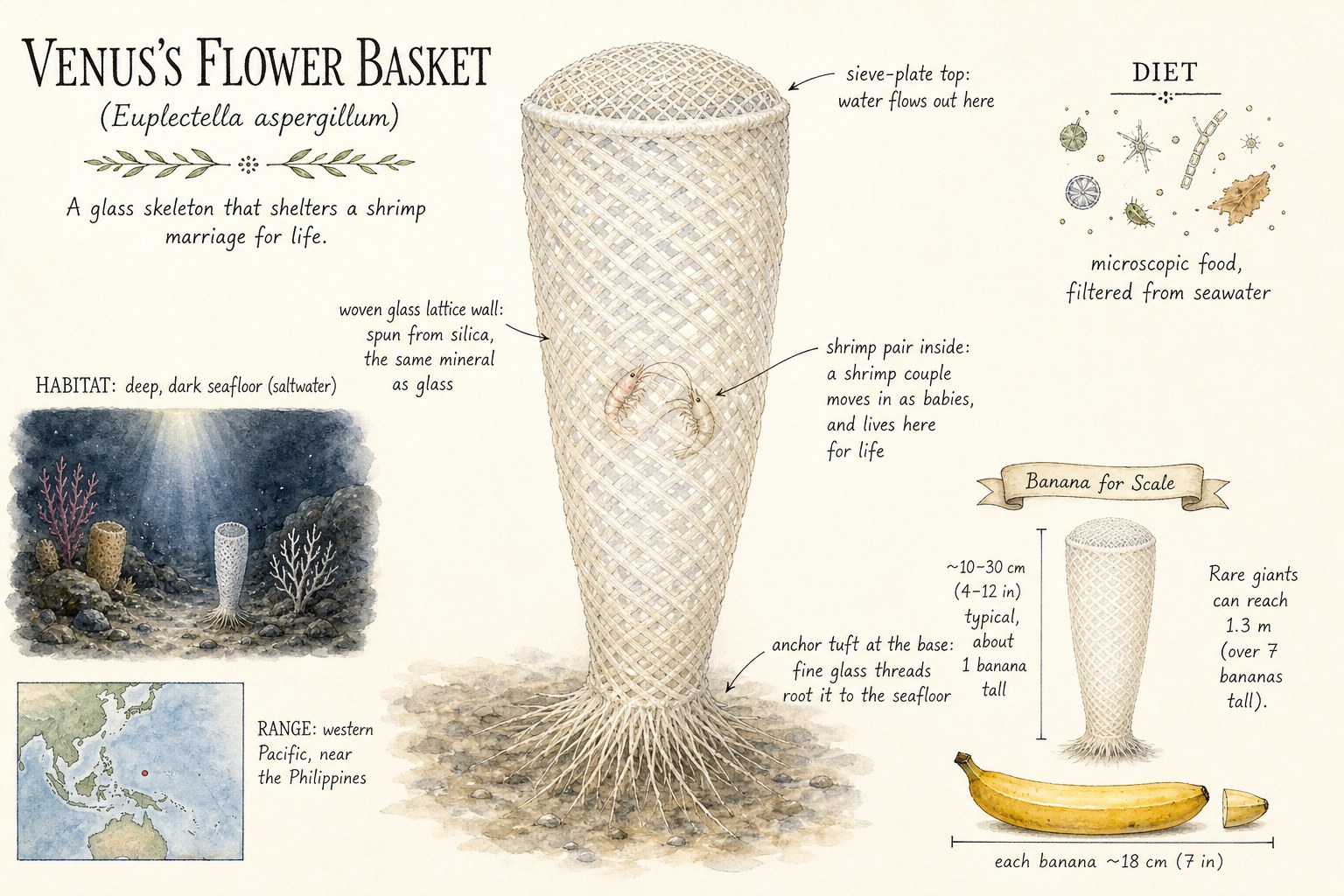 #23Venus's Flower BasketEuplectella aspergillum
yoo-plek-TEL-uh ass-per-JIL-um
Pick random/rebalancing pick
Size
Most individuals 10–30 cm tall; full documented range 7.5 cm up to 1.3 m in rare giants. Banana scale: a typical ~20 cm sponge ≈ 1.1 bananas (1 banana = 18 cm); a 1.3 m giant would be about 7.2 bananas
Habitat
Saltwater, deep sea, benthic (attached to rocky/hard seafloor); depths of 100–1,000 m, most common below 500 m
Range
Western Pacific Ocean, documented near the Philippines. (Related Euplectella species and other family members live in deep oceans worldwide, including the Atlantic/Gulf of Mexico, but those sightings are identified only to family, not to this exact species — see flags)
Diet
Microscopic organisms and organic debris (bacteria, plankton, drifting detritus), filtered from seawater as flagella on internal cells called choanocytes drive water through the body; no active hunting
Lifespan
Not documented for this species. Its extreme depth (100–1,000 m) has kept its life history largely unstudied. (Unrelated glass sponge species in other genera are among the longest-lived animals on Earth, but that has never been measured for E. aspergillum itself — this card deliberately does not borrow that figure; see flags)
Conservation
Not Evaluated (IUCN Red List) — no Red List assessment found for this species. ADW independently confirms "no special status" under the IUCN Red List, US Federal List, or CITES
Wow
A pair of glass sponge shrimp (genus Spongicola) swim into the sponge as larvae, grow too big to ever leave through its lattice walls, and live out their entire lives sealed inside together, which is why a dried specimen is a traditional Japanese wedding gift symbolizing "till death do us part"
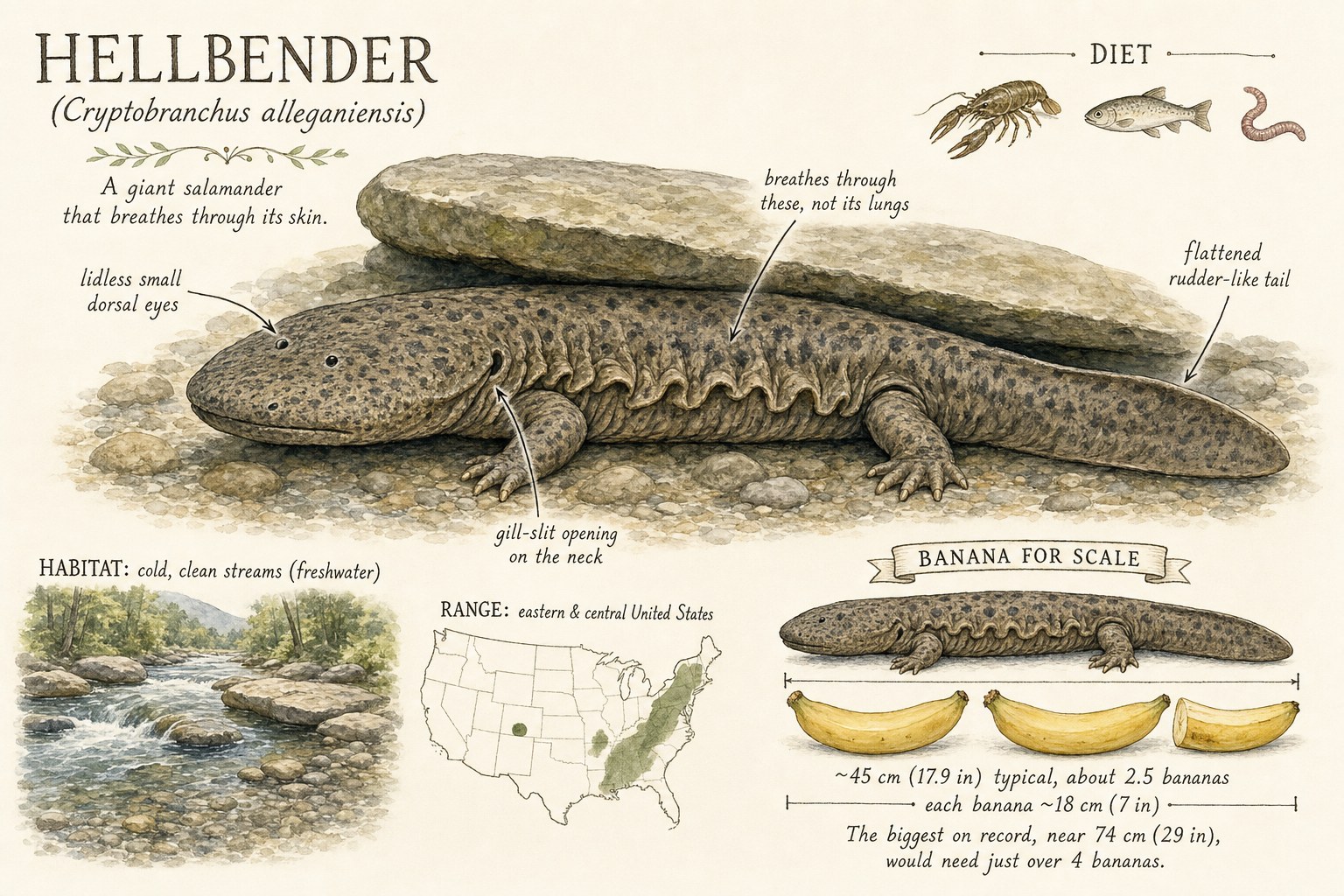 #24HellbenderCryptobranchus alleganiensis
krip-toh-BRANG-kus al-uh-gay-nee-EN-sis
Pick timely pick
Size
Adults typically 30–74 cm (12–29 in) total length; Animal Diversity Web's sampled average is 45.4 cm (17.9 in). Banana scale: a typical ~45 cm adult ≈ 2.5 bananas (2 whole + 1 half; 1 banana = 18 cm); the largest hellbenders on record, near 74 cm, run about 4.1 bananas. Weight is a genuine source conflict: ADW's sampled individuals ranged 405–1,010 g (0.9–2.2 lb), while the Smithsonian and the Center for Biological Diversity describe larger adults reaching roughly 1.8–2.3 kg (4–5 lb) — both ranges given
Habitat
Freshwater only. Cold, clean, fast-flowing, well-oxygenated rocky streams and rivers with large flat rocks for shelter; fully aquatic its entire life, unlike most salamanders, which leave the water as adults
Range
Eastern and central United States, endemic. From southwestern/south-central New York south to northern Georgia and Alabama, west into southern Illinois, Indiana, and Ohio, with an isolated population in Missouri (home of the Ozark hellbender subspecies, also found in adjacent Arkansas)
Diet
Mostly crayfish (over half of stomach contents in one ADW survey), also small fish, aquatic insects, worms, mollusks, tadpoles, and occasionally smaller salamanders; a nocturnal ambush predator that uses a fast gulp of suction to seize prey
Lifespan
Wild: commonly 12–15 years, with documented individuals reaching 25–30. Captivity: up to 29 years documented
Conservation
Vulnerable (IUCN Red List, assessed 2022) — a population decline of 30–50% over roughly three generations, driven by disease and habitat loss. Note: several Tier 2 pages (Smithsonian's live page, ADW's 2015-dated page) still display the superseded 2004 "Near Threatened" assessment; the 2022 reassessment is more current and used here (see flags). Separately, under the US Endangered Species Act: the Ozark hellbender subspecies has been listed Endangered since 2011; Missouri's population of the eastern hellbender was listed Endangered in 2021; the rest of the eastern hellbender's range was proposed for Endangered listing in December 2024, but that rule remains unfinalized as of this card's writing (see pick type and flags)
Wow
A hellbender's lungs barely work. Instead, loose folds of wrinkled skin running down each side of its body absorb up to 95% of the oxygen it needs, straight out of the water
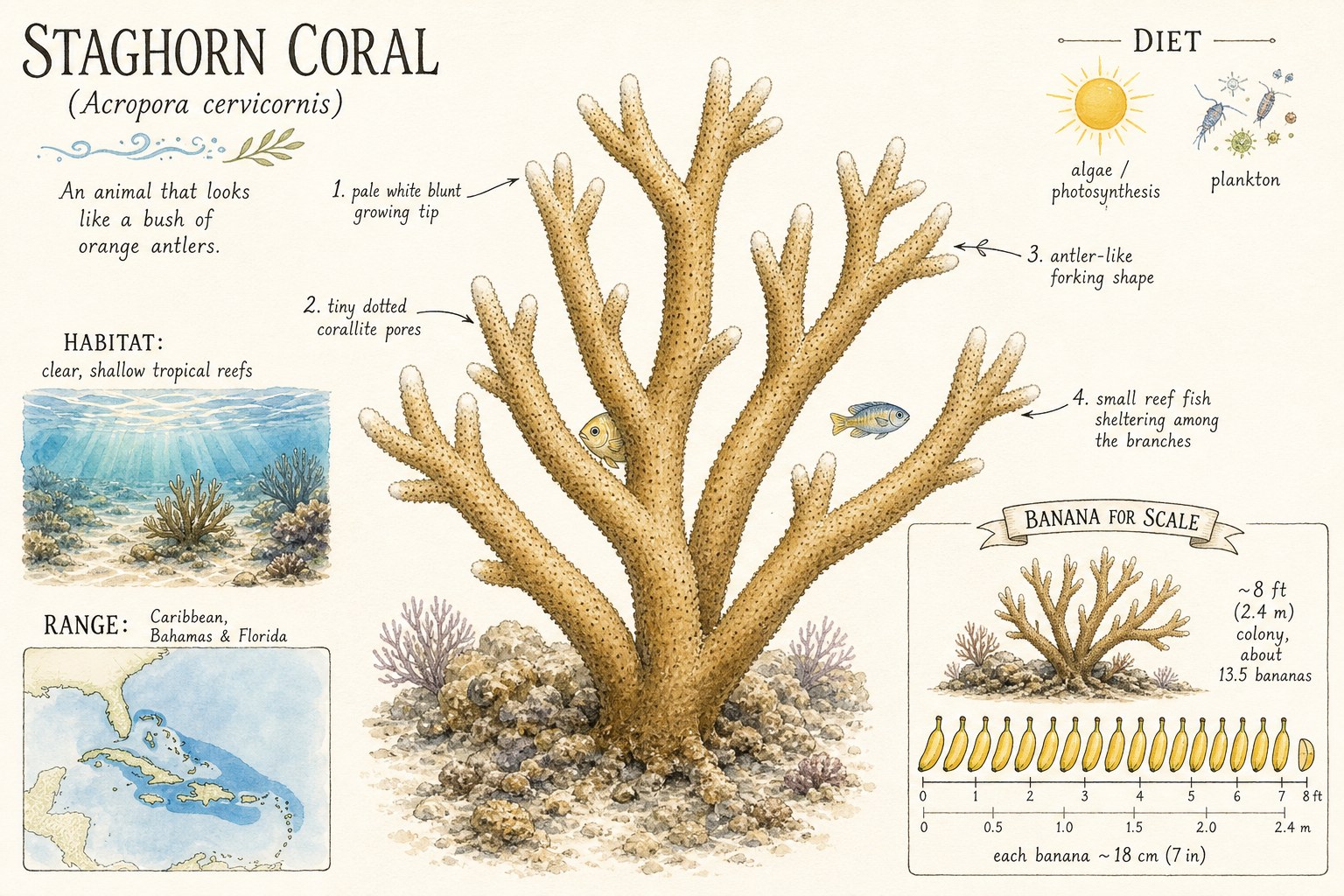 #25Staghorn CoralAcropora cervicornis
ak-ROP-or-uh sur-vih-KOR-nis
Pick timely pick
Size
A colony can grow at least 4 ft (1.2 m) tall and, at its largest, about 6 to 8 ft (1.8–2.4 m) across (NOAA gives both "at least 6 ft" and "up to 8 ft" for diameter on the same page; both figures given). Banana scale: a large colony spanning ~8 ft (2.4 m) ≈ 13.5 bananas (13 whole + one just-over-half piece; 1 banana = 18 cm). Branches are 1–3 in (2.5–7.6 cm) thick and lengthen 4–8 in (10–20 cm) a year, the fastest growth rate of any known western Atlantic coral
Habitat
Saltwater only. Clear, shallow, sunlit tropical reef water, typically 15–60 ft (5–18 m) deep (NOAA); IUCN's fuller documented depth range extends to about 98 ft (30 m). Found on back-reef and fore-reef habitats, spur-and-groove, bank, and patch reefs
Range
Western Atlantic / Caribbean. Found throughout the Bahamas, Florida, and the wider Caribbean; the northern edge of its range is Palm Beach County, Florida, where it is now rare. Not endemic to one country, but geographically restricted to this one region
Diet
Gets most of its energy for free from zooxanthellae, single-celled algae living inside its own tissue that photosynthesize and pass sugars to the coral. Supplements this at night, when each polyp extends its tentacles to sting and capture drifting zooplankton
Lifespan
NOAA states colonies can live "up to hundreds of years." This figure should be read with the caveat that a coral colony is not one continuous individual in the way a mammal is: it grows, fragments, and regrows, so the concept of a single "lifespan" is blurrier than for most animals in this series (see flags)
Conservation
Critically Endangered (IUCN Red List, assessed 2022; assessment ID e.T133381A165860142, criteria A2bce). Separately, listed as Threatened under the U.S. Endangered Species Act since 2006 — staghorn and elkhorn coral were among the first species ever listed under the ESA specifically because of the threat from a warming climate. Also CITES Appendix II and SPAW Annex II (regional Caribbean protection). Population: NOAA states the species declined roughly 97% starting in the early 1980s due to white band disease, down to less than 3% of its former abundance
Wow
Once a year, a few nights after the full moon in late summer, every staghorn coral colony across an entire reef releases its eggs and sperm into the water within the same handful of minutes. Divers call the result a mass spawning event; it looks like an underwater snowstorm running upward
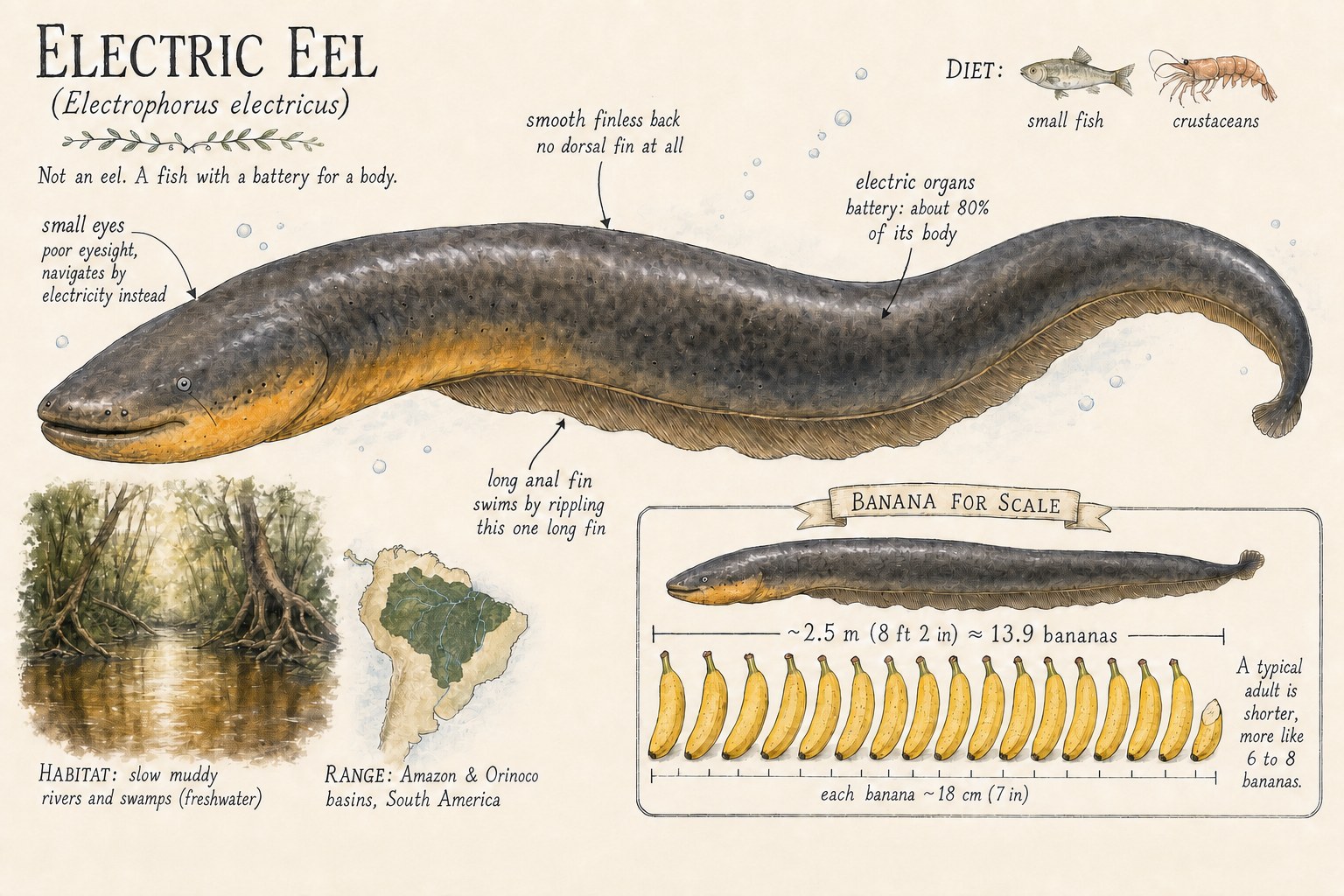 #26Electric EelElectrophorus electricus
Pick random/rebalancing pick
Size
Commonly 6–8 ft (2–2.5 m). The largest documented individuals, of the newly recognized species Electrophorus voltai, reach about 2.5 m (8 ft 2 in) and up to 22 kg (49 lb), making them the largest of all Gymnotiformes. Banana scale, using that largest documented length: ~13.9 bananas (13 whole bananas plus one banana cut to about seven-eighths length; 1 banana = 18 cm)
Habitat
Freshwater only. Slow-moving, muddy rivers, swamps, oxbow lakes, streams, and seasonally flooded forest, especially shaded side channels of the Amazon and Orinoco river systems. Obligate air-breather: gains up to 80% of its oxygen through a highly vascularized mouth lining and must surface every few minutes
Range
Northern and northeastern South America: the Amazon and Orinoco basins, spanning Brazil, the Guianas, Suriname, Venezuela, Colombia, Ecuador, and Peru. Not endemic to a single country
Diet
Generalist carnivore as an adult: fish, crustaceans, insects, and small vertebrates including amphibians, reptiles, and small mammals. Juveniles feed mainly on invertebrates, and newly hatched eels will eat unhatched eggs from their own clutch. Hunts using a rapid "doublet" electric pulse that involuntarily twitches hidden prey and reveals its location, then a volley of up to 400 high-voltage pulses per second to immobilize it; swallows prey whole via suction, since it lacks teeth for chewing
Lifespan
Wild lifespan unknown. In captivity, males typically live 10–15 years and females 12–22 years
Conservation
The genus was long treated as one species; it's currently split into three. Electrophorus electricus (narrow sense): Least Concern (IUCN Red List, assessed 2009; assessment ID e.T167700A6369863), an assessment made before the 2019 species split. Electrophorus voltai: Least Concern (IUCN Red List, assessed 2021; assessment ID e.T204715926A204826094). Electrophorus varii: Not Evaluated
Wow
Its whole rear body is essentially a living battery: three electric organs make up about 80% of its length, and it can discharge up to 800 volts (the newly described species E. voltai has been measured at up to 860 volts, the strongest bioelectric output ever recorded in any animal). Even stranger, in 2021 scientists published the first documented case of electric eels hunting in coordinated packs: more than 100 E. voltai were found sharing one Amazonian lake, herding schools of small fish into a tight ball at dusk, then blasting the ball with simultaneous group shocks in teams of 2 to 10
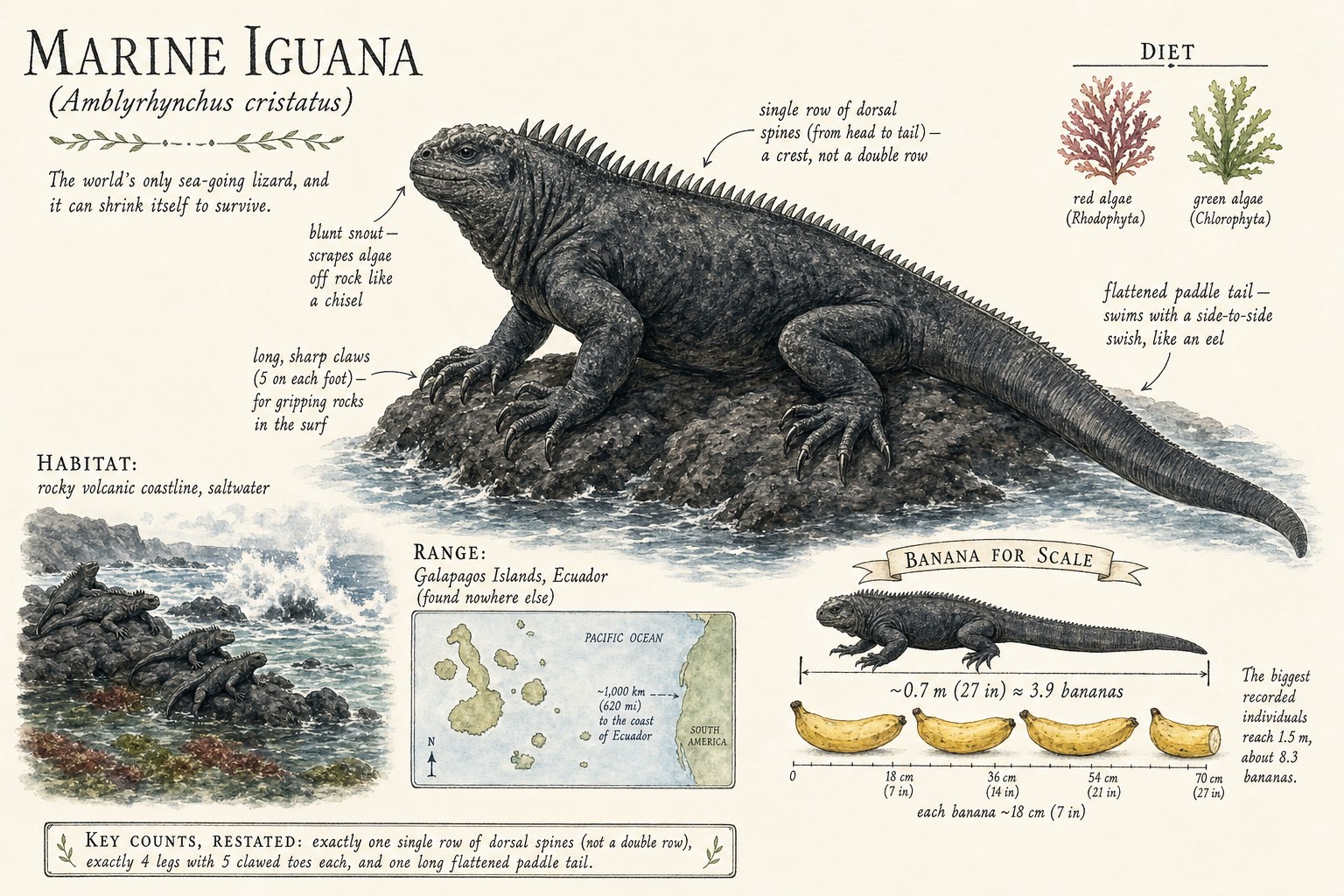 #27Marine IguanaAmblyrhynchus cristatus
am-blee-RIN-kus kris-TAH-tus
Pick random/rebalancing pick
Size
Average total length ~0.7 m (about 27 in); largest documented individuals up to 1.5 m (about 5 ft). Average weight ~1.5 kg (about 3.3 lb). Males are noticeably larger than females. Banana scale (typical): ~3.9 bananas (three whole bananas + a fourth cut to about seven-eighths length); largest documented: ~8.3 bananas (eight whole + a one-third piece). 1 banana = 18 cm
Habitat
Saltwater/marine. Rocky volcanic coastlines, intertidal flats, and shallow subtidal reefs of the Galapagos; comes ashore daily to bask and needs sandy or volcanic-ash soil to nest
Range
Endemic to the Galapagos Archipelago, Ecuador (~900 km / 560 mi off the South American coast). Found on coastal areas of nearly all the islands; largest, densest populations on Fernandina and Isabela. Total estimated range is small, about 275 km²
Diet
Almost entirely red and green marine algae, scraped off rocks with a blunt snout and small, chisel-like teeth. Larger iguanas (mostly males) dive to feed on subtidal algae; smaller iguanas and females graze intertidal rocks at low tide. Occasionally grasshoppers, crustaceans, and some land plants
Lifespan
Genuine source conflict: Galapagos Conservation Trust gives a wild average of 5–12 years; the Natural History Museum (UK) gives a wild average of about 12 years with some individuals living as long as 60 years. Both given as the range. Captive data is lower still (~6.4-year average for males, per a small demographic-database sample)
Conservation
Vulnerable (IUCN Red List, assessed 2020; assessors MacLeod, A., Nelson, K.N. & Grant, T.D.). Total population estimated at roughly 19,800–210,000 individuals, fluctuating sharply with El Niño die-offs. Separately, in Dec. 2025 all Galapagos iguanas (marine and land) were uplisted to CITES Appendix I, the treaty's strictest trade category, effective March 5, 2026
Wow
Marine iguanas can shrink their own skeletons. During El Niño famines, when their preferred algae dies off, they reabsorb their own bone and cartilage, losing up to 20% of body length (as much as 6.8 cm over a two-year span in the original study population) — then regrow to full length once the ocean cools and food returns. No other reptile is known to do this
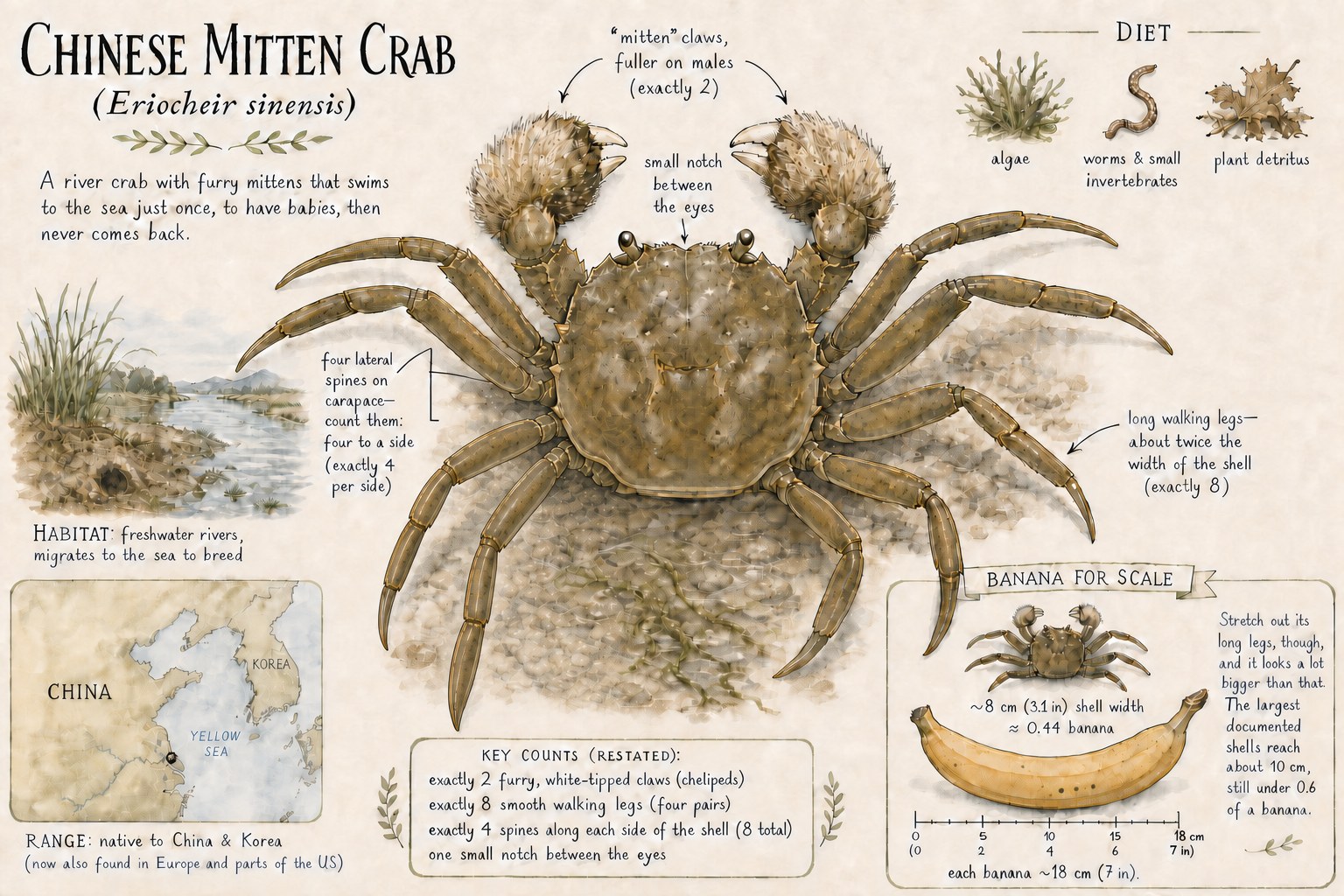 #28Chinese Mitten CrabEriocheir sinensis
AIR-ee-oh-keer sih-NEN-sis
Pick random/rebalancing pick
Size
Carapace (shell) width typically ~80 mm (about 3.1 in) in California populations; documented range 30–100 mm (1–4 in) across its global range, European populations reaching the top of that range. Legs about twice the carapace width. Banana scale: typical adult ≈ 0.44 banana (well under half of one banana); largest documented (~100 mm) ≈ 0.56 banana. 1 banana = 18 cm
Habitat
Catadromous. Adults and juveniles live in freshwater rivers, lakes, canals, and rice paddies, burrowing into muddy banks; migrates to brackish estuaries and open saltwater for larval development and spawning
Range
Native to coastal rivers and estuaries draining into the Yellow Sea, China and Korea. Established/invasive: much of northern and eastern Europe since 1912 (first record, Germany); San Francisco Bay and the Sacramento–San Joaquin Delta, California, since 1992. Non-established or sporadic records: Chesapeake Bay (2005), Delaware Bay (2007), Hudson River, New York (2007), Columbia River, Oregon (1997, 2025), scattered Great Lakes and Gulf Coast reports
Diet
Omnivorous opportunist: algae, aquatic plants, and detritus, plus small invertebrates (worms, mollusks, amphipods, other crustaceans), carrion, and occasionally fish eggs or young fish. Juveniles eat more plant material; adults take more animal matter
Lifespan
Typically 1–5 years in the wild, depending on water temperature and salinity; commonly matures in 2–4 years in San Francisco Bay, sometimes just 1–2 years in its native range, and 3–5 years in parts of Europe. Semelparous: both sexes die within days to weeks of a single reproductive migration and mating event
Conservation
Not Evaluated by the IUCN Red List (no formal extinction-risk assessment exists; ADW confirms "No special status" under the IUCN Red List, US Federal List, and CITES). Separately, it is listed by the IUCN Species Survival Commission's Invasive Species Specialist Group in the Global Invasive Species Database's "100 of the World's Worst Invasive Alien Species" — a measure of ecological impact, not rarity, and a different system from the Red List. In the US it is federally listed as an injurious species under the Lacey Act and regulated in at least 17 states
Wow
Grows up for one to five years in a river, then migrates as far as 1,500 km (about 930 miles), with individuals collected over 1,000 km from the open sea, to reach the sea and breed. Once. Both parents die within days, while their own hatchlings drift back upstream alone to start the cycle again. It's essentially the reverse of a salmon's life story
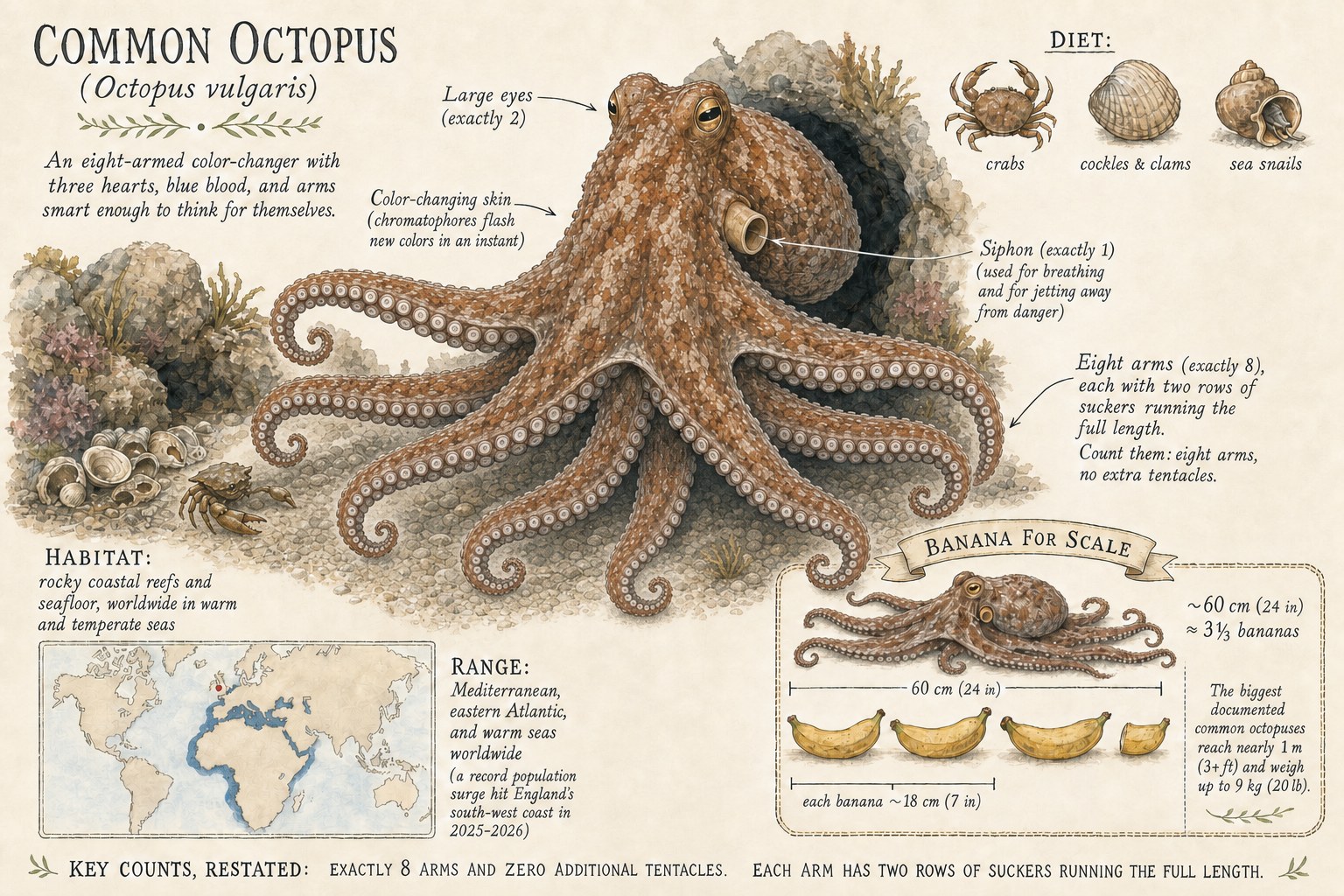 #29Common OctopusOctopus vulgaris
OK-tuh-puss vul-GAIR-iss
Pick timely pick
Size
Typical adults: 30-91 cm (about 1-3 ft) total length including arms; most commonly weigh 3-5 kg (6-11 lb). Documented maximums: mantle to 25 cm, arms individually to 1 m, weight up to 9 kg (20 lb). Banana scale: a representative ~60 cm adult ≈ 3⅓ bananas (1 banana = 18 cm)
Habitat
Saltwater. Rocky coastal reefs, crevices, and the upper continental shelf, from the surface down to about 100-150 m and rarely beyond 200 m. Dens in rock crevices, often marked outside by a small pile of empty shells
Range
Cosmopolitan across tropical, subtropical, and temperate waters worldwide (not polar). Especially abundant in the Mediterranean Sea, the eastern Atlantic (including the English Channel and southern England), the western Atlantic, and Japanese waters. Genetic research now treats "Octopus vulgaris" as a complex of at least six closely related species
Diet
Crabs and other crustaceans, bivalve mollusks (cockles, clams), and sea snails, ambushed and subdued with a venom delivered through its saliva; also known to raid crab and lobster fishing pots
Lifespan
1-2 years (12-24 months) in the wild. Semelparous: breeds once and dies soon after
Conservation
Least Concern (IUCN, assessed 2018) — Allcock, L., Headlam, J. & Allen, G. (ADW's own page still shows "Not Evaluated," but that entry predates the 2018 assessment and has not been updated to reflect it)
Wow
About two-thirds of an octopus's roughly 500 million neurons live in its eight arms, not its brain, so an arm can taste, decide, and react largely on its own, even a length of arm separated from a dead octopus will still curl and respond to a touch
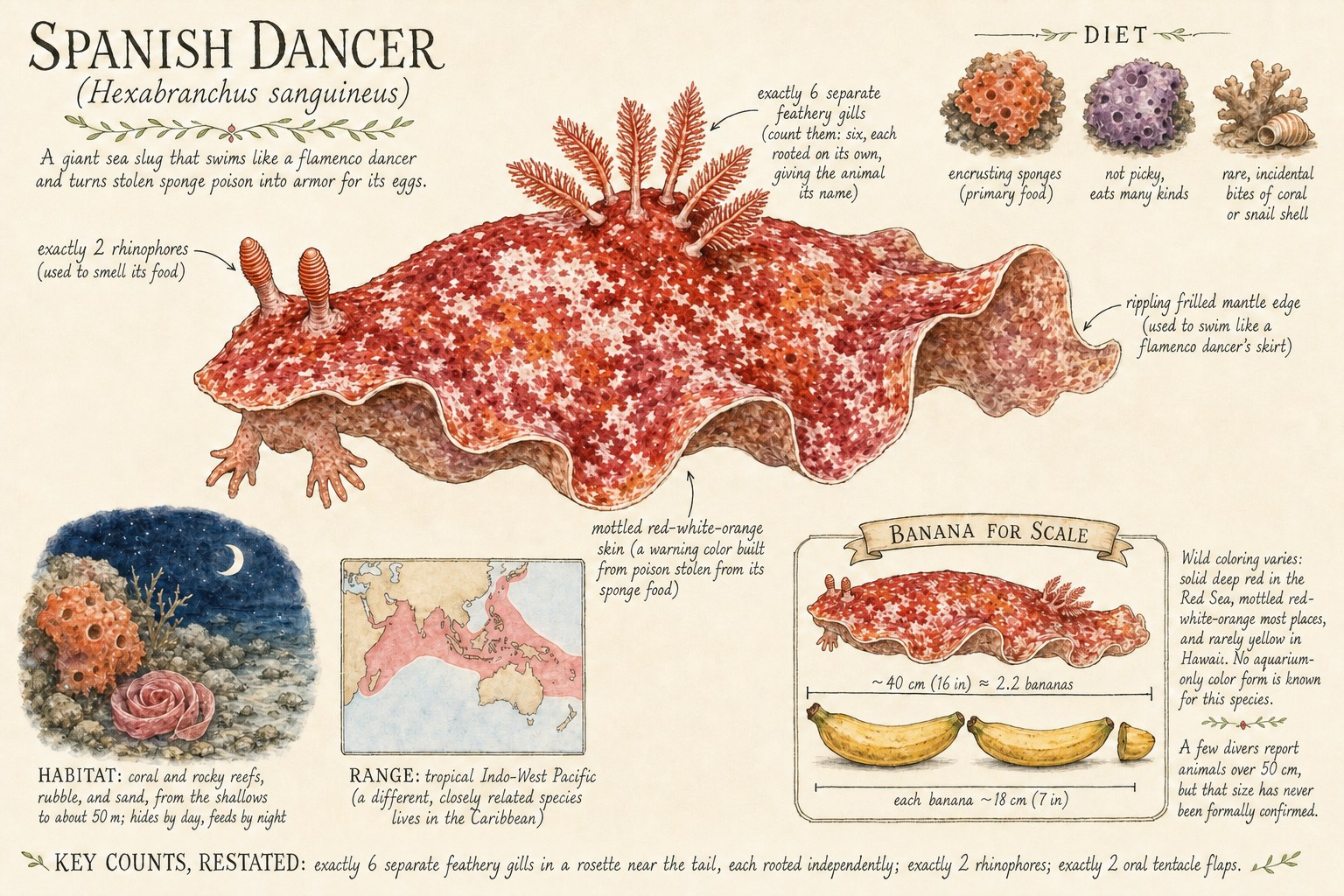 #30Spanish DancerHexabranchus sanguineus
hex-uh-BRANG-kus san-GWIN-ee-us
Pick timely pick
Size
Commonly documented up to about 40 cm (16 in), one of the largest nudibranchs known. Banana scale: ≈2.2 bananas (1 banana = 18 cm): two whole bananas plus a short stub (about ⅕ of a banana). A single unverified diver/magazine report from Djibouti, Red Sea, describes an animal at 520 mm (~20.5 in); flagged as anecdotal, not a formal measurement (see Flags)
Habitat
Saltwater. Coral and rocky reefs, reef rubble, and sandy areas; intertidal zone down to about 50 m, most common shallower than 20 m; nocturnal, hides by day
Range
Tropical Indo-West Pacific: East Africa and the Red Sea across to French Polynesia, north to Japan, south to Australia. Not native to the Caribbean, which has its own closely related species, Hexabranchus morsomus
Diet
Sponges, non-selectively: at least 11 genera across 5 orders and 2 classes documented in gut/fecal samples, mostly encrusting types; minor incidental material includes algae, coral fragments, worm tubes, snail shells, crab claw fragments, and bryozoans
Lifespan
Not specifically documented for this species in the Tier 1/2 literature located this session. General nudibranch pattern: most species live around one year (a few outliers live several years). No dedicated longevity study for H. sanguineus was found; flagged as an open question rather than guessed
Conservation
Not Evaluated (IUCN Red List; no assessment published as of access date 2026-07-25)
Wow
It eats sponges that make their own toxin to avoid being eaten, steals that toxin, slightly modifies it, stores it in its own skin as a warning color, and then packs the same toxin into its egg ribbon, chemically arming its eggs before they've even hatched