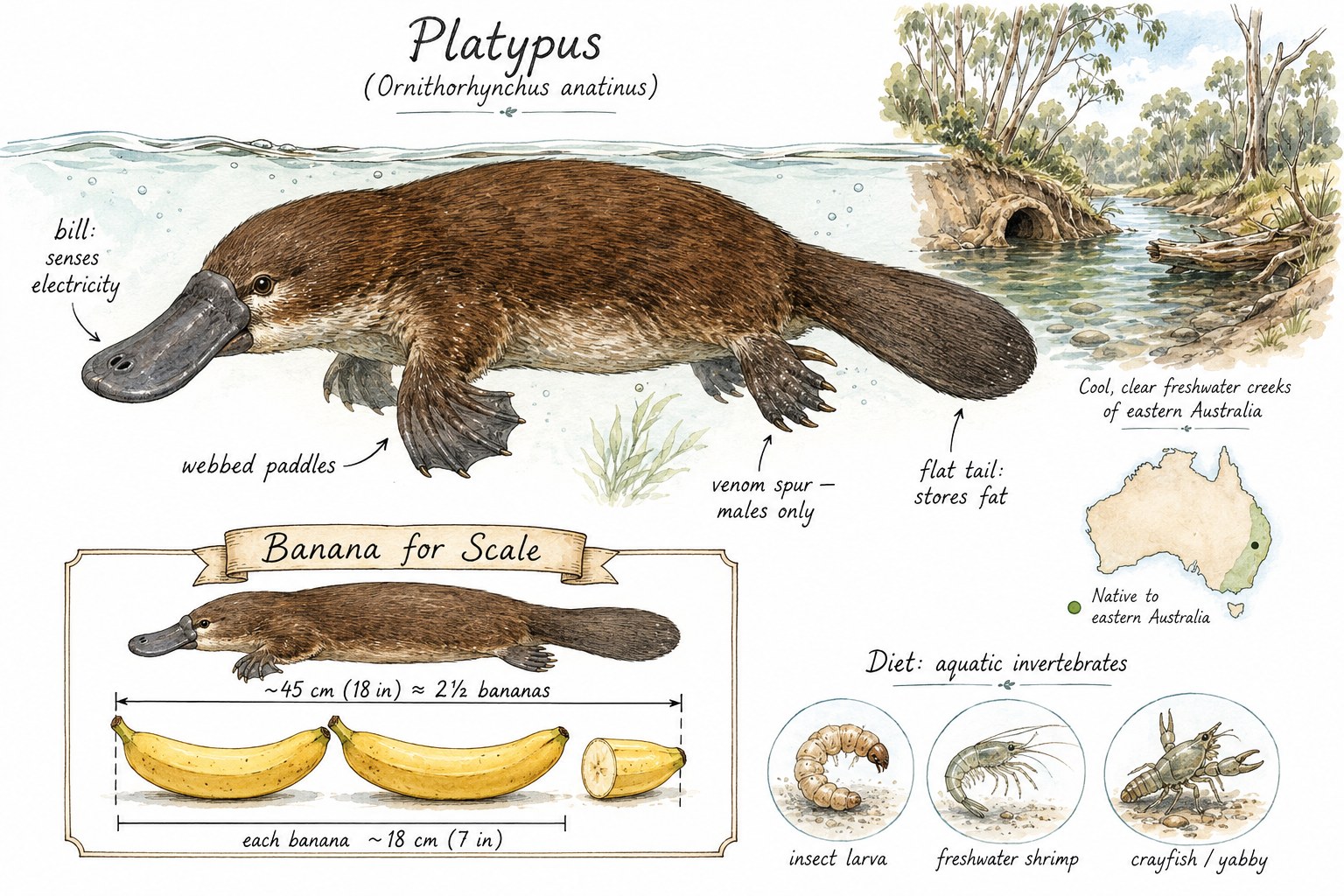
Meet the platypus. Say it like this: PLAT-uh-puss. It lives in rivers in Australia, and it looks like somebody built it out of spare animal parts. It is a mammal, like a dog or a person, but a very unusual one. It has a soft flat bill like a duck. It has a wide flat tail like a beaver. It has webbed feet for paddling and thick brown fur to stay warm in cold water.
Here's the funny thing. When a platypus dives down to find food, it shuts its eyes. It shuts its ears. It shuts its nose too! So how does it find a snack in the muddy water? It uses its bill. The bill can feel tiny buzzes of electricity from little bugs and worms hiding on the bottom. Nibble, nibble, scoop. It tucks the food in its cheeks and floats up to chew.
And the strangest part of all? A mama platypus does not have babies the way a cat or a dog does. She lays eggs. Little soft eggs, hidden in a cozy tunnel by the water.
The platypus is a mammal, but a very strange one. It has fur and it makes milk for its babies, like other mammals do. But it also lays eggs, which almost no mammal does. Only five kinds of animals in the world lay eggs and make milk. They are called monotremes, and the platypus is one of them.
Its best trick is how it hunts. A platypus feeds at the bottom of rivers, often at night, in water so murky it can't see a thing. So it doesn't try to see. When it dives, it closes its eyes, ears, and nose, and switches on a sense we don't have. Its rubbery bill is packed with about 40,000 tiny sensors that pick up electricity. Every time a shrimp or a worm flexes a muscle, it gives off a faint electric crackle, and the platypus feels it. It sweeps its bill side to side like a metal detector, snaps up the prey, and stuffs it in its cheek pouches to chew later at the surface.
Grown-up platypuses have no teeth, so they grind their food between hard pads in their mouths. They spend 10 to 12 hours a day hunting, because a body that stays warm in cold water burns a lot of fuel. When they're done, they rest in a burrow dug into the riverbank.
One more surprise: male platypuses are venomous. Each back ankle has a sharp spur linked to a venom gland, and the venom is strongest during breeding season. It won't kill a person, but people who've been jabbed say the pain is horrible and can last for weeks. That makes the platypus one of the only venomous mammals on Earth.
The platypus (Ornithorhynchus anatinus) is the last surviving member of the family Ornithorhynchidae, and one of only five living monotremes, the order Monotremata that also includes the four species of echidna. Monotremes split off from the rest of the mammal family tree well over 100 million years ago, and the platypus still carries the evidence in its bones. Its shoulder girdle is built from five bones in a pattern closer to a reptile's than to a cat's or a human's, and its legs splay out to the sides rather than tucking underneath. It walks with a reptile's sprawl and swims with a mammal's fur coat.
Its most sophisticated feature is a sense almost no other mammal has. When it forages, the platypus dives with its eyes, ears, and nostrils clamped shut and navigates entirely through its bill. The bill's skin holds roughly 40,000 electroreceptors, sensitive enough to register electric fields as weak as a few tens of microvolts per centimetre, interleaved in stripes with about 60,000 mechanoreceptors that sense pressure and motion. Together they let the animal reconstruct its surroundings from the electrical twitch of a prey animal's muscles and the tiny pressure wave that twitch pushes through the water. It's electroreception paired with touch, a hunting system worked out in murky rivers where eyes are useless.
Breeding hinges on the seasons, and July sits right at the leading edge. Courtship and mating happen in the water in late winter and spring, earliest in warm Queensland and progressively later moving south, stretching from roughly August in New South Wales to as late as December in Tasmania. After mating, the female seals herself into a long nesting burrow, lays one to three leathery eggs (usually two), and curls around them, pressing them against her belly with her tail. She has no nipples; the hatchlings, blind and bean-sized, lap up milk that seeps through patches of skin on her abdomen. The male's venom, delivered through that ankle spur, also peaks now, which points to a job settling contests between rival males during the breeding rush.
The platypus keeps handing biologists surprises. In 2020, researchers reported in the journal Mammalia that platypus fur biofluoresces, glowing a soft blue-green under ultraviolet light, the first time the trait had been found in an egg-laying mammal. Nobody yet knows what, if anything, it's for.
The IUCN lists the platypus as Near Threatened (assessed 2014). It remains reasonably widespread across eastern Australia, but it depends completely on healthy freshwater systems, and those are under pressure from land clearing, dams and river regulation, prolonged drought, and drowning in illegal net traps. Its deep history runs even further back: the 110-million-year-old jaw of the platypus relative Steropodon galmani is one of Australia's oldest known mammal fossils, and a 61-to-63-million-year-old fossil tooth from Patagonia shows the platypus lineage once reached South America, back when it and Australia were joined in the supercontinent Gondwana.