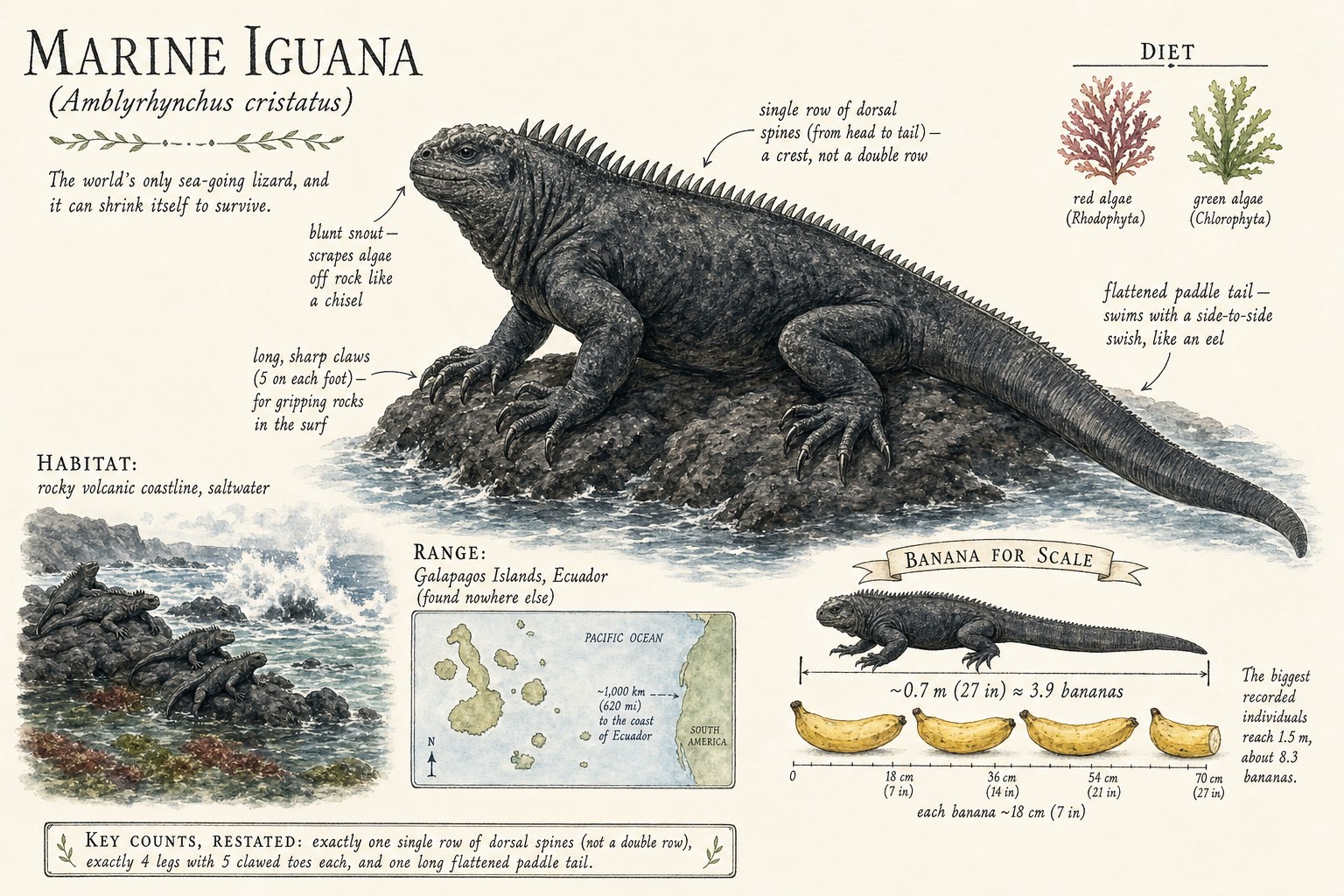
Meet a lizard that swims in the sea. It's called the marine iguana, and it's a reptile, like a turtle or a snake's cousin. It lives only on rocky islands far out in the ocean, called the Galapagos. Most lizards stay on dry land. Not this one. It dives right into the waves and munches algae off the rocks, using its blunt little snout like a spoon. Its claws are extra long and sharp, so it can hold on tight when the water gets rough. Eating all that salty seawater makes it need to get rid of the salt, so guess what it does? It sneezes it right back out! When the sun comes out, the iguana climbs onto the rocks to warm up, piled in a heap with its friends. And here is the wildest trick of all. When food runs short, its whole body can shrink, bones and all, then grow back later when there is plenty to eat again.
The marine iguana is a reptile. It's the only lizard on Earth that finds food in the ocean. It lives only on the Galapagos Islands, a group of volcanic islands off the coast of Ecuador. There it grazes on red and green algae growing on underwater rocks. Bigger iguanas, mostly males, dive down and grip the rocks with long, sharp claws. They scrape algae loose with a blunt snout and small, chisel-like teeth. Smaller iguanas and females stay closer to shore. They feed on algae exposed at low tide.
Swimming takes a toll, though. The ocean around the Galapagos is chilly, and a marine iguana's body temperature drops with it. To cope, its heart rate slows to about half its normal speed underwater. That saves energy, so it can keep feeding a little longer. Then it heads back to the rocks to warm up in the sun. All that seawater it swallows is loaded with salt, more than its body can handle. A gland behind its nose filters the extra out. Then the iguana sneezes the salt away in a fine white spray.
Then there is the shrinking. Every few years, a warm-water event called El Nino heats up the ocean. The iguanas' favorite algae dies off. Rather than starve, marine iguanas do something no other reptile is known to do. They shrink. They reabsorb their own bone and cartilage and get up to 20 percent shorter. Smaller bodies need less food to survive. When the water cools and algae comes back, the same iguanas grow tall again. Some shrink and regrow several times in one lifetime.
Marine iguanas (Amblyrhynchus cristatus) belong to the order Squamata, the scaled reptiles that include every lizard and snake alive today. They sit in the family Iguanidae. The genus Amblyrhynchus holds exactly one species: this one. Its ancestors likely rafted to the Galapagos from mainland South America on logs or floating debris. They then split off from the archipelago's land iguanas around 4.5 million years ago. What they evolved into has no real parallel among living lizards. Every other iguana on Earth eats plants on dry land. This one eats algae underwater.
Diving into cold water creates a problem for a cold-blooded animal. The marine iguana's body has some clever answers. Its heart rate drops to roughly half its normal pace the moment it submerges. This trick is called bradycardia. It slows the animal's metabolism and stretches out how long it can keep feeding before surfacing to rewarm. A gland behind each nostril filters excess salt straight out of its bloodstream. The iguana then expels the salt in a forceful sneeze, sometimes crusting its snout in fine white crystals. During the breeding season, males on some islands, especially Espanola, flush bright green and red. On other islands they stay black, or turn brick-red and dull green, a difference tied to each island's own volcanic rock and light.
The strangest trick, though, is reversible. In a study published in Nature in 2000, biologists Martin Wikelski and Corinna Thom tracked marine iguanas across El Nino events. These are periodic warm-water cycles that wipe out the red and green algae these lizards depend on, leaving only a toxic brown algae behind. Individuals on two islands shrank by as much as 6.8 centimeters, nearly 20 percent of body length, over two-year stretches. They did it by reabsorbing their own bone and connective tissue. Smaller iguanas need less food and burn less energy foraging, and the ones that shrank the most survived the longest. Females tend to shrink more than males, likely because producing eggs already demands so much of their energy budget. When the ocean cools and algae returns, the same lizards grow back to their old length. Some cycle through several rounds of shrinking and regrowing in one lifetime.
For decades, biologists treated the marine iguana as a fairly uniform species with seven subspecies, a classification dating to Irenaus Eibl-Eibesfeldt's work in the 1960s. Newer genetic research led by conservation biologist Amy MacLeod has identified eleven distinct subspecies scattered across the islands. Each is shaped by its own isolated population and coastline, and each is now treated as its own conservation priority rather than one interchangeable whole.
That reassessment matters, because the marine iguana is listed as Vulnerable on the IUCN Red List, assessed 2020. Its total population is estimated at somewhere between roughly 19,800 and 210,000 individuals. That wide range comes straight from the boom-and-bust cycles El Nino creates: a single severe event can kill 85 to 90 percent of a local population in one season. Introduced predators like rats, cats, and dogs take a heavy toll on eggs and juveniles that evolved with almost no land predators to worry about. Oil spills and marine microplastics add newer threats. In December 2025, delegates at the CITES CoP20 conference voted to uplist all Galapagos iguanas, marine and land, to Appendix I, the treaty's strictest category, banning international commercial trade outright. The change took effect March 5, 2026. Researchers are now flying drones over the coastline through a project called Iguanas From Above, using the images and citizen scientists to count iguanas across the islands and track how each population is doing, one colony at a time.