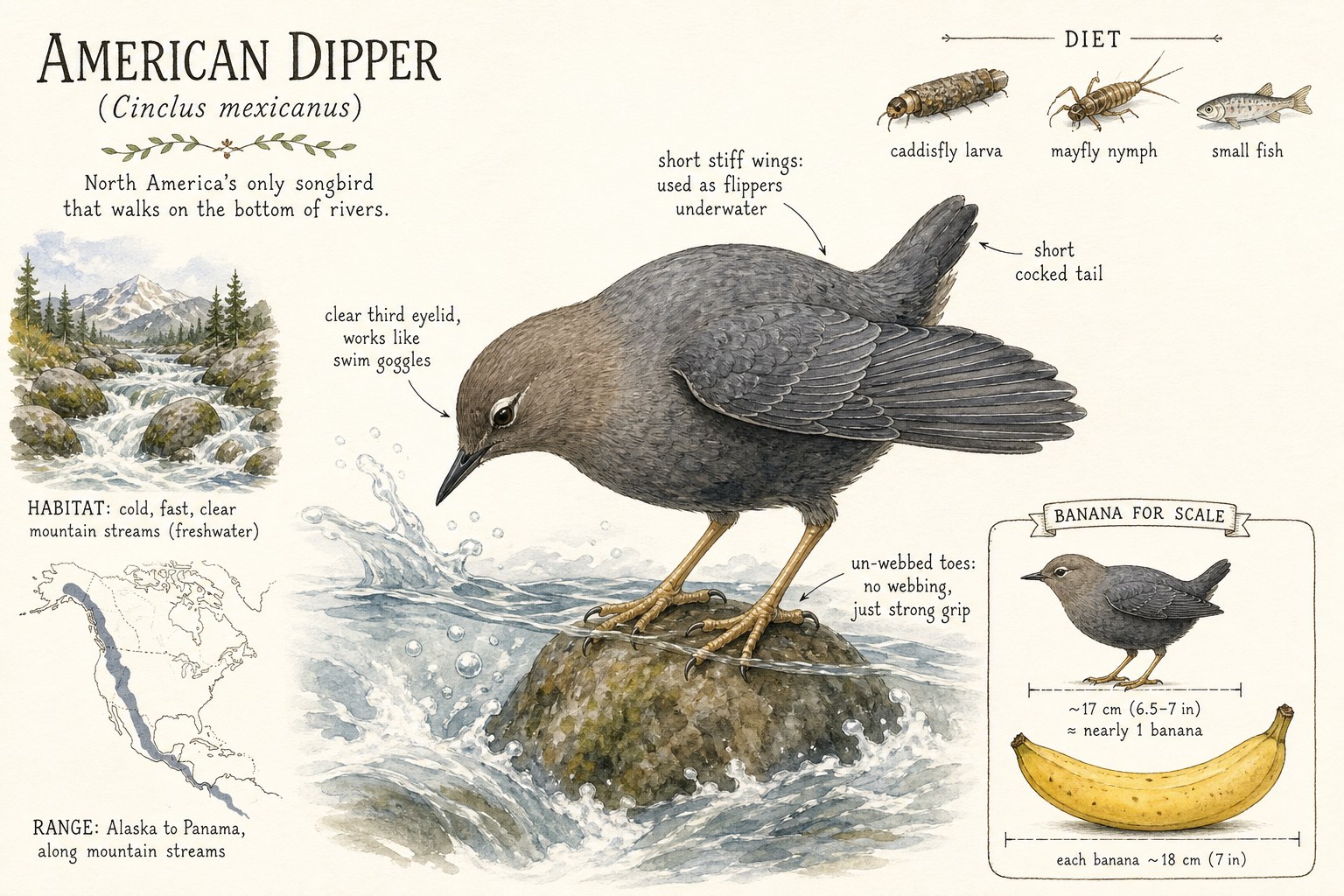
Meet the American dipper. It's a bird. But this bird does something wild. It walks underwater! It hops right into a fast, cold mountain stream and marches along the bottom, looking for bugs to eat. Its short wings work like little paddles down there. It even has a special clear eyelid, like tiny swim goggles, so it can see while it walks. The dipper never gets webbed feet like a duck. It just grips the slippery rocks with its toes and holds on tight. Then it pops back up, gives a shake, and does it all over again.
The American dipper is a stocky gray songbird. It's about the length of a dollar bill, 16 to 18 centimeters (6.5 to 7 inches) beak to tail. Its size isn't what makes it strange. This is the only songbird in North America that hunts underwater. It dives headfirst into fast, cold mountain streams. Then it walks along the bottom, wings half open, paddling to hold its place against the current.
Staying under for up to 15 seconds takes real equipment. A clear third eyelid, called a nictitating membrane, slides across each eye. That lets the dipper keep hunting with its eyes open underwater. Skin flaps seal its nostrils shut the moment it dives. A big oil gland waterproofs its feathers. Its blood carries extra oxygen too, so it can hold its breath longer than most birds its size.
Down there, the dipper hunts caddisfly and mayfly larvae, small fish, and even fish eggs. It grips slick rocks with strong toes, and unlike a duck, those toes have no webbing at all. It spends its whole life along one stretch of mountain stream, somewhere in a range that runs from Alaska down through the western US and Mexico to Panama. Because it can only survive in clean water, scientists use dipper sightings to check if a stream is healthy. Wild dippers usually live around 7 years. The IUCN Red List calls the species Least Concern, assessed in 2016, though a few streams have lost their dippers to pollution.
The American dipper belongs to Passeriformes, the perching-bird order that holds more than half of all bird species. But within that order it sits almost alone, in a family called Cinclidae. That family holds exactly five species worldwide, all in one genus, Cinclus, and all of them dippers. No other songbird lineage has committed to an underwater life the way this family has. The American dipper is the only one of the five native to the Western Hemisphere. The rest live scattered across Europe, Asia, and the Andes, a strange little archipelago of aquatic songbirds split apart by oceans and mountains.
Walking against a current strong enough to knock a person off their feet takes real engineering. The dipper's short, stiff wings act as underwater flippers. They push down hard enough to pin its body to the streambed while its long toes, bare of any webbing, grip the stone. A nictitating membrane, a clear third eyelid, sweeps across each eye to protect it and keep it clear underwater. Flaps of skin clamp its nostrils shut on the dive. Its blood carries an unusually high load of hemoglobin, letting it bank more oxygen per breath than most perching birds its size, and a notably slow metabolism stretches that oxygen supply even further.
Cinclus mexicanus takes its species name from Mexico, where naturalist William Bullock collected the specimen that William Swainson formally described in 1827. Five recognized subspecies now span the bird's range, from Alaska's unicolor population in the north down to forms scattered through Central America. Dippers cannot survive in silty or polluted water, so biologists treat them as a living gauge of stream health: find a dipper, and the water is almost certainly clean. Partners in Flight estimates the global breeding population at roughly 160,000 birds. The IUCN lists the species as Least Concern, assessed in 2016, though local populations have blinked out where logging, mining, or heavy pollutants like PCBs have fouled the water they depend on.
Naturalist John Muir loved this bird, which he called the water ouzel, more than any other company on his Sierra wanderings. He once watched a single dipper for hours just to see how at ease it looked inside a waterfall. That impression holds up today. A bird that dives headfirst into an ice-cold mountain stream, walks its bottom on bare, un-webbed toes, and pops back up to sing from the nearest boulder has done more than tolerate cold water. It built its whole body, blood, and behavior around living in it.