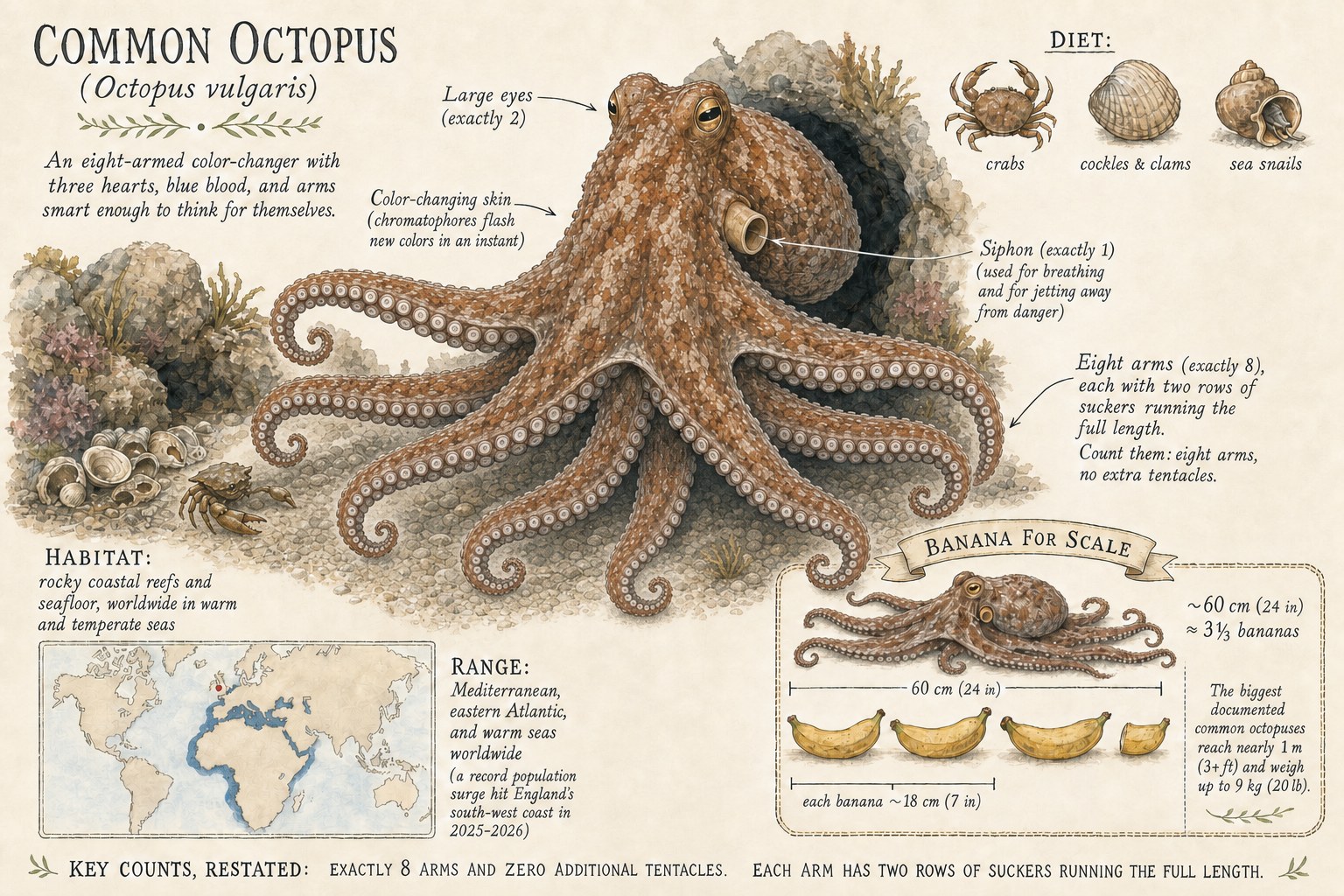
Watch this eight-armed animal change color faster than you can blink. This is the common octopus, and it's a cephalopod (SEF-uh-luh-pod), the same watery family as squid and cuttlefish. It has three hearts. Its blood is blue, not red. The octopus has no bones at all, so it can squeeze through a gap as small as a coin. Each of its eight arms can taste whatever it touches. Every arm is so clever it can grab a crab all by itself, without asking the octopus's brain first. Stretched out, one octopus is about three bananas long. And here's some real news. Last year, so many octopuses showed up in the sea near England that scientists gave it a name: an octopus bloom.
The common octopus is a cephalopod. That's the same group of animals as squid and cuttlefish, all named for the arms crowded around their mouths. It has eight arms, each lined with two rows of suckers. It has zero bones in its whole body. The only hard part of an octopus is its beak. If the beak fits through a gap, the rest of the octopus can squeeze through too, even a gap no wider than a coin. It also has three hearts. Two of them pump blood to its gills to pick up oxygen. The third heart sends that oxygen out to the rest of its body. Its blood carries oxygen with copper instead of iron, like ours does. That's why it comes out blue instead of red.
An octopus doesn't think with just one brain. About two-thirds of its 500 million neurons live in its eight arms, not its head. That means an arm can taste what it touches. It can decide what to do. It can react, all without waiting for orders from the brain. Scientists tested this in the lab. They gently pinched an arm that had already come free from an octopus that had died. It still curled up and reacted on its own.
Its skin is just as remarkable. Thousands of tiny organs called chromatophores sit under an octopus's skin. Tiny muscles can pull them open to flash new colors across its whole body in an instant. Add in bumpy skin it can raise or smooth flat. An octopus can go from pale gray to spiky mottled brown before a hungry fish even notices it's there. Common octopuses usually live only one to two years. They breed just once. Both parents die soon after.
Right now, there's a real octopus story happening in the seas around South West England. Britain already has its own native octopus, a smaller species called the curled octopus. But starting in 2025, common octopus numbers exploded off the coasts of Devon and Cornwall. Catches climbed to nearly 65 times the usual amount, the biggest surge seen there in 75 years. Scientists think warmer seas are pulling more octopuses north and helping them thrive. Fishers who catch crab and lobster have felt it most. A hungry octopus is remarkably good at breaking into a shellfish pot.
The common octopus, Octopus vulgaris, belongs to the class Cephalopoda, order Octopoda, family Octopodidae. That's the same lineage as squid and cuttlefish. Its genus name comes from the Greek oktopous, meaning eight-foot. Vulgaris is simply Latin for common. Genetic research published in 2022 complicated that tidy name. Biologists once treated Octopus vulgaris as one single, worldwide species. It turns out to be a complex of at least six closely related species, still sorting themselves out under nearly identical bodies. The octopus on a Mediterranean reef and the one off the coast of Brazil may not, strictly speaking, be the same animal at all.
Much of what makes an octopus strange starts in its nervous system. It carries roughly 500 million neurons, a number in the same range as a dog. About two-thirds of them sit inside its eight arms, not its brain. Each arm can taste, decide, and act largely on its own. Researchers have shown that even a length of arm severed from a dead octopus will still curl and respond to a pinch. Layered on top of that is a genuine paradox. Octopuses are colorblind. They cannot perceive the very hues they match so precisely. Yet thousands of neurally controlled organs called chromatophores can recompose the animal's color and texture in a fraction of a second, backed by light-reflecting iridophores and shape-shifting skin bumps called papillae. Researchers still aren't sure how a colorblind animal pulls that off. One leading idea is that light-sensitive proteins scattered across its skin let it sense brightness and pattern without ever seeing color at all.
Hunting is a mix of ambush and chemistry. An octopus pounces on crabs, other crustaceans, and bivalve mollusks such as cockles and clams. It subdues them with a venom delivered through its saliva. Reproduction, by contrast, is a single, final act. A male passes his sperm to a female using a modified arm called a hectocotylus. A female can lay anywhere from 100,000 to 500,000 eggs. She guards them constantly, without eating, for months, until they hatch. Soon afterward, both parents die. Most females die from hormonal changes in a gland near their brain, a change triggered once her eggs are safely laid.
The IUCN Red List classifies the common octopus as Least Concern, assessed in 2018 by Allcock, Headlam, and Allen. That status still comes with a caveat. Heavy commercial fishing, more than 20,000 tonnes a year off northwest Africa alone, can push local populations down hard even while the species as a whole isn't at risk. One widely used reference database, the Animal Diversity Web, still lists the species as Not Evaluated. That page predates the 2018 assessment and hasn't caught up.
That fishing pressure is exactly why the events of 2025 caught scientists' attention. Common octopuses are not normally abundant in British waters. They prefer the warmer Mediterranean and the coast of northwest Africa. But marine researchers at the University of Plymouth and the Marine Biological Association recorded commercial catches almost 65 times the recent average off Devon and Cornwall. It was the biggest bloom in at least 75 years, with smaller episodes on record from 1900 and 1950. Between January and August of 2025 alone, fishers landed somewhere between £6.7 million and £9.4 million worth of common octopus, even as it devastated the crab, lobster, and scallop fisheries the same boats normally depend on. The likely trigger is a marine heatwave paired with a pulse of low-salinity water, a signature that points toward octopus larvae drifting across the Channel from breeding grounds near France and the Channel Islands. Juvenile octopuses have already turned up in UK waters into 2026. This newly arrived population may be settling in rather than passing through.