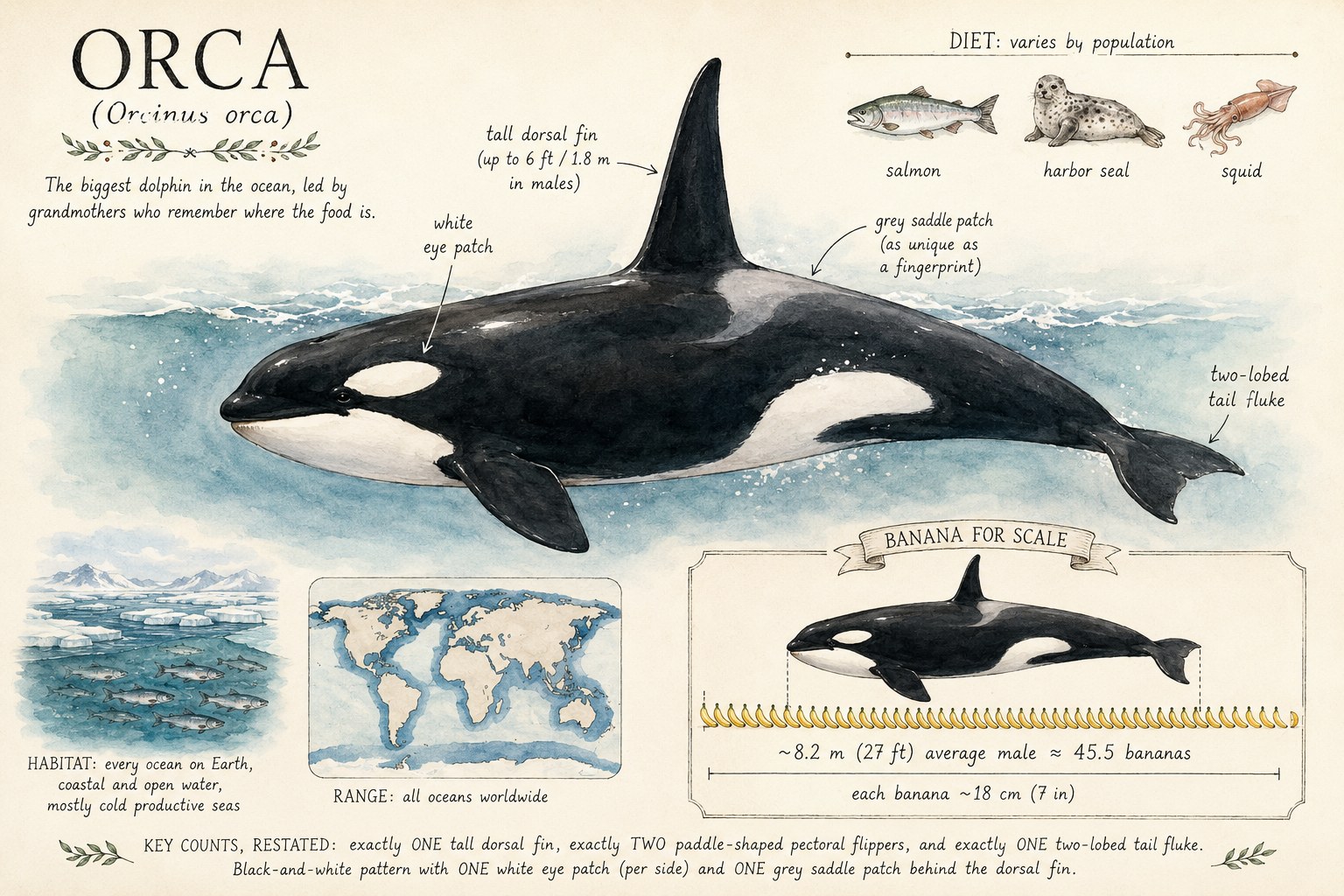
Say hello to the orca, also called the killer whale. It is a mammal, just like you. That means it breathes air and feeds its babies milk. But an orca is really a giant dolphin, the biggest dolphin in the whole world. It is black and white, with a white patch over each eye like a tiny painted oval. Orcas swim in families called pods. The kids stay with their moms their whole lives. Grandma orcas are the leaders. They remember where to find food, even food they saw fifty years ago. An orca can grow longer than a school bus. It hunts fish, seals, and sometimes even bigger whales, working together with its family like a team. Under the water, orcas click and whistle to talk to each other. Each pod even has its own special way of talking, almost like a secret accent just for them.
The orca, or killer whale, is a mammal. Despite the name, it is really the largest member of the dolphin family. Adult males can reach about 8.2 meters (27 feet) long. They can weigh up to 6,000 kilograms, about 13,000 pounds. The biggest males on record stretch to 9.8 meters, or 32 feet. Females are smaller, usually around 7 meters (23 feet). Every orca wears its own black-and-white pattern: a white patch above each eye, a gray saddle behind the tall dorsal fin, and a pale belly. No two saddle patches look exactly the same. Scientists use them like fingerprints to tell orcas apart.
Orcas live in every ocean on Earth, from icy polar seas to warm tropical water. They travel in family groups called pods, led by the oldest females. A calf usually stays with its mother for life. What an orca eats depends on where it lives. Some pods hunt almost only salmon. Others chase seals, sea lions, and even whales twice their own size, working together like a team.
Orcas talk underwater with clicks, whistles, and pulsed calls. Every pod has its own dialect, a set of sounds passed down from grandmother to mother to calf. Two pods in the same ocean might sound as different as two people speaking different languages. That dialect is learned, not born-in. Orca culture gets handed down the same way a family recipe does.
Orcinus orca (or-SY-nus OR-kuh) is a toothed whale in the family Delphinidae, the oceanic dolphins. It is by far the largest species in that family. Its genus name has an unsettled origin. Many popular sources trace Orcinus to Orcus, the Roman god of the underworld. But taxonomic references note that reading may be folk etymology. The name more plausibly comes from an old Latin word for a large-bellied vessel, a nod to the animal's barrel-shaped body. Either way, orca is now the preferred term among biologists. "Killer whale" overstates a reputation the species has never actually earned against people.
Ecologically, Orcinus orca is really several different animals wearing one scientific name. In the northeastern Pacific alone, researchers recognize at least three ecotypes. Resident orcas travel in large, stable matrilines and specialize on fish, especially Chinook salmon. Transient, or Bigg's, orcas move in small, looser groups and hunt marine mammals: seals, sea lions, and other whales. Offshore orcas range far from shore in bigger groups and feed heavily on sharks and rays. These ecotypes share the same waters but rarely interbreed. Some researchers argue a few should be classified as separate species.
That taxonomic mess is a real part of why the IUCN Red List classifies Orcinus orca globally as Data Deficient, an assessment made in 2017. The picture is too fragmented, ecotype by ecotype and region by region, to assign one clean global status. Individual populations tell a sharper story. The Southern Resident orcas of the Pacific Northwest are a fish-eating population numbering only around 75 animals. They have been listed as Endangered under the US Endangered Species Act since 2005, squeezed by a shortage of Chinook salmon, underwater noise, and pollution.
The strangest part of orca biology might be their lifespan. Female orcas can live into their eighties or nineties. For decades after their last calf, they stop reproducing altogether. That kind of extended post-reproductive life shows up in almost no other wild mammal besides orcas and humans. A 2019 study in the Proceedings of the National Academy of Sciences tracked decades of data from Pacific Northwest orca populations. It found that grandmothers who had stopped breeding raised the survival odds of their grandcalves. They likely did it by leading the pod to food and sharing knowledge built up over a long life. Menopause, in other words, may exist in orcas for something like the reason many scientists suspect it exists in us. An experienced grandmother is worth more to the family alive and leading than she is having one more calf of her own.
Every population and ecotype shares the orca's basic toolkit. That toolkit includes cooperative hunting, echolocation for finding prey in dark water, and vocal dialects passed down within matrilines rather than written into genes. A large brain, tight matrilineal families, and culture transmitted by learning: that combination is part of why researchers increasingly discuss orca society in the same terms reserved for elephants, great apes, and us.