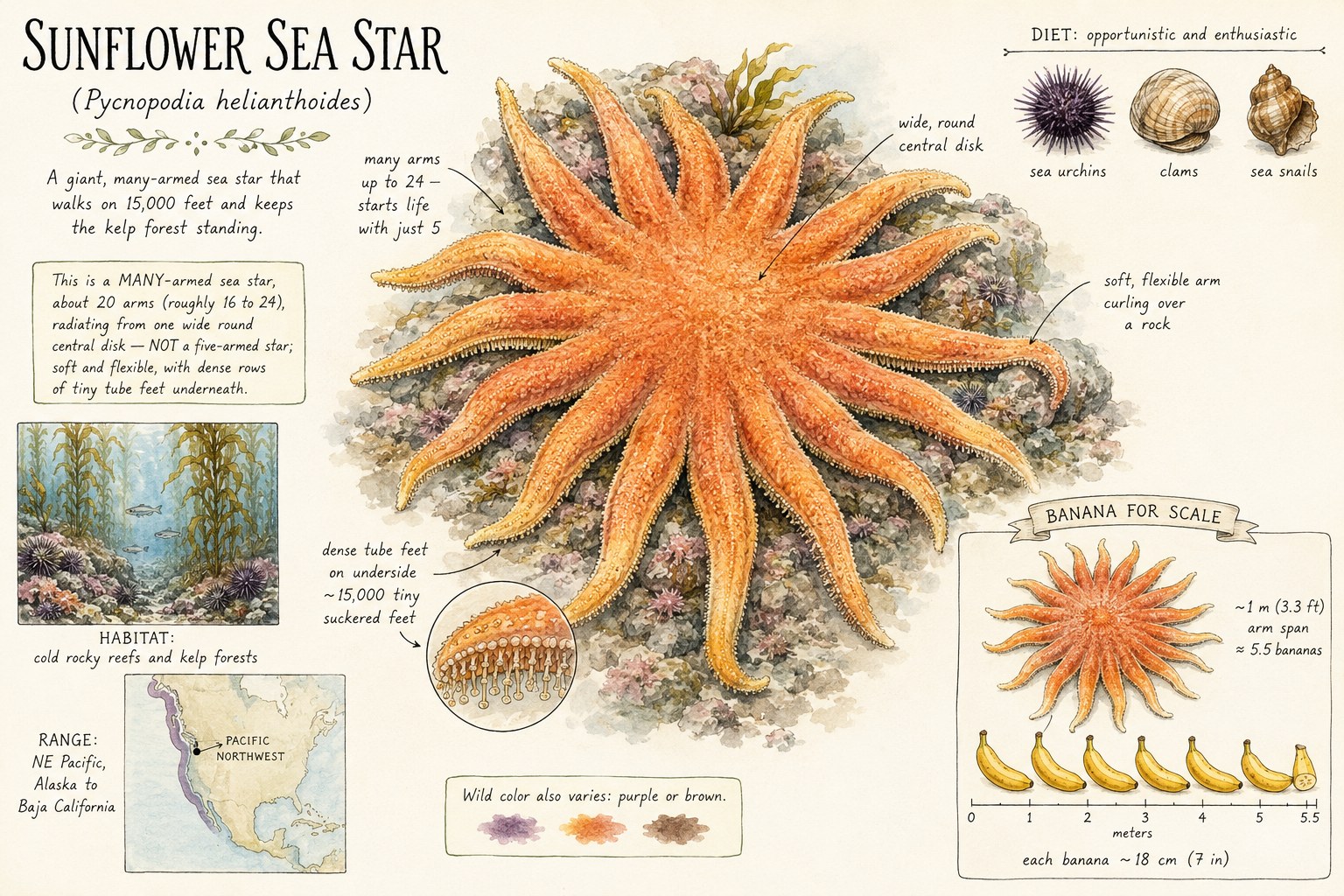
Say hello to the sunflower sea star. It is not a fish, and it is not a plant. It is an echinoderm, which is the sea-star group. Most sea stars have five arms. This one can have twenty! It creeps along the bottom of the sea on thousands of tiny feet. There are more than fifteen thousand of them, and they are soft and squishy. It is a hungry hunter. It loves to eat spiky sea urchins. When it was a baby, it had only five little arms. Then it grew more, and more, until it looked like a big soft sunflower. Some are orange. Some are purple. And for a sea star, it moves fast.
The sunflower sea star is an echinoderm, the same group that holds the other sea stars and the sea urchins. It is one of the biggest sea stars on Earth, and also the heaviest, at around 5 kilograms (about 11 pounds). A large one can stretch a full meter, roughly 3 feet, from one arm tip to another. Most sea stars keep exactly five arms their whole lives. This one is different. It begins with five arms as a baby and keeps adding more as it grows. A full-grown star often has twenty arms, and sometimes as many as twenty-four.
All those arms need feet. On its underside, the sunflower star has around 15,000 tiny tube feet, and each one works like a little water-powered sucker. Using them together, it can crawl about a meter every minute. That does not sound quick until you remember that most sea stars barely seem to move at all. This is the fastest sea star anyone has ever timed. It uses that speed to chase down a meal, mostly sea urchins, but also clams, snails, and even other sea stars.
Its way of eating is stranger still. A sunflower star does not swallow its food. Instead it pushes its stomach out through its mouth, spreads it around the prey, and digests the meal right there on the seafloor. Then it pulls its stomach back inside. And if a hungry crab clamps onto one of its arms, the star can simply drop that arm and crawl away. A brand-new arm grows back within a few weeks.
The sunflower sea star, Pycnopodia helianthoides, is the largest-armed member of the sea-star class Asteroidea, an echinoderm in the order Forcipulatida. Its scientific name fits it well. Pycnopodia means "dense feet," a nod to the roughly 15,000 tube feet packed under its body, and helianthoides means "sunflower-like," for the way its arms fan out from a broad central disk. It is the heaviest sea star known, close to 5 kilograms, and second in arm span only to a rarely seen deep-water star, Midgardia xandaros. It ranges through the cold northeastern Pacific, from the Aleutian Islands of Alaska south to Baja California.
A sunflower star grows in a way few animals do, by adding limbs. It settles out of the plankton as a five-armed juvenile and inserts new arms in pairs as it matures, reaching sixteen to twenty-four. Its skeleton is not a hard shell but a loose mesh of small plates, called ossicles, bound in flexible tissue, which lets the whole body bend and pour over rocks. The tube feet do the walking, the gripping, and much of the tasting. The animal tracks prey by smell and by sensing light and dark, then everts its stomach over the catch to digest it on the spot. Losing an arm is survivable, because self-amputation and regrowth are routine.
In many places it is the main predator of sea urchins, and that job matters enormously. Urchins graze on kelp. Where sunflower stars are common, they hold urchin numbers down and kelp forests stay standing. Where the stars disappear, urchins can multiply and mow the kelp to bare rock, leaving behind a wasteland that biologists call an urchin barren. So one soft-bodied invertebrate helps hold up a whole underwater forest.
Beginning in 2013, a marine epidemic called sea star wasting disease swept the West Coast, made worse by a record ocean heatwave. Sunflower stars were hit hardest of all. Researchers estimated the outbreak killed something like 5.75 billion of them, a global decline near 90 percent, erasing the species from California, Oregon, and Mexico and leaving only scattered survivors farther north. In 2020 the IUCN listed it as Critically Endangered. Then came better news. In 2025 scientists identified the likely killer, a bacterium named Vibrio pectenicida, and aquariums along the coast began spawning sunflower stars and raising the young, hoping to return hardier stars to the sea. For an animal that grows its own arms, the comeback is only starting.