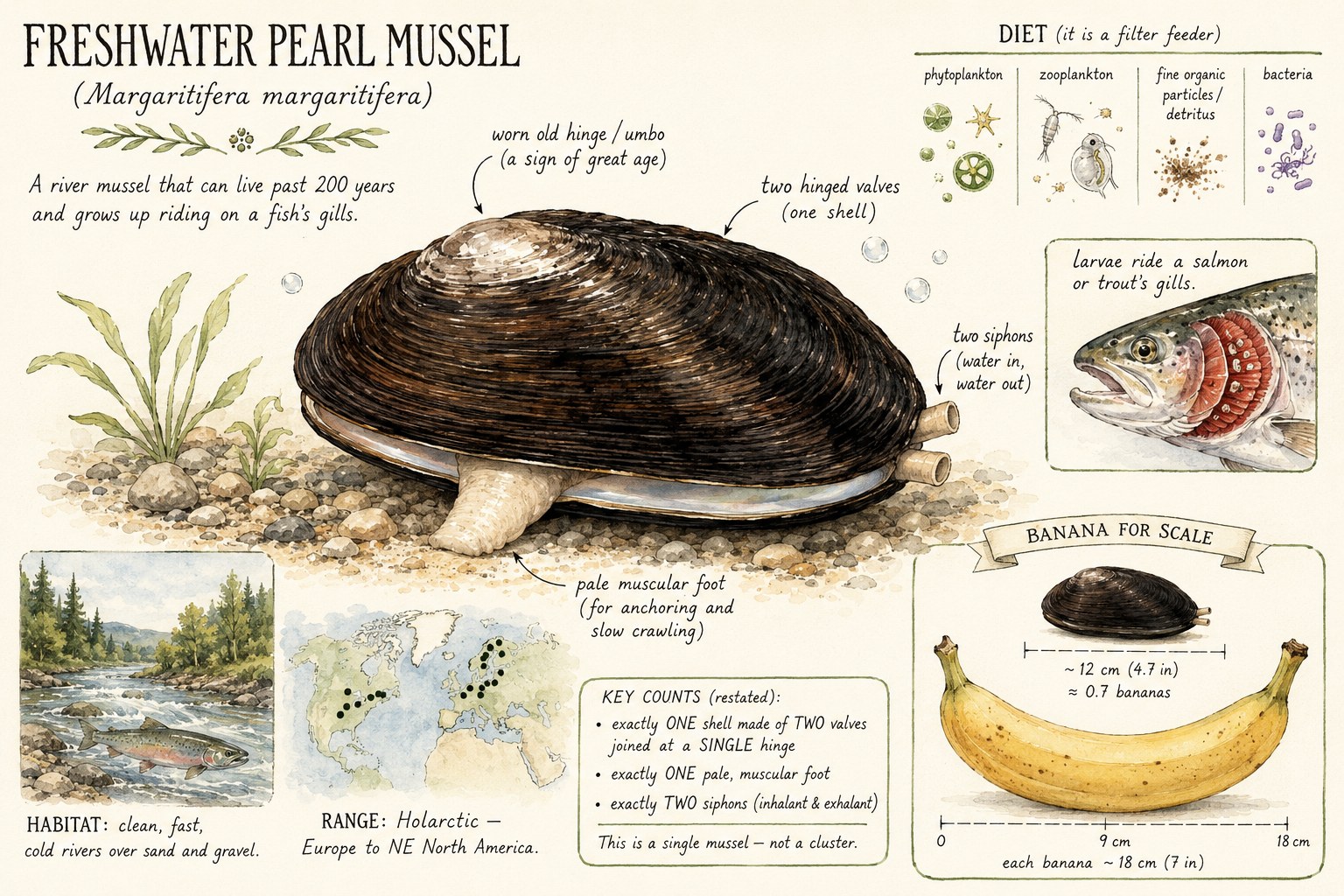
Say hello to the freshwater pearl mussel. It lives at the bottom of cold, clean rivers. It looks like a dark, smooth rock with two halves, and it hardly ever moves. It is a mollusk, a cousin of clams and snails. But here is the amazing part. This little animal can live longer than almost anything else on Earth. Some have lived more than two hundred years! That is older than your great-great-great-grandma. It sips river water all day and cleans it as it goes, like a tiny water filter. And when it is a baby, it does something silly. It grabs onto a fish and hitches a ride. The baby holds tight to a salmon's gills for almost a whole year. Then it lets go, drops down, and starts its own long, slow, quiet life.
The freshwater pearl mussel is a shellfish that has turned patience into a superpower. It lives buried in the gravel of clean, fast rivers, with just the top of its dark shell poking out. It does not chase food. Instead it pulls river water in through a little opening, strains out tiny bits of plankton and other specks to eat, then pushes the clean water back out. One adult mussel can filter about 50 litres of water a day, roughly thirteen gallons. A whole riverbed of them helps keep the water clear.
The strangest part is how it grows up. A female can release one to four million tiny larvae, called glochidia (gloh-KID-ee-uh), into the river at once. Each one is smaller than a grain of sand, and almost all of them will die. The lucky few get breathed in by a passing salmon or trout and clamp gently onto the fish's gills. They ride there for most of a year, not hurting the fish, until they are big enough to let go, sink into the gravel, and live on their own.
Then they just keep living. Freshwater pearl mussels are one of the longest-lived animals on the planet. Many pass 100 years, and the oldest one ever found was about 280 years old. An animal that old was alive before cars, before light bulbs, before anyone owned a single photograph.
The freshwater pearl mussel (Margaritifera margaritifera, mar-guh-rih-TIFF-er-uh) is a bivalve mollusk, a relative of clams and oysters, in the family Margaritiferidae. Its scientific name is almost a description: margarita is Latin for "pearl," and -fera means "bearing," so the animal is literally the pearl-bearer. For centuries people tore through riverbeds hunting the fine pearls its shell can produce, and that hunt is one reason the species is now in trouble.
It lives in clean, fast-flowing, low-nutrient rivers and streams across the Holarctic, on both sides of the North Atlantic, from northern Russia and Scandinavia through Britain and Ireland to the rivers of eastern Canada and New England. Adults are elongated and kidney-shaped, dark brown to black, usually about 10 to 13 centimeters long, and they sit anchored in coarse sand and gravel with roughly a third of the shell exposed. Feeding is passive. Water is drawn in through a siphon, fine organic particles are filtered out, and the cleaned water is expelled, which is why a healthy mussel bed acts like a slow, living water treatment plant.
Reproduction runs through a fish. In summer, males release sperm into the current, females take it in and brood the fertilized eggs on their gills, and the resulting larvae, called glochidia (gloh-KID-ee-uh), are flushed into the river by the million. A glochidium survives only if it is inhaled by a salmonid, an Atlantic salmon or a brown trout, and snaps shut on the fish's gill. It spends most of the next year there, encased and growing, before dropping to the riverbed as a tiny mussel. Miss the fish, and it dies within days.
Then comes the payoff for all that risk: an extraordinarily long life. The freshwater pearl mussel is one of the longest-lived animals known. Careful shell-ring studies and Russian research by Valeriy Zyuganov put the maximum lifespan around 210 to 250 years, and the oldest individual on record was roughly 280. Growth is glacially slow, sexual maturity arrives around 10 to 20 years, and a single mussel may keep reproducing for over 75 years.
That slow pace is also a weakness. The IUCN Red List assessed the species as Endangered in 2017, and in Europe it is considered Critically Endangered. Populations have collapsed across their range from pearl fishing, river pollution, silt that smothers the gravel young mussels need, and the loss of the salmon and trout their larvae depend on. Many surviving beds hold only aged adults with no young coming through, a population quietly running out of time even where the animals themselves are still alive.