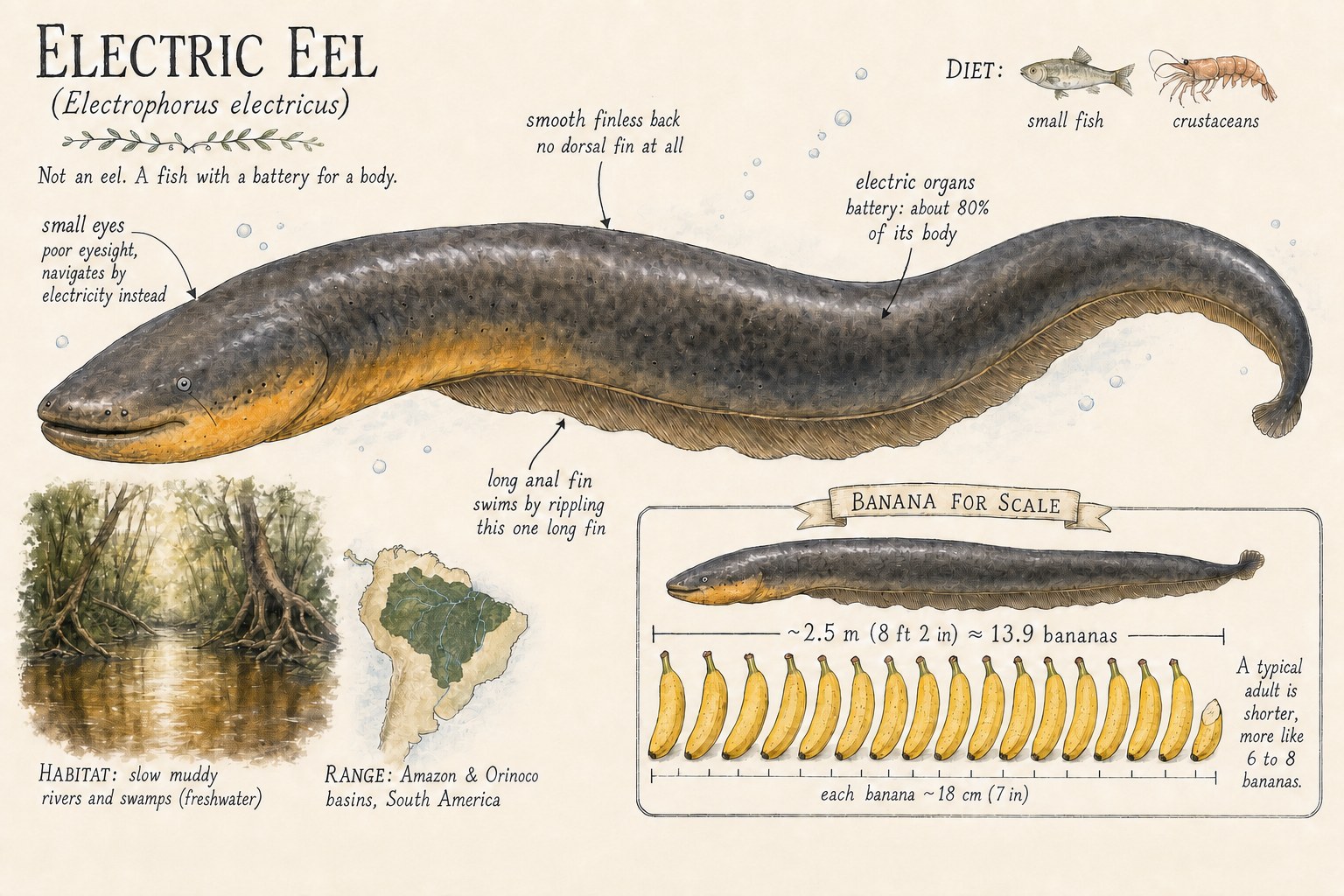
Meet the electric eel. Here's a surprise. It isn't an eel at all! It's a fish, and it's really more like a catfish in disguise. This fish lives in rivers in South America. It swims through muddy water where it's hard to see. So it uses electricity instead of eyes. Its whole tail is like a battery. It can zap prey to stun it. It can zap a scary animal to scare it away. Some electric eels even hunt in teams! A whole group swims together, herds little fish into a tight ball, then zaps them all at once.
The electric eel isn't really an eel. It's a fish, and it's actually closer to a catfish. It lives in slow, muddy rivers and swamps across South America, especially the Amazon and Orinoco basins. The water there is murky and low in oxygen. So the electric eel breathes air through its mouth instead of relying only on gills. It has to come up for a breath every few minutes.
Most of its long body, about 80 percent, is packed with electric organs. These organs work like a built-in battery. A weak pulse helps the eel sense its surroundings in the dark, almost like sonar. A strong pulse can reach about 800 volts in a typical electric eel. That's enough to stun a fish. It's also enough to make a person's muscles jump.
Electric eels usually hunt alone at night. They send out quick double pulses that make hidden prey twitch and give away its position. But in 2021, scientists studying a related species found something nobody expected. Over a hundred electric eels were living together in one small lake. At dusk, groups of two to ten eels would herd schools of small fish into a tight ball. Then they'd all shock the ball at once, sending fish flying out of the water. It was the first time anyone had documented electric eels hunting as a team.
Despite the name, Electrophorus electricus is not a true eel. True eels belong to the order Anguilliformes. The electric eel belongs to a different order entirely, Gymnotiformes, the Neotropical knifefishes, in the family Gymnotidae. Its closest relatives are South American knifefish, which makes it more closely related to catfish and carp than to any actual eel. The genus name Electrophorus comes from Greek, roughly "electricity bearer," a fitting name for a fish that is essentially shaped like a battery.
About 80 percent of the electric eel's body is given over to three specialized electric organs: the main organ, Hunter's organ, and Sachs' organ. Together they generate both weak and strong electric fields. The weak field comes mostly from Sachs' organ. It works like radar, letting the eel navigate and detect objects in murky water where it can barely see. The strong field comes from the main organ and most of Hunter's organ. That's the one used for hunting and defense.
In 2019, researchers took a closer look at what everyone had always assumed was a single species. Using genetics, skull shape, and shock strength, they split it into three separate species. There is Electrophorus electricus in the narrow sense, Electrophorus varii, and Electrophorus voltai, named for the physicist Alessandro Volta. E. voltai lives in the fast, oxygen-rich upland rivers of the Brazilian Shield. It produces discharges up to 860 volts, the strongest bioelectric output ever measured in any animal.
Hunting behavior is where the story gets genuinely strange. A hunting electric eel fires a rapid double pulse, called a doublet. That pulse makes any hidden prey twitch involuntarily and gives away its location. The eel then fires a volley of high-voltage pulses, as many as 400 per second, to fully immobilize its target. It swallows the prey whole, since it lacks the teeth to chew something still thrashing. There's an even stranger trick for bigger threats. When a large animal is only partly submerged, an electric eel can leap up out of the water and press its chin directly against it. That delivers a far more concentrated shock than it could ever manage through open water alone.
For decades, electric eels were assumed to be solitary hunters. That assumption broke down in 2012. Researchers exploring a lake connected to Brazil's Iriri River found more than a hundred adult Electrophorus voltai living together. At dusk, the eels would swim in a wide circle, herding a school of small tetras into an increasingly tight ball near the surface. Then, in coordinated bands of two to ten, the eels would break from the circle and fire simultaneous electric volleys into the ball. Stunned fish went flying into the air. Published in 2021, it remains the only confirmed case of coordinated group hunting in any electric fish. None of the three recognized species is currently considered at risk: Electrophorus electricus was listed Least Concern by the IUCN in 2009, and Electrophorus voltai got its own Least Concern assessment in 2021, while Electrophorus varii hasn't been formally evaluated yet.