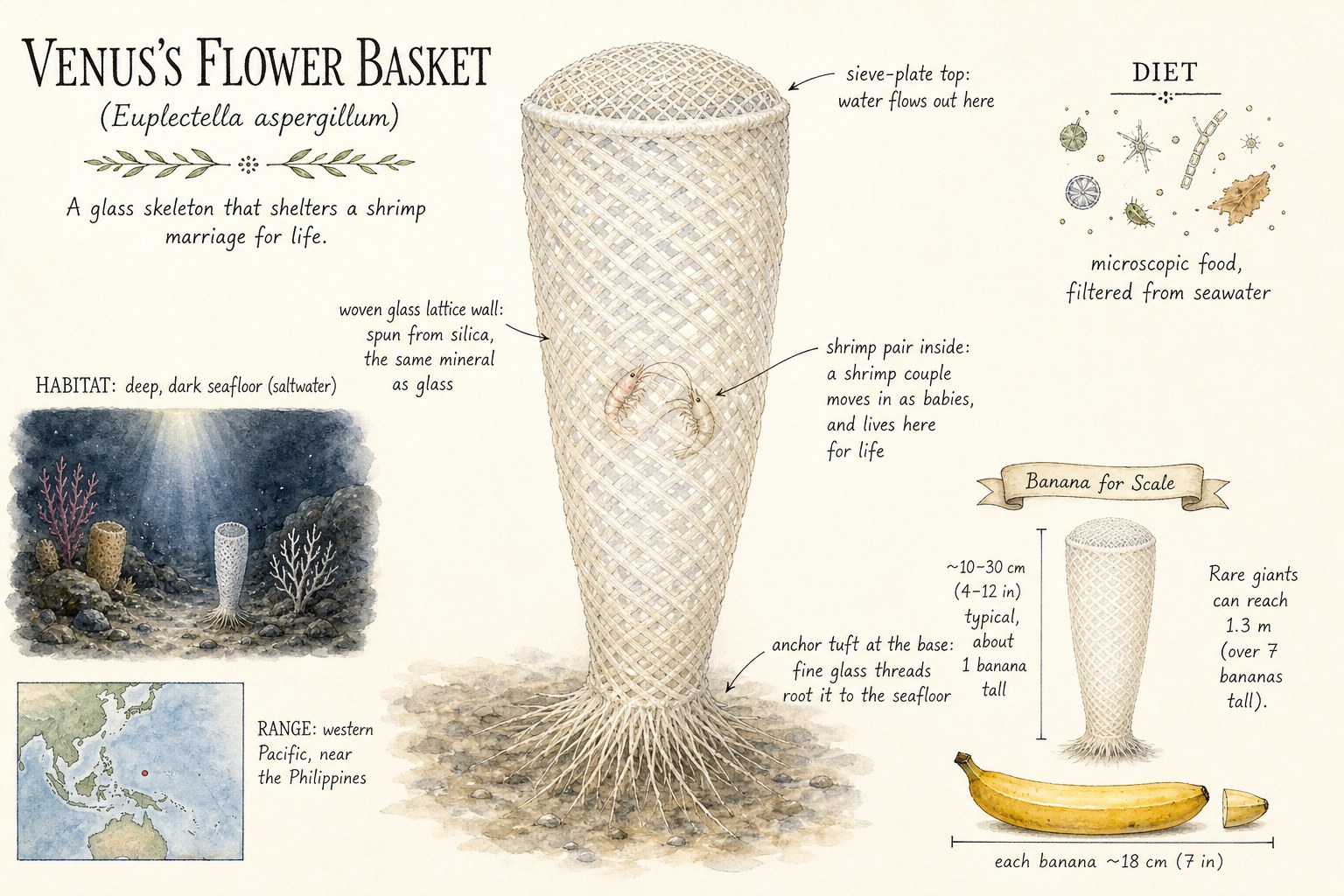
Down in the deep, dark ocean lives a sponge shaped like a glass basket. Not a kitchen sponge. A real live animal! It has no brain, no heart, and no eyes. It just sits in one spot and drinks in tiny bits of food from the water, through a body made of glassy threads. Inside its glassy walls lives a little shrimp family. A mom shrimp and a dad shrimp swim in when they are babies. They grow up, and they grow too big to swim back out! So they stay inside the glass basket together, safe from anything that wants to eat them. Some people in Japan give this glass sponge as a wedding gift. It means "together forever," just like the shrimp curled up inside.
Venus's flower basket (yoo-plek-TEL-uh ass-per-JIL-um) is a sponge, one of the simplest kinds of animal in the ocean, with no brain, no muscles, and no heart. It just sits fixed to the seafloor, pulling water through its body and straining out tiny drifting bits of food, a trick called filter feeding. Most sponges feel squishy, but this one does not. It builds its whole body out of silica, the same mineral used to make glass, into a lacy, see-through tube. Most grow 10 to 30 centimeters tall. Rare giants can top a meter.
About 100 to 1,000 meters down in the Pacific Ocean, near the Philippines, this glass tube becomes a home. A pair of tiny shrimp swims inside while they are still babies, one male and one female. As they grow, they get too big to fit back through the sponge's lattice walls. So they stay together inside for life. They clean the sponge and eat its leftover scraps. In return, the glass cage keeps bigger predators out. When the shrimp have babies of their own, the tiny young are small enough to swim free, and they go find a glass basket of their own.
That permanent shrimp partnership is why, in Japan, people have long given this sponge's dried skeleton as a wedding gift. It stands for a love that never leaves.
Euplectella aspergillum belongs to Porifera, the sponge phylum. Within it, the species sits in a strange class called Hexactinellida, the glass sponges. Ordinary sponges are held together by soft collagen fibers. Glass sponges are not. They build a rigid skeleton from six-rayed silica spicules, fused into one continuous lattice. The design is so distinctive that a dead sponge's glass frame can stand on the seafloor long after the living tissue inside has died. The genus name means roughly "well woven" in Greek, a fair description of the tube's basketwork. The species name borrows from the aspergillum, a perforated instrument used in Catholic ritual to sprinkle holy water, which the sponge's shape resembles.
A thin net of living tissue drapes over that glass scaffold. It is made of fused, amoeba-like cells called the trabecular reticulum. Whip-like flagella on cells called choanocytes drive water through the animal's body. There is no gut, no nervous system, and by most definitions no true organs. Water enters through thousands of tiny pores, gets filtered for bacteria and organic debris, and exits through one large opening at the top, called the osculum. It is a body plan that predates brains and hearts by hundreds of millions of years, and it still works.
The most studied part of Euplectella is its skeleton's optical behavior. In 2004, materials scientists led by Joanna Aizenberg at Bell Labs published a study in the Proceedings of the National Academy of Sciences. They found that the sponge's largest spicules, called basalia, are built almost exactly like man-made fiber-optic cable. Each has a pure silica core wrapped in a lower-density cladding layer, which keeps light bouncing down the fiber's length instead of leaking out. Commercial fiber is drawn at extreme heat and shatters if bent too far. These biological fibers grow at cold, ocean-bottom temperatures, and you can tie one in a knot without breaking it.
The sponge's most famous relationship is with a pair of glass sponge shrimp, genus Spongicola. The shrimp enter the sponge's central cavity as free-swimming larvae. Once they mature, they are simply too large to pass back out through the lattice. A single male and female typically end up sealed inside together for life. They shelter from predators, feed on detritus, and help keep the sponge's interior clean. Their offspring are born small enough to slip out, and they disperse to find baskets of their own. In Japan, a dried Euplectella skeleton, sold with its resident shrimp skeletons still inside, has long been given as a wedding gift, a physical symbol of a bond that lasts until death.
Little else about this species' life history has been confirmed, including something as basic as how long one individual actually lives. Almost everything about Euplectella aspergillum happens hundreds of meters down, in total darkness, far from easy observation, which is exactly why a sponge nobody can casually visit ended up teaching materials scientists something new about fiber optics.