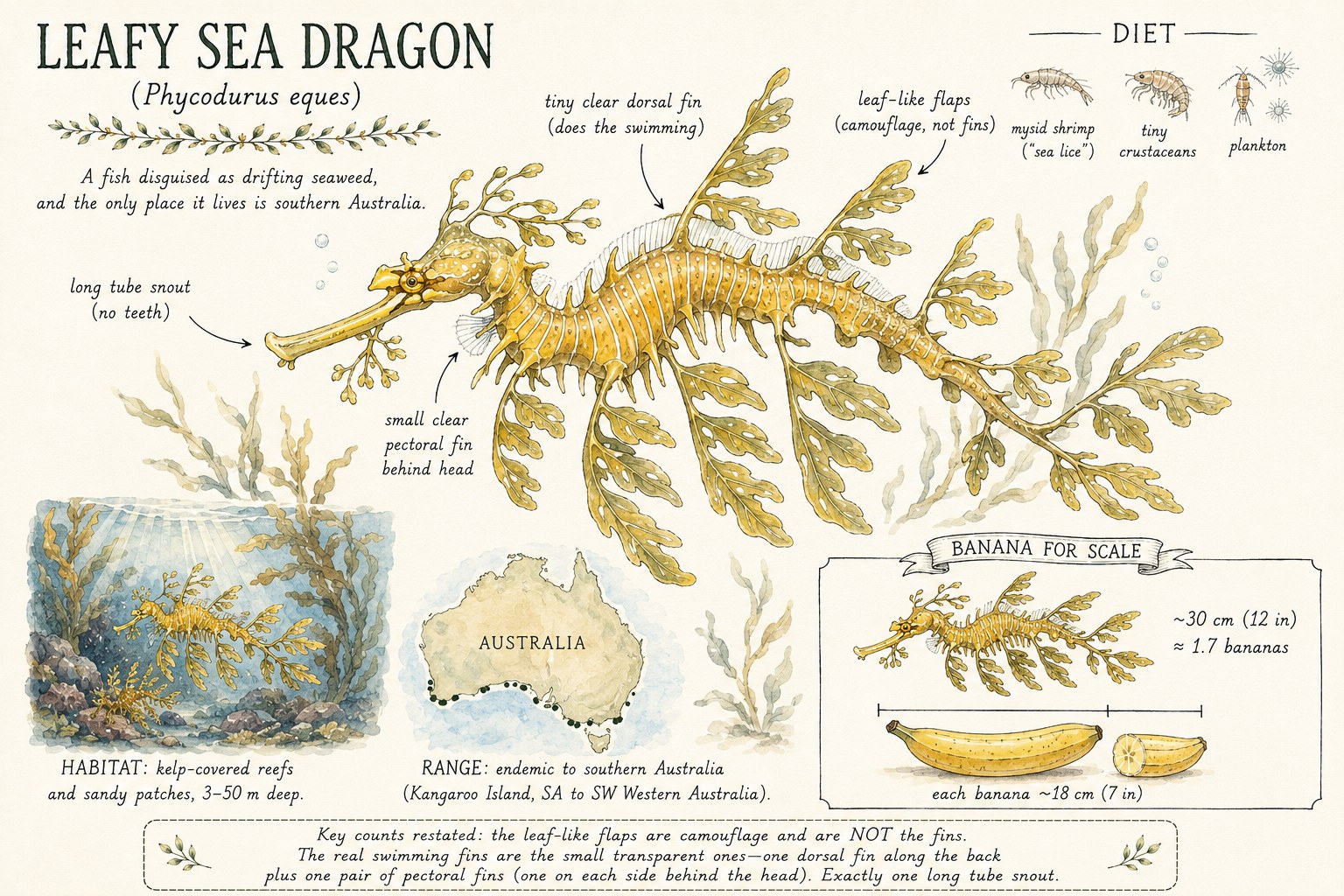
Meet the leafy sea dragon. It is a fish, but it looks just like a piece of floating seaweed. All those leafy flaps on its body are not for swimming. They are a costume! They help it hide, because it looks like a drifting bit of weed and not like a fish at all.
So how does it move? It has tiny see-through fins, so tiny you can barely see them. One little fin flutters on its back. Two more flutter near its head. They wiggle super fast, and the sea dragon glides along, slow and quiet, like a leaf on the water.
It has no teeth. Not one! It has a long snout shaped like a straw. It finds teeny shrimp and slurps them right up. Sluuurp.
Here is the best part. The dad carries the babies. A mama sea dragon gives him a big bunch of bright pink eggs, and he keeps them safe on the bottom of his tail until they hatch. Then out swim the tiny sea dragons, ready to hide in the seaweed too.
The leafy sea dragon is a fish that has turned itself into a lie. Its body is covered in leaf-shaped flaps of skin, and those flaps look exactly like the kelp and seaweed it lives around. The trick is that the leaves do not move it at all. They are pure disguise. When a leafy sea dragon drifts past, predators and even hungry sea dragons see floating weed instead of a meal.
So what actually does the swimming? Two sets of fins so thin they are nearly clear. A single fin runs along its back, and a small fin sits on each side of its head, near the neck. These fins beat very fast, sometimes dozens of times a second, but they are almost invisible. The animal seems to float along on its own, moving without any obvious effort.
A leafy sea dragon has no teeth and no stomach. It eats through a long, pipe-shaped snout that works like a turkey baster. It points that snout at a tiny shrimp called a mysid, also nicknamed a sea louse, and sucks it straight in. Because it has no stomach to store a meal, it has to keep hunting almost all day long.
The strangest habit belongs to the fathers. When it is time to breed, the female presses about 250 bright pink eggs onto a spongy patch on the underside of the male's tail. He carries them there for around four to six weeks, until they hatch into tiny sea dragons that must fend for themselves right away. Leafy sea dragons live in only one place on Earth, the cool coastal waters of southern Australia, and they are the official marine emblem of the state of South Australia.
The leafy sea dragon (Phycodurus eques, fy-koh-DYOO-rus EK-wayss) belongs to the family Syngnathidae (sing-NATH-ih-dee), the same group that holds the seahorses and pipefishes. Like its relatives, it has a body encased in bony rings and a long tubular snout instead of jaws. What sets it apart is the extravagant set of leaf-shaped appendages growing from its body, structures that mimic the fronds of the kelp and seaweed it lives among. Divers have swum straight past leafy sea dragons without noticing them, and that is the whole point.
Those leaves do no work when it comes to movement. Propulsion comes entirely from two nearly transparent fins: a dorsal fin along the back and a pair of pectoral fins set just behind the head. The fins beat rapidly and are so clear against the water that the animal appears to drift rather than swim, holding its seaweed disguise even while in motion. It is one of the most complete examples of camouflage in the ocean, fooling both the shrimp it hunts and whatever might hunt it.
Feeding is built around a snout that works like a pipette. Leafy sea dragons have no teeth and no true stomach, so they draw small crustaceans, mainly mysid shrimp (MY-sid, sometimes called sea lice), in through the snout and swallow them whole. With no stomach to hold a store of food, they feed almost continuously through the day. Adults reach roughly 30 to 35 centimeters (about 12 to 14 inches).
Reproduction follows the syngnathid pattern of male care, taken to a vivid extreme. The female transfers about 250 bright pink eggs onto a spongy brood patch on the underside of the male's tail, where they are fertilized and embedded in the tissue. The male broods them for roughly four to six weeks and then releases fully formed, independent young. The species is endemic to the temperate coastal waters of southern Australia, from around Kangaroo Island in South Australia west to the coast of south-western Western Australia, usually over sandy patches near kelp reefs between about 3 and 50 meters deep.
The IUCN Red List assessed the leafy sea dragon as Least Concern in 2016, an improvement in outlook from earlier concern. It was not always so secure. Heavy collection for the aquarium trade drove numbers down badly enough that Australia gave the species full legal protection in the early 1990s, and habitat loss and pollution along the southern coast remain real pressures. For an animal that survives by looking like something it is not, the leafy sea dragon has become one of the most recognizable fish in the sea, and a point of pride for the state that made it an emblem.