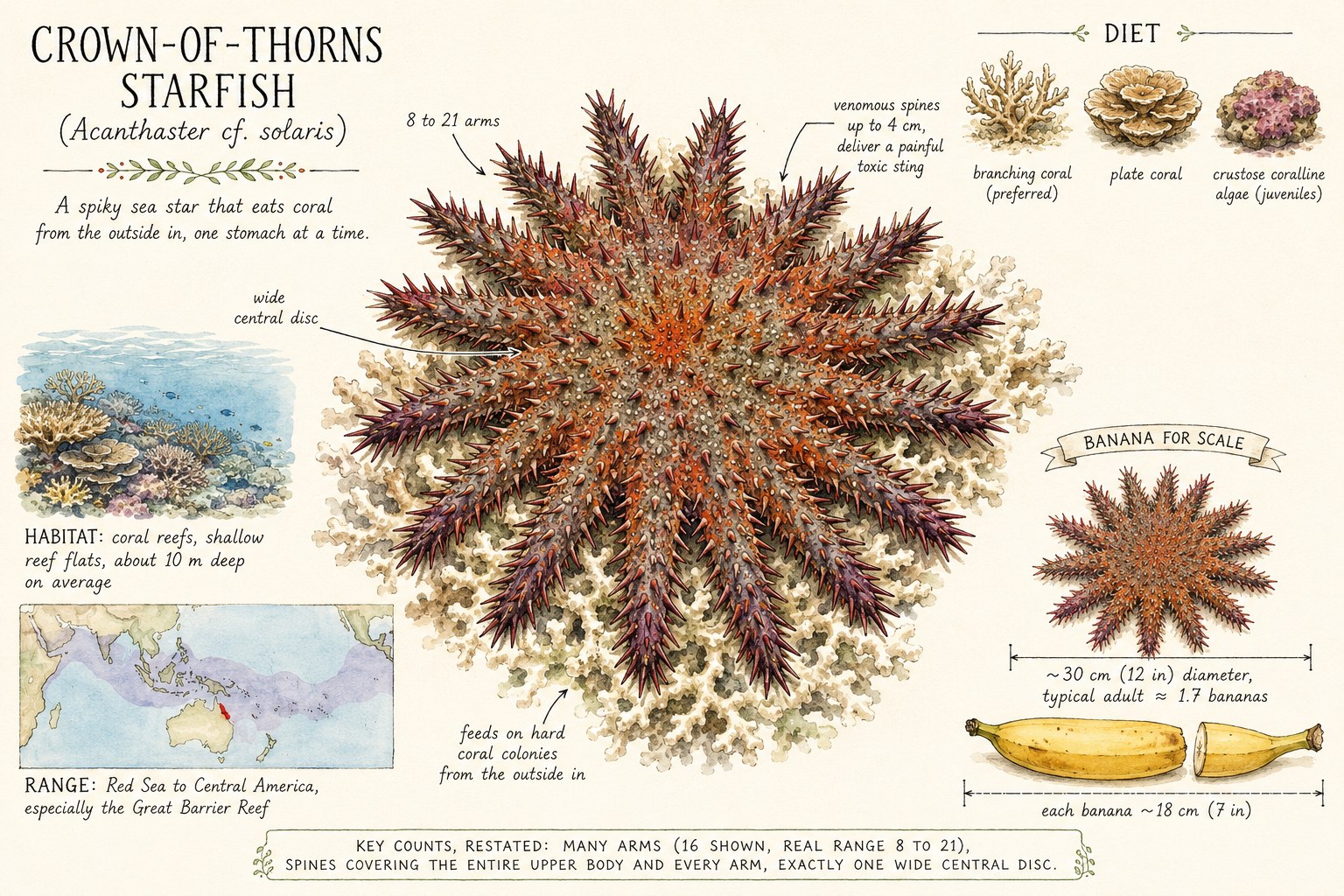
The crown-of-thorns starfish is not your ordinary beach starfish. It is a sea star, part of the same animal group as the five-armed stars you find in tide pools, but this one is much bigger and much spikier. It can grow arms all around a body as wide as a trash can lid. Its whole back is covered in long, sharp, purple-tipped spines, like a pincushion that learned to crawl. Those spines are not just for show. Touch one and it hurts, a lot, so divers know to stay away. Here is the strange part. This starfish eats coral. It climbs on top and pushes its own stomach out of its body, right onto the coral, like a blanket made of juice. Then it slurps the coral up from the outside in. One starfish alone barely dents a reef. But sometimes thousands of them show up at once, and that is when a healthy coral reef can turn gray and bare in just a few months.
The crown-of-thorns starfish is an echinoderm. That's the sea-star group, the same one as the little five-armed stars you find at the beach. This one is built bigger and spikier. It grows anywhere from about 8 to 21 arms around a wide body. Its whole back bristles with thick spines up to 4 centimeters long, and those spines carry venom. Step on one by accident and a broken-off spine can hurt for days.
What makes this starfish famous is not the spines, though. It's what it eats. As an adult, it feeds almost only on living coral. It pushes its own stomach out through its mouth and drapes it over the coral like a wet cloth. Then it digests the coral animals right where they sit, and pulls its stomach back inside when it's done. One adult can strip clean about 10 square meters of coral in a year. That's roughly the floor space of a small bedroom.
A single starfish grazing here and there barely matters to a reef. Real trouble starts when huge numbers show up together. Scientists call this an outbreak. One large female can release more than 200 million eggs in a single summer. When ocean conditions let more of those eggs survive than usual, a reef with a handful of starfish can suddenly have thousands. Outbreaks like this have hit Australia's Great Barrier Reef again and again since the 1960s. A new one is spreading through its northern reefs again this year. That's exactly why researchers are watching this animal so closely right now.
The crown-of-thorns starfish is not, strictly speaking, one species. For decades biologists lumped every population across the Indo-Pacific under a single name, Acanthaster planci. Genetic studies in the last fifteen years split that name apart. There turn out to be at least four or five closely related species: true A. planci in the Indian Ocean, a separate species in the Red Sea, one near the Americas, and the population on Australia's Great Barrier Reef, provisionally named Acanthaster cf. solaris (the "cf." flags that taxonomists are still confirming the match). Popular sources still often say "Acanthaster planci" as a catch-all term. This card flags that shorthand rather than quietly repeating it.
Whatever its exact species name, the Great Barrier Reef population is an echinoderm, in the class Asteroidea alongside every other sea star. It is built for one job: eating hard coral fast. It hunts by climbing onto a coral colony and everting its stomach through its own mouth, directly onto the coral tissue. Digestive enzymes liquefy the coral polyps for absorption, a feeding style shared with many sea stars but rarely used at this scale. An average adult clears roughly 478 square centimeters of living coral tissue per day. A reef under a full outbreak can lose up to 90 percent of its coral cover.
The venom is a real defense, not folklore. Long spines, sometimes reaching four centimeters, deliver a chemical cocktail. Plancitoxins can damage liver tissue. Saponins destroy red blood cells on contact. That combination deters most reef fish, but not all of them. Triggerfish, pufferfish, and the giant triton sea snail (Charonia tritonis) all still prey on adults. The triton is so effective against this species that protecting triton populations has become its own conservation goal.
Outbreaks remain a genuinely unsettled scientific question. Researchers largely agree that periodic booms are a natural part of Great Barrier Reef ecology, visible in the sediment record long before modern farm runoff existed. But most also agree that nutrient pollution, which feeds the phytoplankton that starfish larvae eat, and decades of overfishing starfish predators have likely made outbreaks more frequent and more severe than they once were. Managers now run a targeted culling program: divers inject individual starfish with bile salts, reef by reef. In 2025, researchers reported early success using synthetic starfish pheromones to lure and concentrate animals for faster, cheaper removal, a genuinely new tool against an old, recurring problem.