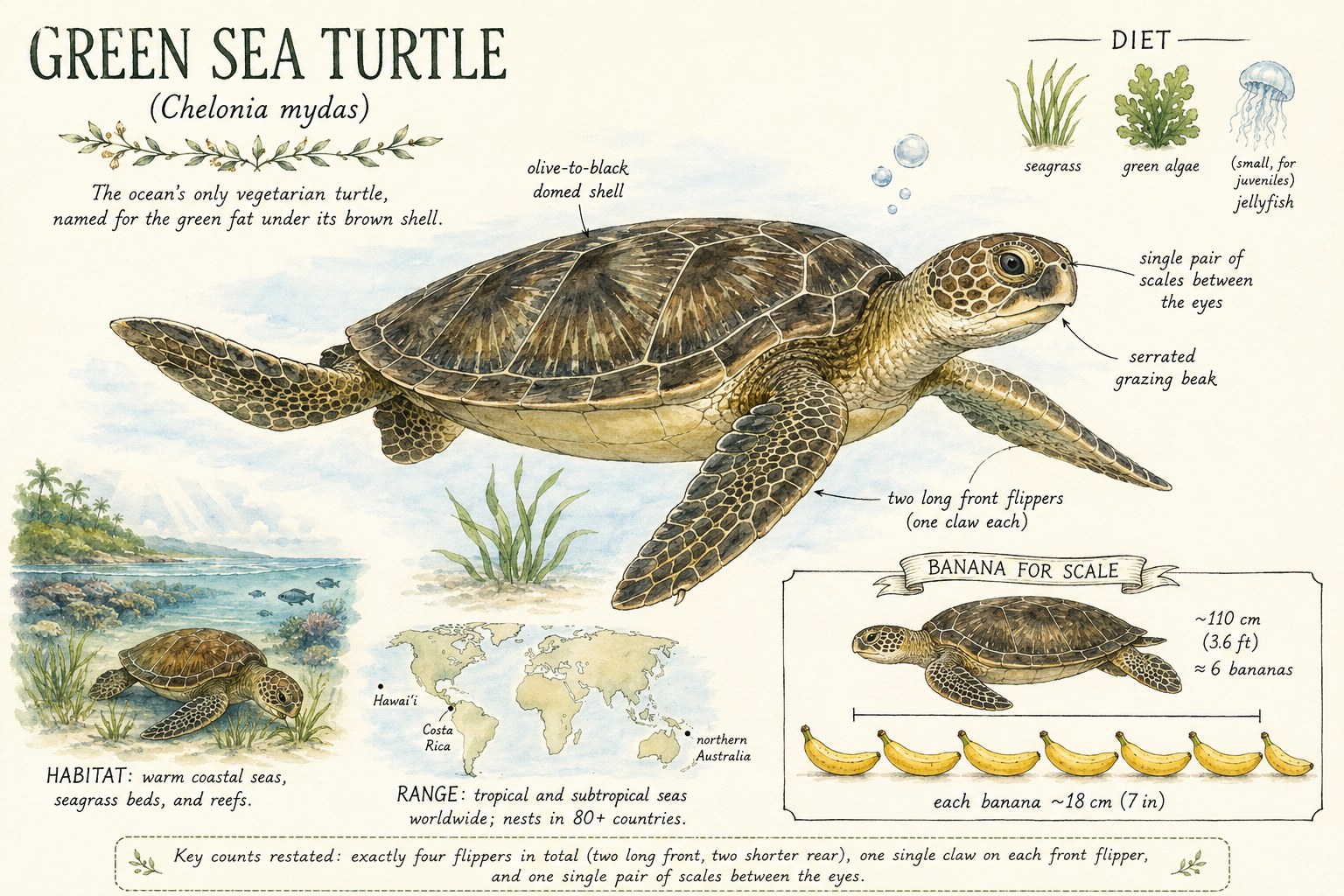
Say hello to the green sea turtle. It is big and round, and it flies through the water using two long front flippers, like wings. It is a reptile, a cousin of snakes and lizards. It waves them up and down, and off it goes. Green sea turtles are not really green on the outside. Their shell is brown, or grey, or almost black. The green part is hidden inside them, in their fat, and it comes from all the plants they eat. A grown-up green turtle is a plant eater. It munches sea grass on the sea floor, snip snip snip, like a cow in an underwater field. That is why some people call it the sea cow of the reef. Here is the best part. When a mama turtle is ready to lay her eggs, she swims all the way back to the very same beach where she was born. She might travel for weeks to get there. How does she find it? She can feel the Earth like a giant magnet, and it points her home. She digs a nest in the warm sand, lays her round white eggs, and covers them up. Then the baby turtles hatch at night and race down to the sea.
The green sea turtle is the biggest hard-shelled turtle in the sea. A grown one measures 3 to 4 feet across its shell and can weigh 300 pounds or more, about as much as a big refrigerator. It is also the only sea turtle that eats like a vegetarian. Baby greens will snack on jellyfish and tiny animals, but once a green turtle grows up, it switches to a diet of seagrass and algae. Its jaw even has a finely toothed edge, like a bread knife, perfect for snipping blades of grass off the sea floor.
That diet is where the name comes from, and it fools almost everyone. A green turtle's shell is not green. It is brown, olive, or nearly black. The green is on the inside, in a layer of fat that turned greenish from a lifetime of eating plants.
Now for the real magic trick. A female green turtle almost always returns to nest on the same beach where she hatched, even if she has to swim across a whole ocean to reach it. Scientists think she does this by reading the Earth's magnetic field. Every stretch of coastline has its own faint magnetic signature, and a turtle seems to memorize the one at her home beach when she is a hatchling, then find it again decades later. Something else strange happens in the nest itself. The temperature of the sand decides whether an egg becomes a male or a female. Warm sand makes mostly females, and cooler sand makes mostly males.
The green sea turtle (Chelonia mydas, kel-OH-nee-uh MY-dass) is the largest of the hard-shelled sea turtles, and the only one that grazes as an adult. Young greens are omnivores that drift in the open ocean, eating jellyfish and small animals. Once they settle onto shallow coastal feeding grounds, they switch almost entirely to seagrasses and algae. A green turtle crops the same seagrass beds over and over. That keeps the blades short and growing, so the animal really does tend its own pasture. The name is a bit of misdirection. The shell is olive to nearly black, but the body fat carries a greenish tint from that plant diet, and the fat is what earned the species its name.
Like all sea turtles, greens cannot flush concentrated salt through their kidneys. Instead they run it out through large salt glands behind the eyes. On land a nesting female looks like she is weeping, and those thick tears are really her way of dumping the sea. Sex is not fixed by chromosomes here. It is set by heat. Under temperature-dependent sex determination, eggs in warmer sand tend to become female and eggs in cooler sand tend to become male. Above roughly 29 degrees Celsius, most hatch as females, which makes the species quietly vulnerable to a warming climate.
The navigation is the headline act. Females show strong natal homing. They return to nest on or near the beach where they hatched, sometimes after crossing thousands of kilometers of open sea. The leading idea is geomagnetic imprinting. A hatchling seems to learn the unique angle and strength of Earth's magnetic field at its home beach. Years later it uses that magnetic signature like an address to steer back. A female may nest several times in a season, laying around 100 to 120 eggs per clutch, then skip a year or two before making the trip again.
The conservation story took a historic turn very recently. In October 2025, at the IUCN World Conservation Congress in Abu Dhabi, the global green turtle assessment jumped from Endangered, where it had sat since 1982, straight to Least Concern. It skipped the categories in between. The change rests on roughly a 28 percent rise in the global population since the 1970s. That is the payoff from decades of guarding nesting beaches, curbing the egg and meat trade, and fitting trawl nets with turtle excluder devices. The recovery is real but uneven. The United States still lists green turtle populations as Endangered or Threatened under its own Endangered Species Act, and some regional groups, like the Southwest Pacific rookery at Raine Island, are still losing hatchlings as rising seas flood their nests.