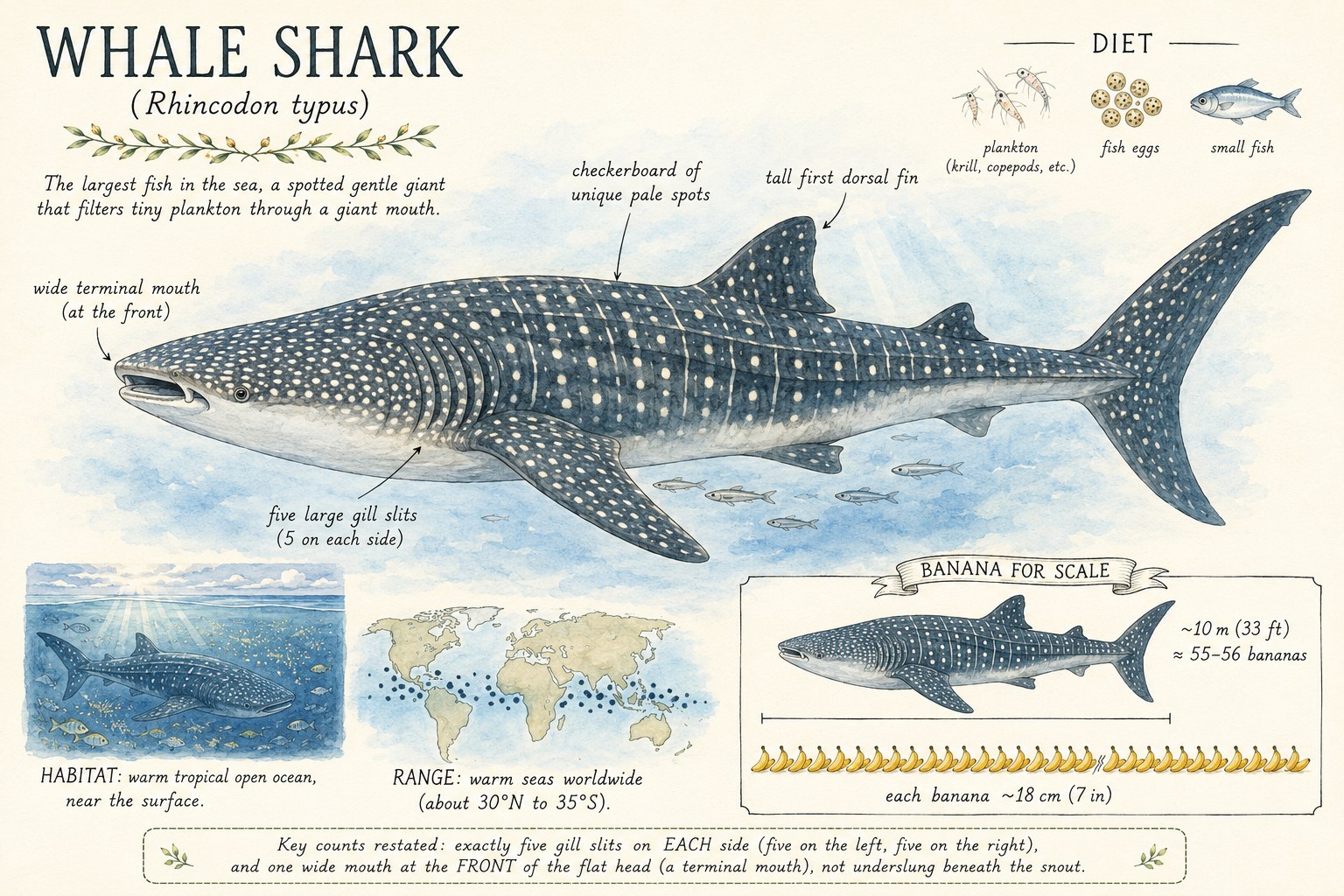
Meet the whale shark. It is not a whale at all. It is really a shark, and it is the biggest fish in the whole wide sea. It is as long as a school bus, with soft grey skin covered in pale spots and stripes. Every single whale shark has its very own pattern of spots, just like you have your own fingerprints. No two are ever the same. Its mouth is enormous and wide. But do not worry one bit. This gentle giant only eats teeny, tiny food. It swims along with its big mouth open and gulps in mouthfuls of water full of little floating specks. Then it pushes the water back out and keeps the food inside. It has thousands of little teeth, but it never bites a soul. It is slow and gentle and calm. It just glides through the warm blue water, spot by spot by spot.
The whale shark is the largest fish alive today. A large adult can stretch 33 to 39 feet long, roughly the length of a school bus, and weigh as much as 20 tons. Remember, it is a shark, not a whale. The "whale" in its name only points to its enormous size.
For such a giant, it eats surprisingly small meals. A whale shark is a filter feeder. It swims forward with its wide mouth open, taking in huge gulps of seawater packed with plankton, tiny fish, and fish eggs. Then it pushes the water out through its gills, and special sieve-like pads called gill rakers trap the food inside. It carries around 3,000 tiny teeth, but it does not use them to eat at all.
Here is the neat part. Every whale shark wears a pattern of pale spots and stripes, and no two patterns are exactly alike. Scientists photograph the spots behind the gills and use them like a fingerprint to tell one shark from another. They even borrowed a computer program first built to map stars in the night sky to help match the patterns.
The whale shark (Rhincodon typus) is the only living member of the family Rhincodontidae and the largest fish on Earth. The name comes from Greek and means roughly "rasp tooth," after the file-like rows of tiny teeth in its jaws. It belongs to the order Orectolobiformes, the carpet sharks, which makes this ocean giant a close relative of the small, bottom-dwelling wobbegongs. Reliable measurements run to about 12 meters (39 feet), and the largest well-documented individual reached 18.8 meters.
Despite its size, it lives on some of the smallest food in the sea. It feeds by ram and suction filtration, either cruising forward with its mouth agape or hanging almost vertically and drawing in mouthfuls of plankton-rich water. The catch, everything from copepods and shrimp to fish eggs and small schooling fish, is strained out against modified gill rakers while the water flows away through five large gill slits on each side. Its roughly 3,000 teeth play no role in feeding.
Reproduction stayed a mystery for a long time. Whale sharks are ovoviviparous, meaning the eggs develop and hatch inside the mother, who then gives birth to live young. Much of what we know comes from a single female caught off Taiwan in 1995, nicknamed "megamamma," who carried around 300 embryos at different stages of development. That litter showed the species can store sperm and produce pups over time rather than all at once.
Each shark carries a unique constellation of spots, and researchers have turned that into a tracking tool. In 2005 a marine biologist and a NASA astrophysicist adapted an algorithm originally designed to match star fields in Hubble Space Telescope images, using it to match the spot patterns behind a whale shark's gills. The system lets scientists and divers identify individuals from photographs in a global database, following the same animal as it migrates thousands of miles.
That tracking matters, because the species is in trouble. The IUCN listed the whale shark as Endangered in 2016, raising it from Vulnerable after estimates of steep population declines over the past three generations. Slow to mature and prized in some fisheries for its fins and meat, it is also struck by ships and tangled in gear. It is a wide-ranging, warm-water animal that gathers at seasonal feeding sites around the world, which is exactly where people work hardest to protect it.