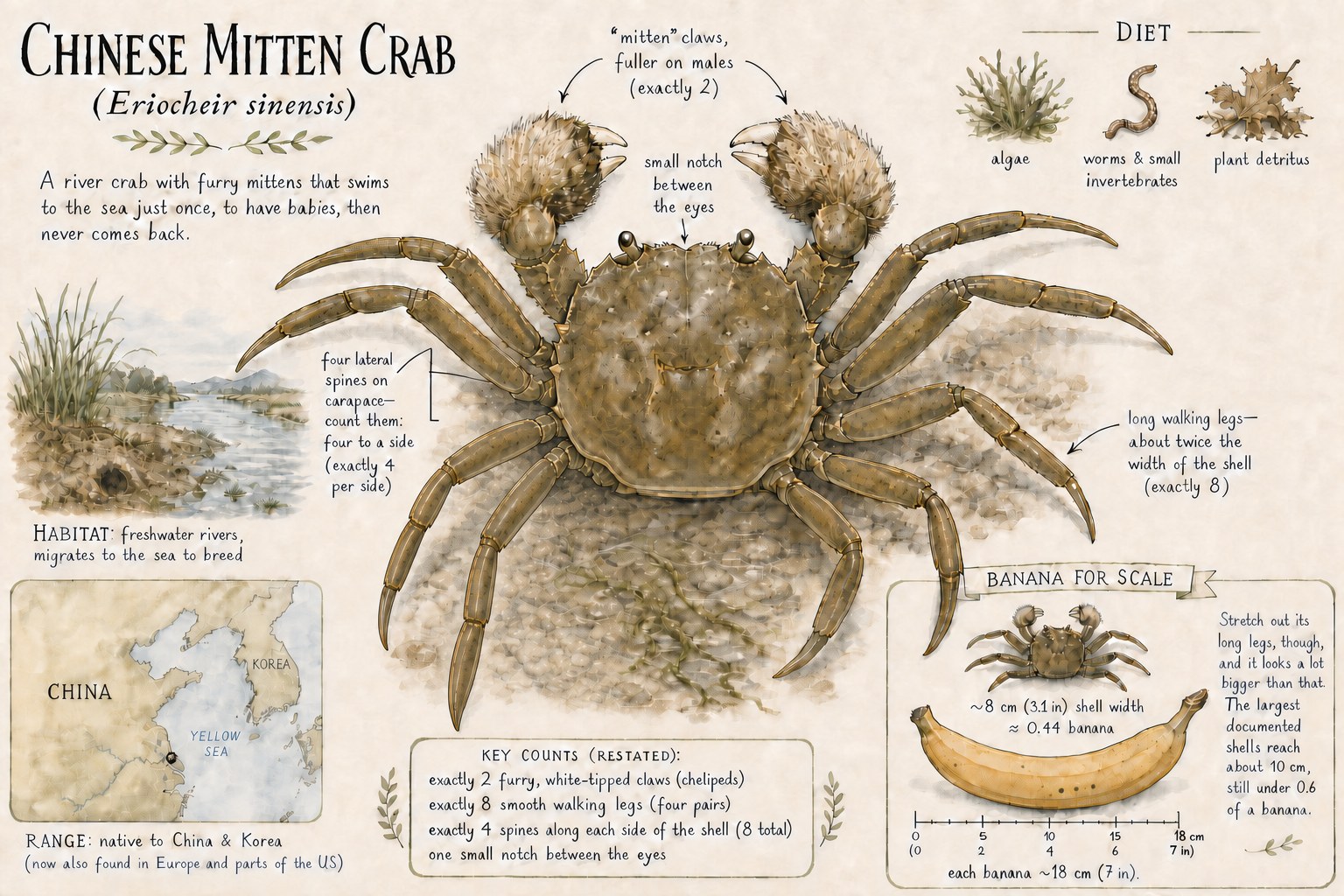
Meet a little crab wearing two fuzzy white mittens. Its real name is the Chinese mitten crab, and it's a crustacean, the same family as shrimp and lobsters. This crab grows up hiding in muddy burrows along a riverbank. Then one day, it does something amazing. It walks. Not just underwater. Right up onto dry land, across grass, even across a road, all the way to the sea. Once it gets there, it finds a mate and has babies. Then, its job done, it dies. But its tiny babies drift back up the river on their own, ready to grow up and make the very same journey one day. This crab is small. Its shell is smaller than half a banana! But stretch out its two furry claws, and it looks like it's wearing giant, fuzzy boxing gloves.
The Chinese mitten crab is a crustacean, part of the crab-and-shrimp group of animals. It's easy to spot. Both claws are covered in dense, bristly hair with white tips. They look like a pair of fuzzy mittens. That's exactly how the crab got its name. Adults are surprisingly small, though. Its shell is usually about 80 millimeters across, a little over 3 inches. That's less than half the length of one banana. Stretch out its long legs, though, and it suddenly looks a lot bigger.
Most river crabs stay in rivers their whole lives. Not this one. The Chinese mitten crab spends years growing up in fresh water. Then it migrates all the way down to the salty sea to breed. Some crabs travel over 1,000 kilometers, about 620 miles, to get there. That's the reverse of a salmon. A salmon is born in a river, grows up in the ocean, then swims back upstream to have babies. This crab does the opposite. When its path is blocked by a dam or a wall, it doesn't turn around, either. It climbs out of the water. Then it simply walks around the obstacle on land, sometimes for weeks, before sliding back in.
Once a female reaches the sea, she can carry a huge number of eggs, anywhere from about 50,000 to over a million. It depends on her size, and on which study you check. Soon after mating and releasing her eggs, both the mother and father crab die. It's the only chance at reproducing they ever get. Their eggs hatch into tiny swimming larvae. The larvae drift with the current, then settle down and crawl back upstream. There, they start the whole cycle over again.
The Chinese mitten crab comes from rivers in China and Korea that drain into the Yellow Sea. It has hitchhiked around the world in the ballast water of ships since at least 1912, when the first one turned up in Germany. It has caused problems in Europe for over a century. It has lived in California's San Francisco Bay since 1992, too. Its burrowing weakens riverbanks and levees. In 1998, so many crabs swarmed through California's water systems that officials built a machine nicknamed Crabzilla, just to scoop them off the intake screens.
The Chinese mitten crab (Eriocheir sinensis) is a decapod crustacean. That puts it in the order Decapoda, alongside true crabs, shrimp, and lobsters. It sits in the family Varunidae. That's a fairly recent change: genetic studies moved it out of the older family Grapsidae, once biologists realized the group deserved its own rank. Its genus name comes from Greek: erion means wool, cheir means hand. Put together, Eriocheir means wool-hand. The species name, sinensis, simply means of China. Both names describe the same thing a five-year-old notices first. Dense, bristly setae cover both claws, fuller on males than females, and they look exactly like a pair of fuzzy mittens.
Most crabs spend their whole lives in one kind of water. This one doesn't. Eriocheir sinensis is catadromous: it matures in fresh water, then migrates to the sea to spawn. That's the mirror image of an anadromous fish like salmon. Individual crabs have been collected more than 1,000 kilometers from the open sea. Total migratory distances of up to 1,500 kilometers, about 930 miles, have been reported. Maturity itself is slow and variable. It often takes one to five years, depending on water temperature. A spawning female may release anywhere from about 50,000 to over a million eggs. That wide range reflects both her size and disagreement between older and newer studies. Both sexes die within days of reproducing. It's an entirely semelparous life history: one migration, one mating season, then death. Meanwhile, the larvae drift back upstream on their own, ready to begin the cycle again.
Few crabs are this stubborn about reaching the sea. When a dam, weir, or concrete wall blocks its path, a mitten crab simply climbs out of the water. It walks overland around the barrier. It can tolerate about 35 days out of water in a damp meadow before it needs to submerge again. In 1998, juvenile mitten crabs surged through California's Sacramento-San Joaquin Delta by the hundreds of thousands, nearly a million in a single season. State and federal agencies built a purpose-made machine to deal with them, nicknamed Crabzilla: an eighteen-foot-tall revolving screen at a fish-salvage facility. It scooped crabs off the intake screens so they could be trucked away and ground into fertilizer.
The species is native to the coastal rivers of China and Korea that empty into the Yellow Sea. It first reached Europe by ship. The earliest confirmed record comes from Germany's Aller River, in 1912, though nobody identified it correctly until 1923. It spread through the Elbe, Weser, Rhine, and Oder within a couple of decades. It has anchored one of the continent's longest-running invasive species stories ever since. Genetic work on the San Francisco Bay population, established since 1992, traces those crabs back not directly to China, but to Europe's already-established population. It's an invasion seeded by an earlier invasion. In the United States, it's federally listed as an injurious species under the Lacey Act, and regulated in at least seventeen states. That's largely because its burrowing destabilizes riverbanks and levees, and its migrating swarms have clogged fish-passage screens, water intake pipes, and commercial fishing nets.
The Chinese mitten crab has never been formally evaluated by the IUCN Red List, which tracks extinction risk. So there's no conservation status to report, in that sense. It appears instead on a very different IUCN-affiliated list: the Global Invasive Species Database's 100 of the World's Worst Invasive Alien Species. That's a measure of ecological disruption, not rarity. There's a real health note too, behind its old reputation as a delicacy in parts of Asia. Raw or undercooked crabs can carry the Oriental lung fluke, Paragonimus westermani (called P. ringeri in some older literature, the same species under an earlier name). It's a parasite that can infect the human lung. That's why food safety guidance in affected regions calls for cooking mitten crabs thoroughly before eating them.