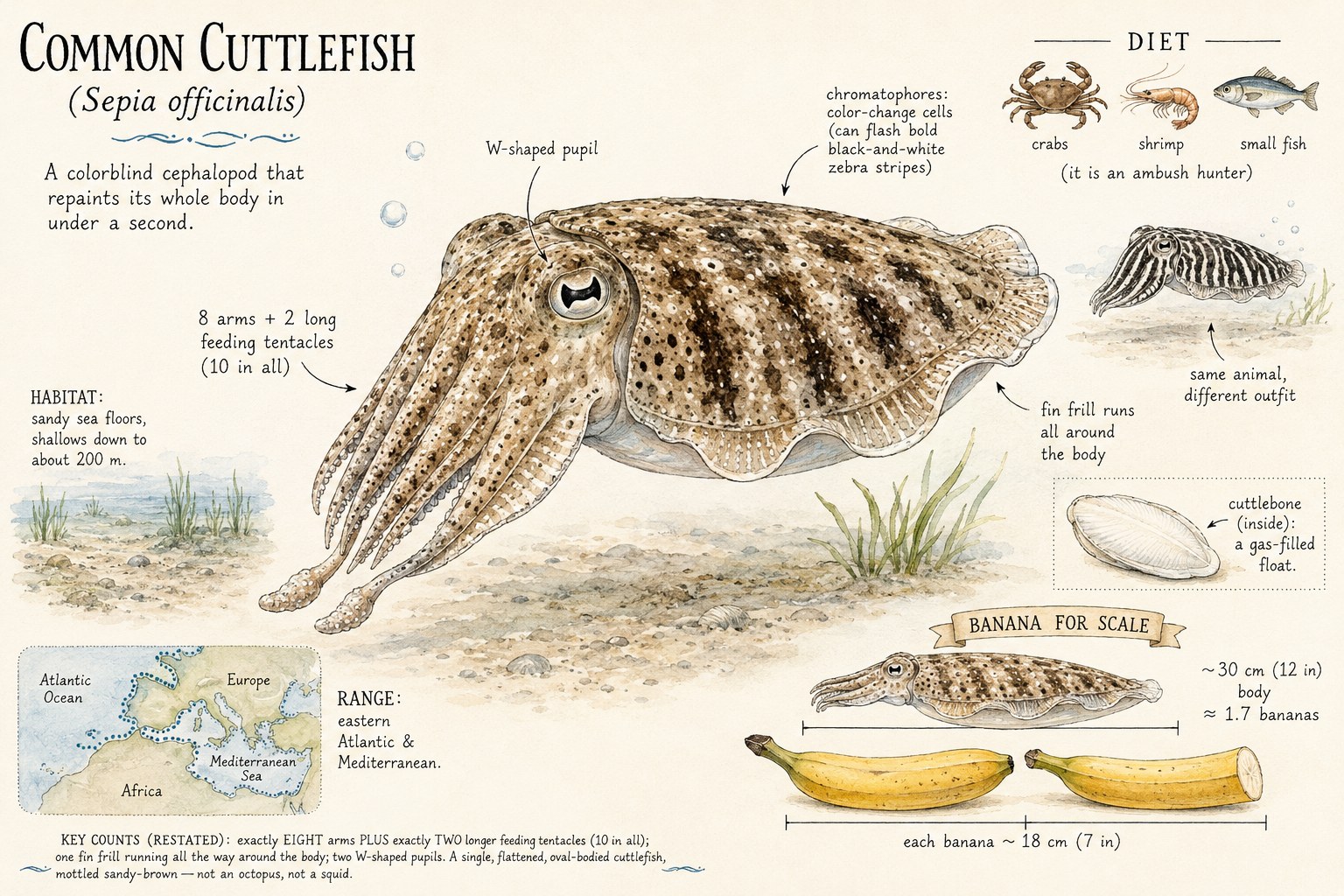
Meet the cuttlefish. It looks a little like a squished octopus with a frilly skirt, but it has its own name and its own magic. A cuttlefish is not a fish at all. It is a cephalopod, part of the octopus and squid family. It has two big eyes, eight arms, and two long tentacles for grabbing food. But here is the amazing part. A cuttlefish can change color in less than a second! One second it is sandy brown. Blink, and it turns stripy. Blink again, and its skin goes bumpy to match a rock. It does this to hide, so a hungry fish swims right past. And now the silliest part of all. The cuttlefish is colorblind. It cannot even see the colors it is making. Somehow it hides in plain sight, wearing colors it has never seen.
The common cuttlefish is a cephalopod, the same animal group as octopuses and squid, and it is one of the best quick-change artists in the sea. Its skin is packed with tiny color sacs called chromatophores (KROH-mat-oh-forz). Each one is a little bag of colored ink wrapped in muscle, wired straight to the brain. When the cuttlefish squeezes them, the colors spread; when it relaxes them, the colors shrink. Under those are mirror-like cells that bounce light. Together they let the animal repaint its whole body in well under a second. It can even change how bumpy or smooth its skin looks.
Here is the strange twist. A cuttlefish is colorblind. Human eyes have three kinds of color sensor, but a cuttlefish has only one, so it cannot see color the way you do. Scientists are still working out how it matches a rock or a patch of sand so well without seeing the colors it copies. One clue is its odd W-shaped pupil. That shape may help it read the brightness and texture of everything around it.
The cuttlefish is a hunter, and camouflage is how it sneaks up close. It drifts over the sandy bottom looking like nothing at all, then fires out its two long tentacles to snatch a crab, a shrimp, or a small fish before the prey knows it is there. It even carries a hidden gadget inside its body: a chalky, gas-filled shell called a cuttlebone that works like a tiny submarine tank, helping the animal float or sink. And its blood is not red like yours. It is blue-green.
The common cuttlefish (Sepia officinalis, SEE-pee-uh off-ih-sih-NAH-liss) is a cephalopod, a mollusk in the same class as octopuses and squid, and a relative of the clams and snails from the same great phylum. Its genus name is worth keeping. Sepia is the old Greek word for cuttlefish, and the brown ink the animal squirts became a pigment that artists used for centuries. The color "sepia," the warm brown of old photographs, is named after this animal's ink.
Its most famous talent is dynamic camouflage. The upper layer of the skin holds thousands of chromatophores, elastic sacs of yellow, red, and brown-black pigment, each ringed by muscles under direct control of the brain. Below them sit reflecting cells, leucophores and iridophores, that scatter and bend light. By expanding and contracting the chromatophores while tuning the reflectors underneath, and by raising three-dimensional bumps in the skin called papillae, a cuttlefish can transform its color, pattern, and texture in a fraction of a second. Researchers at the Marine Biological Laboratory have filmed one settling onto sand, then rock, then a bed of shells, matching each in turn.
The paradox is that the animal is colorblind. Where a human retina carries three types of color receptor, the cuttlefish carries a single type, which should make it monochromatic. How it produces such accurate color matches to backgrounds it apparently cannot see is still debated. One leading idea ties it to the eye's odd W-shaped pupil and the way different wavelengths focus at slightly different depths, which might let a single-receptor eye tease color from blur.
The rest of its body is just as unusual. A cuttlefish runs on three hearts and blue-green blood, because it carries oxygen with copper-based hemocyanin rather than iron-based hemoglobin. It controls its depth with the cuttlebone, a porous internal shell filled with gas and liquid in adjustable proportions. It hunts by ambush, gliding in disguised before shooting out two retractable feeding tentacles to seize crabs, shrimp, and fish. When threatened, it fires a cloud of dark "sepia" ink and jets away.
For all that machinery, the life is short and ends the same way. Sepia officinalis lives only about one to two years, breeds a single spring or summer, and then dies, a pattern biologists call semelparity. It ranges through the eastern North Atlantic, the English Channel, and the Mediterranean, down the coast of West Africa. The IUCN Red List assessed it as Least Concern in 2012, noting that although it is heavily fished, its populations are not in overall decline. A brilliant, brief life, spent mostly in disguise.