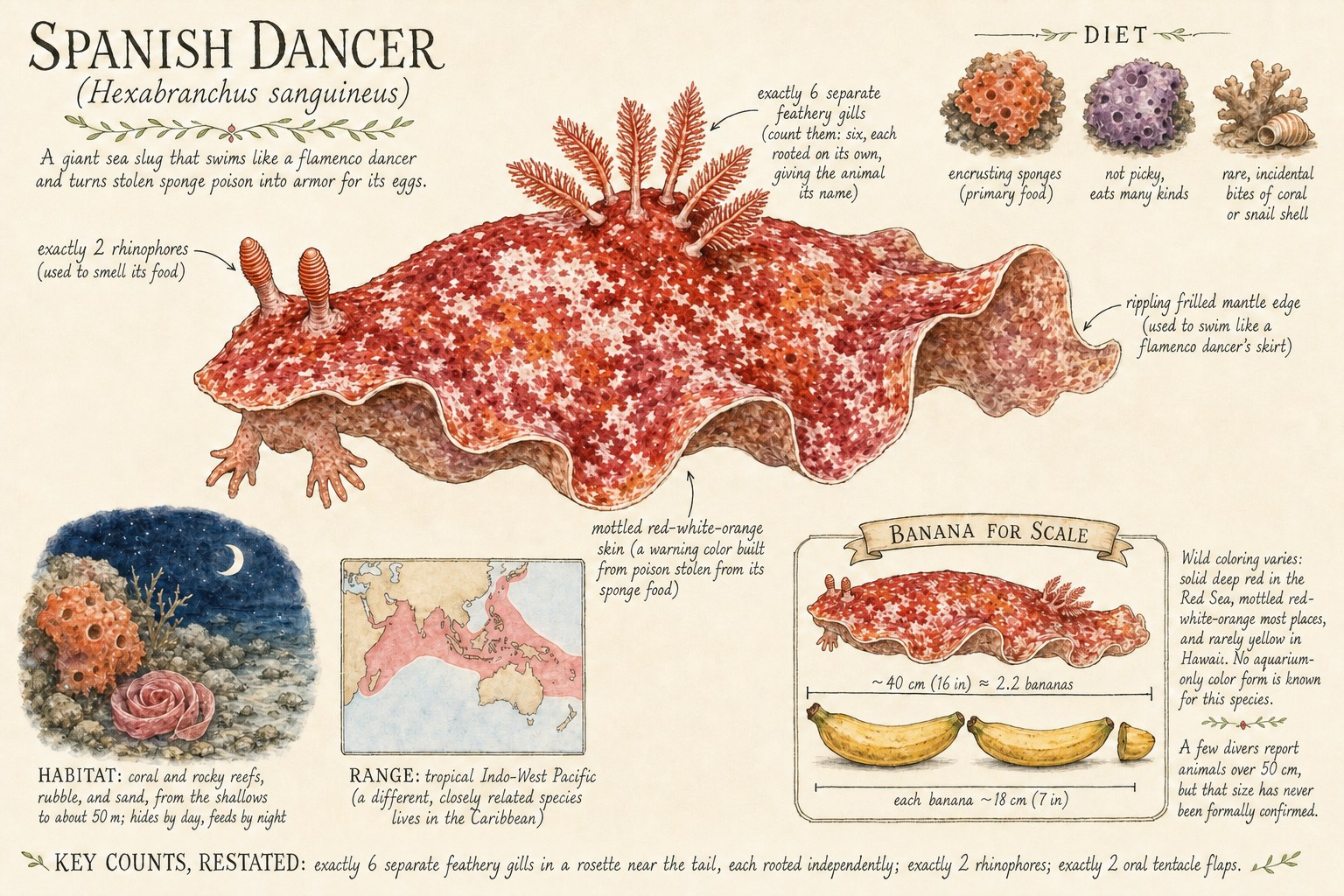
Watch this giant sea slug unfold like a flower. Then it dances away. This is the Spanish dancer. It is a mollusk, the same family as snails and clams. But this one lost its shell long ago. By day, it hides flat on a coral reef. By night, it comes out to eat sponges, the squishy blobs that grow on rocks. If a fish gets too close, the Spanish dancer flips open its red and white edges. Then it swims off, flapping like a skirt in a dance. It can keep dancing for over an hour without stopping. Six feathery gills sit on its back like a little red flower. Stretched out, a big one is about two and a fifth bananas long. Here is the best part. The sponges it eats are poisonous. So the Spanish dancer steals that poison for itself. It even paints the poison onto its eggs, to keep its babies safe before they hatch.
The Spanish dancer is a mollusk. That puts it in the same big group as snails, clams, and octopuses. But it belongs to a branch called nudibranchs: sea slugs that lost their shells millions of years ago. Instead of a shell, it protects itself with color, chemistry, and a getaway dance. Most days it stays hidden on a coral or rocky reef, blending into the rubble. At night it crawls out to hunt sponges. It is not picky. Scientists checked its stomach contents and found pieces of at least eleven different kinds of sponge. They also found scraps of coral, worm tube, and snail shell.
Six feathery gills sit in a ring on its back. They are not attached to each other. Each one plugs separately into its skin. That is actually where the animal gets its scientific name: Hexabranchus means six gills. When something threatens it, the Spanish dancer unrolls the wide, frilly edges of its body. Scientists call those edges the mantle. It flashes a startling red and white pattern. Then it swims away, rippling those edges up and down like a flamenco dancer's skirt. Divers have watched one flap for over an hour without stopping. If it stops moving, it sinks.
Its best trick, though, is chemical. The sponges it eats are loaded with toxin. The sponge makes that toxin so it will not get eaten. The Spanish dancer eats the sponge anyway. It swallows the poison, tweaks it slightly, and stores it in its own skin. That warns off predators. Then it goes one step further. The same chemical gets packed into its egg ribbon, a long pink strand coiled into a rose shape on the reef. The eggs are protected before they even hatch.
Coral Reef Awareness Week happens every year in the third week of July. The Spanish dancer is a good reminder of why healthy reefs matter. It needs living sponges and coral rubble to survive. So wherever divers find lots of Spanish dancers, they are usually looking at a reef that is doing well.
Hexabranchus sanguineus belongs to the class Gastropoda, order Nudibranchia, family Hexabranchidae. It is a mollusk, in the same phylum as clams, mussels, and octopuses. But nudibranchs are the branch that abandoned the ancestral snail shell entirely. The genus name is Greek for six gills. The species name is Latin for blood-colored, a reference to the deep red color form first collected in the Red Sea. In practice, the gill count is not fixed. Divers and researchers have photographed Spanish dancers with anywhere from four to eight separate gills. Each one is rooted independently into the body wall, rather than sharing one retractable pocket the way most other dorid nudibranchs do.
Diet drives almost everything else about this animal. It feeds on encrusting sponges: at least eleven genera across five orders, documented in gut-content studies. Many of those sponges manufacture toxic compounds called macrolides, meant to deter fish. The Spanish dancer eats them anyway. It absorbs the toxin, modifies its structure slightly, and stores it in its own skin as a stolen chemical defense. The same compound gets loaded into its egg ribbon: a coiled, rose-shaped mass of thousands of eggs, laid on rock or coral rubble and camouflaged against the reef. Development takes six days at twenty-seven degrees Celsius. It stretches to twelve days in cooler water, one of the few precisely measured details in an otherwise loosely studied life history. Lifespan specifically for this species has not been rigorously documented. Most nudibranchs live around a year, and there is no strong reason to think the Spanish dancer differs. But no dedicated longevity study for the species turned up in the available literature.
Its escape swim is a genuine oddity in a group that mostly just crawls. When disturbed, it unfurls the frilled margins of its mantle. It undulates them in vertical waves, a motion divers nicknamed after the flamenco. That motion generates enough thrust to lift a slug-shaped body well off the reef. One long-time observer recorded a single animal swimming for over an hour straight, since a Spanish dancer that stops flapping simply sinks. Size claims for the species vary widely. Two independent sources put the practical maximum at around forty centimeters, already one of the largest nudibranchs on record. An unverified diver and magazine report from Djibouti, in the Red Sea, describes one reaching five hundred twenty millimeters. Its own chronicler flagged that figure as anecdotal, not scientifically measured.
A small, ornately patterned shrimp, Periclimenes imperator, often rides along on the Spanish dancer's back as a commensal. It was first described from specimens under a centimeter long, collected off Zanzibar and Mozambique in 1967. The relationship costs the slug nothing. The shrimp gets a mobile home and a free ride between feeding grounds. As for conservation, the IUCN Red List has not published an assessment for Hexabranchus sanguineus. Its status is officially Not Evaluated, rather than a guessed safe. There is no documented population decline. But the species depends entirely on the coral and sponge habitat that reef researchers watch most closely every July, during Coral Reef Awareness Week. A shrinking reef ultimately means fewer sponges, and fewer Spanish dancers.