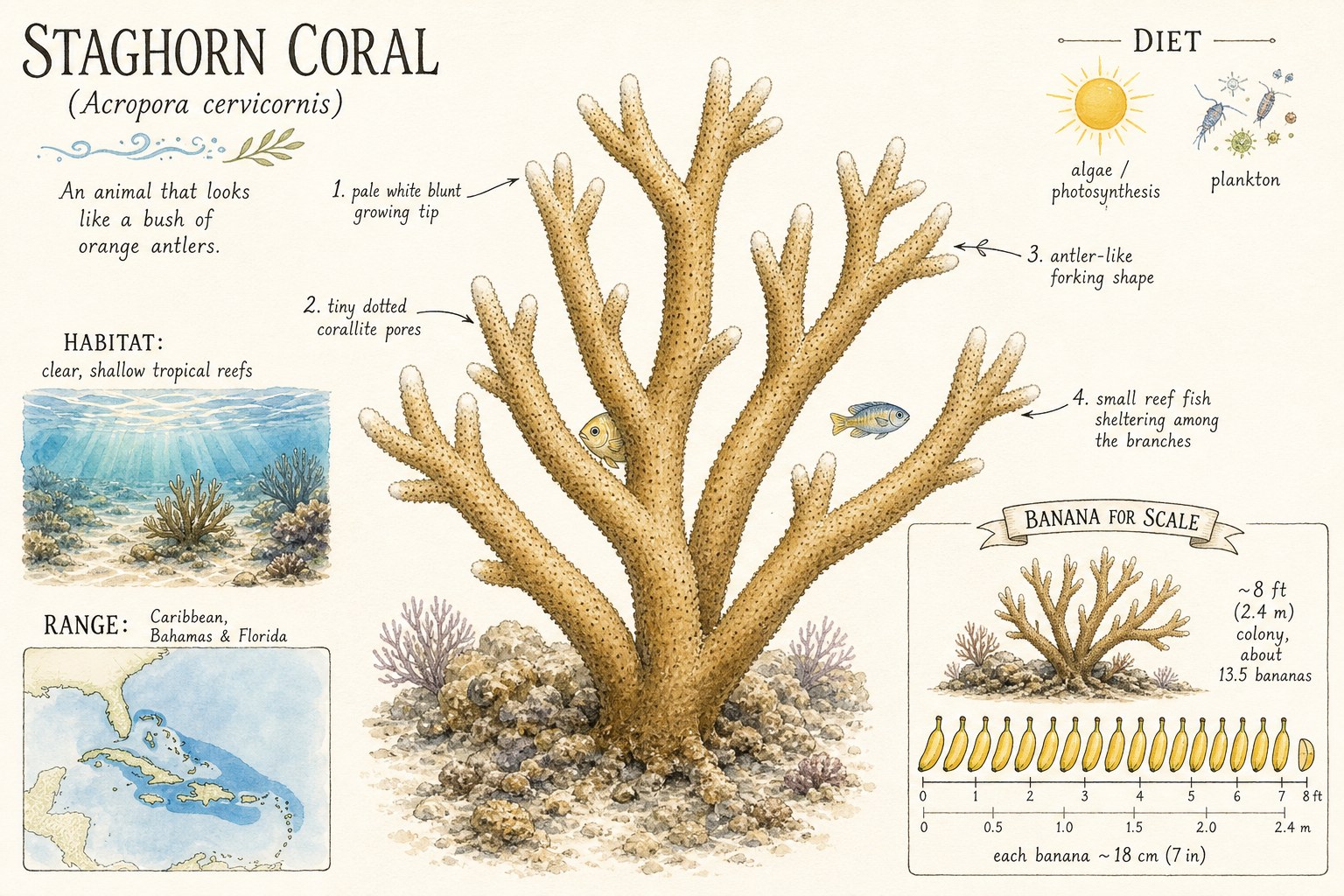
Look at this coral. It looks like a pile of orange antlers. But here's a surprise. Coral is alive, and it is an animal, not a plant, not a rock. It's a cousin of the jellyfish. And get this: one coral branch is really home to thousands of tiny animals. Each one is smaller than your pinky nail. They build one branchy house, and they share it. Every year, the branches grow a little longer. Once a year, something amazing happens. On a certain night, after a full moon, the whole reef of coral does the same thing. Every bit of it lets go of tiny eggs, all at the very same moment. For a few minutes, the whole sea looks like it is snowing. Snowing upward.
Staghorn coral is a cnidarian. That's the same big animal group as jellyfish, sea anemones, and moon jellies. Each branch you see is really an apartment building. Thousands of tiny animals called polyps live inside it. Each polyp is no bigger than a grain of rice. They all share the same skeleton. A single colony can grow 8 feet across. That's wider than a queen bed. It can grow at least 4 feet tall, branch by branch.
Staghorn coral grows fast. It is one of the fastest-growing corals in the whole Atlantic Ocean. Healthy branches can add 4 to 8 inches a year. Some of that growth is free energy. Tiny algae live right inside the coral's skin. They turn sunlight into food, just like a plant does. At night, the coral hunts too. Each polyp reaches out its own tentacles and grabs floating plankton. It's part solar panel, part fishing net.
Once a year, staghorn coral does something remarkable. A few nights after the full moon in late summer, every colony on a reef spawns at once. They release clouds of eggs and sperm into the water, all at the same moment. Scientists call it a mass spawning event. That kind of timing has not been enough to save this coral, though. Starting in the early 1980s, a disease called white band disease hit the Caribbean hard. It wiped out around 97 percent of all staghorn coral. Reefs that used to be solid thickets now have only scattered patches.
Today, staghorn coral is listed as Critically Endangered. Scientists and volunteers are fighting back. They grow new coral on underwater nurseries. Then they snap off healthy branches and replant them on damaged reefs by hand. It is slow work. But it is helping this coral catch up to a reef it once built almost by itself.
Acropora cervicornis belongs to Anthozoa, the coral-and-anemone class within the phylum Cnidaria. Its order is Scleractinia, the stony corals that build skeletons from calcium carbonate. A colony is a single genetic individual, multiplied thousands of times over. Each polyp sits in its own skeletal cup, called a corallite. Every polyp in the colony shares a thin, connecting sheet of living tissue with its neighbors. The species name gives away its shape. Cervicornis is Latin for deer-horned, a nod to branches that fork and taper like a stag's antlers.
Like most reef-building corals, Acropora cervicornis depends on a symbiotic partner: zooxanthellae, single-celled algae that live inside its tissue. These algae photosynthesize and pass most of the sugar they make straight to their coral host. That partnership is what lets corals build reefs at all. Without it, growth slows to a crawl. When the partnership breaks down, usually from heat stress, the coral expels its algae and turns white. Scientists call this bleaching, and it leaves a colony pale, starving, and open to disease. Staghorn coral hedges its bets, though. At night, its polyps extend their own tentacles to sting and catch drifting zooplankton.
Reproduction here runs on a strange, precise clock. Acropora cervicornis is a simultaneous hermaphrodite. Each colony makes both eggs and sperm, though it generally avoids fertilizing itself. Once a year, several nights after the full moon in late summer, colonies across an entire reef spawn in unison. They release bundles of eggs and sperm that rise toward the surface, fertilize, and drift as larvae before settling onto hard ground to found new colonies. In the wild today, though, asexual reproduction does more of the work. Broken branches simply reattach and regrow, which is the same trick coral nurseries use to propagate new colonies for restoration.
For roughly 5,000 years, Acropora cervicornis was one of the main architects of Caribbean reefs. It grew in dense stands called thickets, so extensive that an entire reef zone still bears its name. That changed fast. Starting in the early 1980s, white band disease, a bacterial illness still not fully understood, swept through the Caribbean. It killed an estimated 97 percent of the species within a few decades. In 2006, staghorn and elkhorn coral became among the first species ever listed as Threatened under the U.S. Endangered Species Act specifically because of a warming climate. In 2022, the IUCN Red List raised its global status to Critically Endangered.
Conservation now runs largely through coral nurseries. Divers grow thousands of staghorn fragments on underwater trees, then outplant them onto damaged reefs by hand. It is a slow, strange form of gardening, one that treats a wild animal like a cutting from a houseplant. It is working, in patches. Whether it can outpace a warming ocean is the real question behind every coral reef story being told right now.