Meet the crayfish, a little animal that looks like a tiny lobster. It lives in ponds and slow, muddy water. A crayfish is a crustacean, part of the crab-and-shrimp group. It has two big claws for grabbing food and for telling other crayfish to back off. When a crayfish gets scared, it snaps its tail and shoots backward, fast. Here is the strange part. A crayfish wears its bones on the outside, like a little suit of armor. When it grows too big for the suit, it wriggles out and grows a new one. And if it loses a claw, it can grow that back too. Then it goes right back to poking around in the mud, hunting for a snack.
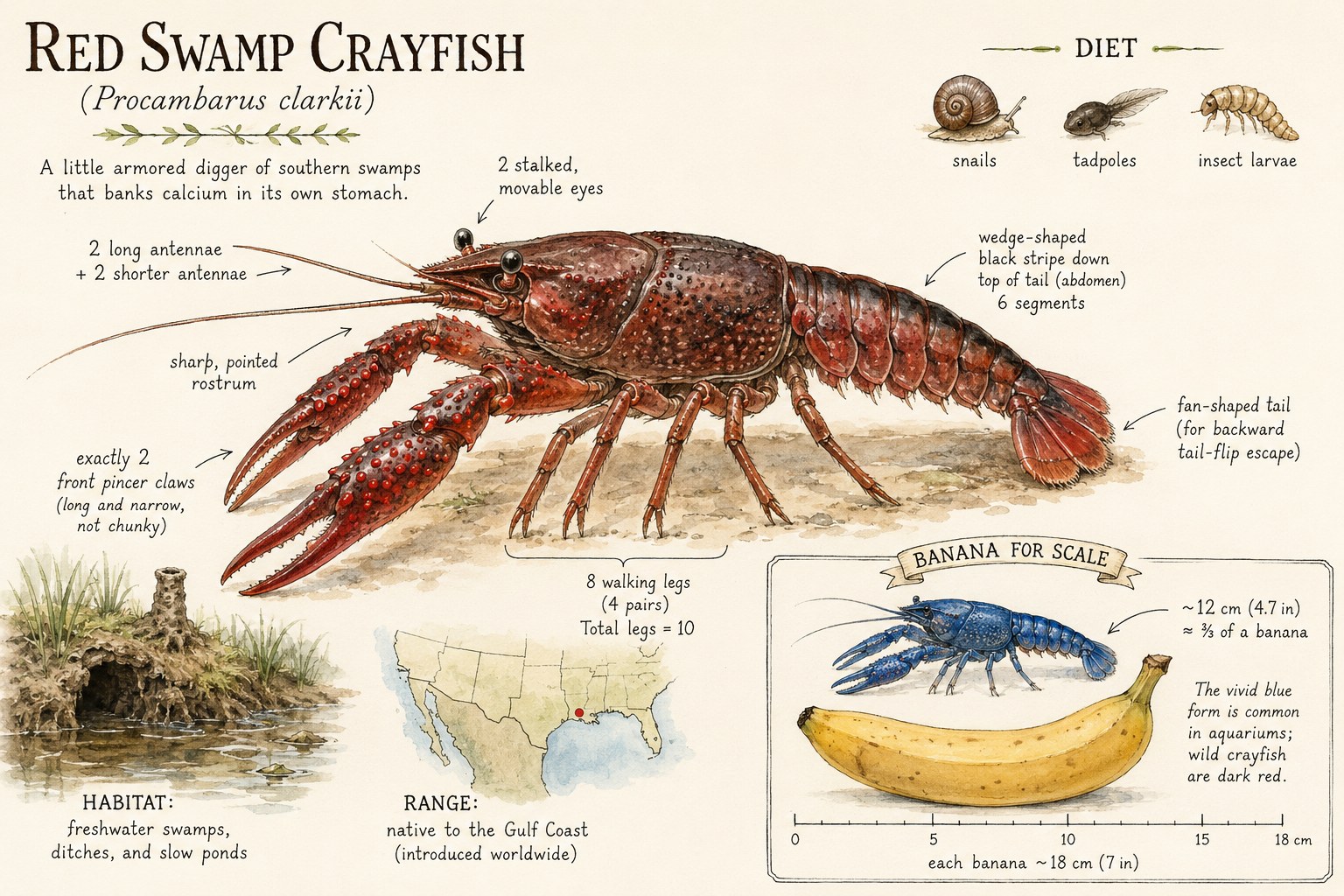
The red swamp crayfish is a crustacean, the same big group that holds crabs and shrimp. It grows about 4 inches long and wears a dark red shell with a black wedge on its tail. Those two front claws do a lot of jobs: grabbing snails and tadpoles, fighting other crayfish, and warning enemies to stay away.
A crayfish can't stretch its hard shell, so to get bigger it has to molt, which means climbing out of the old shell and growing a new one. The clever part comes next. Right before it molts, the crayfish pulls calcium out of its old shell and stores it as two little stones in its stomach, called gastroliths. Once the new shell is ready, it dissolves those stones and uses the calcium to harden up fast. It even eats its old shed shell to save the rest.
When its pond dries up, this crayfish doesn't just wait around. On wet nights it can crawl across land, sometimes for more than a mile, to find new water. If the ground gets too dry, it digs a burrow up to three feet deep to reach the water below. A mother crayfish carries her eggs under her curled tail, hundreds at a time, and the babies ride along with her until they can look after themselves.
The red swamp crayfish, Procambarus clarkii, is a decapod crustacean in the family Cambaridae, native to the swamps, sloughs, and sluggish ditches of the south-central United States and northeastern Mexico. Decapod means "ten feet," and the name fits: five pairs of legs, with the front pair enlarged into the long, narrow pincers the animal is known for. It is a slow-water specialist that avoids strong currents and spends its days hidden under logs and rocks, coming out at night to hunt.
Like all arthropods, a crayfish grows by molting, shedding the rigid exoskeleton it has outgrown. The problem is calcium. A fresh shell starts out soft, and rebuilding it from nothing would leave the animal defenseless for too long. So the crayfish banks its own calcium ahead of time. Molting hormones strip calcium carbonate from the old shell and store it as a pair of gastroliths, hard disc-shaped stones tucked into the foregut. After the molt, the crayfish digests those stones and uses the released calcium to reharden its mouthparts and claws first, then finishes the job with calcium from food and water. Many crayfish also eat the cast-off shell to recover what is left.
Few freshwater animals are as hard to discourage. P. clarkii tolerates warm, low-oxygen, even polluted water, breathes air for short stretches, and disperses overland on rainy nights, sometimes traveling more than a kilometer to reach a new pond. In drought it burrows 40 to 90 centimeters down to the water table and waits out the dry season. A large female can produce more than 600 young, and the animal can breed at only three months old. Those traits built the Louisiana crawfish industry, where farm ponds cover tens of thousands of hectares. The same traits made it one of the most damaging invasive crayfish on Earth, burrowing through levees and pushing out native species wherever it lands, from Europe to East Africa to Japan.
The IUCN lists Procambarus clarkii as Least Concern, assessed in 2010, which for this species is almost an understatement. In its home waters it is an ordinary part of the food web, feeding herons, raccoons, and fish, and thinning out the snails that carry human parasites. Everywhere else, it is the crayfish that showed up and stayed. Not bad for an animal that keeps its skeleton on the outside and packs a spare supply of calcium in its stomach.