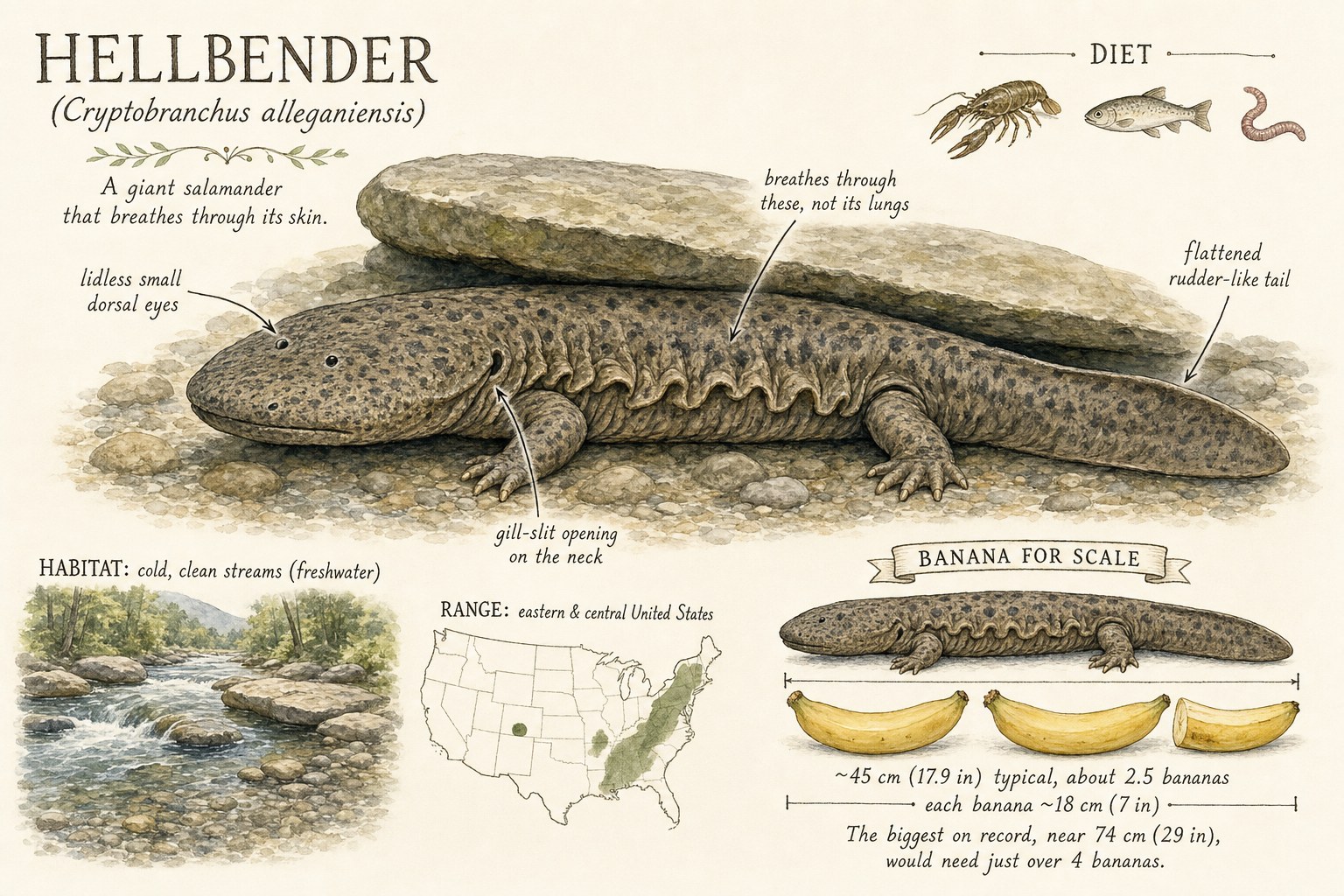
Down in cold mountain streams lives a giant, wrinkly amphibian called a hellbender. It's a kind of salamander, and it can grow as long as your arm! People who live near it have funny nicknames for it. Some call it a snot otter. Some call it a lasagna lizard, because its baggy skin looks like noodles. Here's the wildest part. A hellbender barely uses its lungs. It breathes through its skin instead, like it's wearing a scuba suit made of wrinkles. It hides all day under one big flat rock. At night, it creeps out to hunt crawdads. Hellbenders need water that is clean and cold. If the water gets dirty, hellbenders can't breathe right, and they disappear.
The hellbender is an amphibian, in the same big group as frogs and newts. But it never leaves the water once it grows up. It's the largest salamander in North America. Some stretch close to 74 centimeters (29 inches), a little over four bananas long. Most adults are smaller. They average around 45 centimeters, about a foot and a half, or two and a half bananas.
A hellbender's strangest trick is how it breathes. It has lungs, but they barely work. Loose folds of skin ripple down each side of its body instead. Those folds work kind of like gills built into the skin. They soak up oxygen straight out of the water. Up to 95 percent of a hellbender's oxygen comes in through its skin, not its lungs. That trick only works in cold, fast, clean water. So a hellbender is basically a walking water-quality test. If the stream turns warm, slow, or dirty, hellbenders start disappearing.
At night, a hellbender creeps out from under its rock. It hunts crayfish mostly, plus small fish, worms, and the occasional smaller salamander. It ambushes prey with one fast gulp of suction. During the day it hides under a single big flat rock and rarely wanders far.
Right now, hellbenders are in real trouble. Scientists have tracked 626 known hellbender populations across the eastern United States. Only 371 of them, about 59 percent, still exist. Of the ones still around, just 45 are considered stable. The world conservation group IUCN lists the hellbender as Vulnerable. In 2024, the U.S. government proposed federal protection for it too. As of 2026, that decision still hasn't been finalized.
Cryptobranchus alleganiensis belongs to Cryptobranchidae, the family of giant salamanders. Its only living relatives are the giant salamanders of China and Japan, genus Andrias. Taxonomists have recently split that genus into three or four separate species, not just one. The genus name Cryptobranchus comes from Greek for "hidden gill." That's a nod to the small, circular gill slit on each side of the neck, the last trace of the external gills a larva loses as it grows up. Cryptobranchus alleganiensis is the only living species in its own genus.
Reproduction is a male-run operation. Each fall, a male digs a saucer-shaped nest beneath a large rock and waits there. He blocks the entrance to any female until she lays her eggs, sometimes 150 to 450 of them in long connected strings. He fertilizes them externally, right there in the open water. Then he drives the female out and guards the nest alone. Incubation takes 45 to 80 days, and he rocks his body the whole time, keeping oxygen-rich water flowing over the clutch. He'll also eat some of his own eggs. In streams where the surrounding forest has been cut down, he may eat the entire clutch. Researchers are still working out why. Hellbenders reach maturity around five to eight years old. In the wild they commonly live 12 to 15 years, and some documented individuals have reached 25 to 30.
The species' conservation story is genuinely urgent, and still unresolved. The IUCN Red List classifies the hellbender as Vulnerable, an assessment updated in 2022. That update followed a documented decline of 30 to 50 percent over roughly three generations. Sedimentation, dammed and degraded streams, and a fungal disease called chytrid are the main drivers. In the United States, protection has arrived unevenly. The Ozark hellbender, a distinct subspecies from the Ozarks of Missouri and Arkansas, was federally listed as Endangered back in 2011. Missouri's population of the more widespread eastern hellbender followed in 2021. In December 2024, the U.S. Fish and Wildlife Service proposed Endangered status for eastern hellbenders across the rest of their range, from New York to Georgia. That rule was due to be finalized by December 2025. It wasn't. As of early 2026, the decision sits in an indefinite holding category with no scheduled date, and the Center for Biological Diversity has now sued to force a final answer.
Genetic research is complicating the picture further. Field guides have long treated this as one species with two subspecies. It may actually be several distinct lineages: Ozark, Missouri River, Tennessee River, Kanawha River, and Susquehanna River hellbenders. Taxonomists are still working out where the boundaries fall. The Center for Biological Diversity calls hellbenders living fossils, animals that have kept roughly the same body plan for an extraordinary stretch of geologic time. Whatever the final species count turns out to be, every lineage depends on the same fragile ingredient: cold, clean, fast-moving water, and that water is getting harder to find.