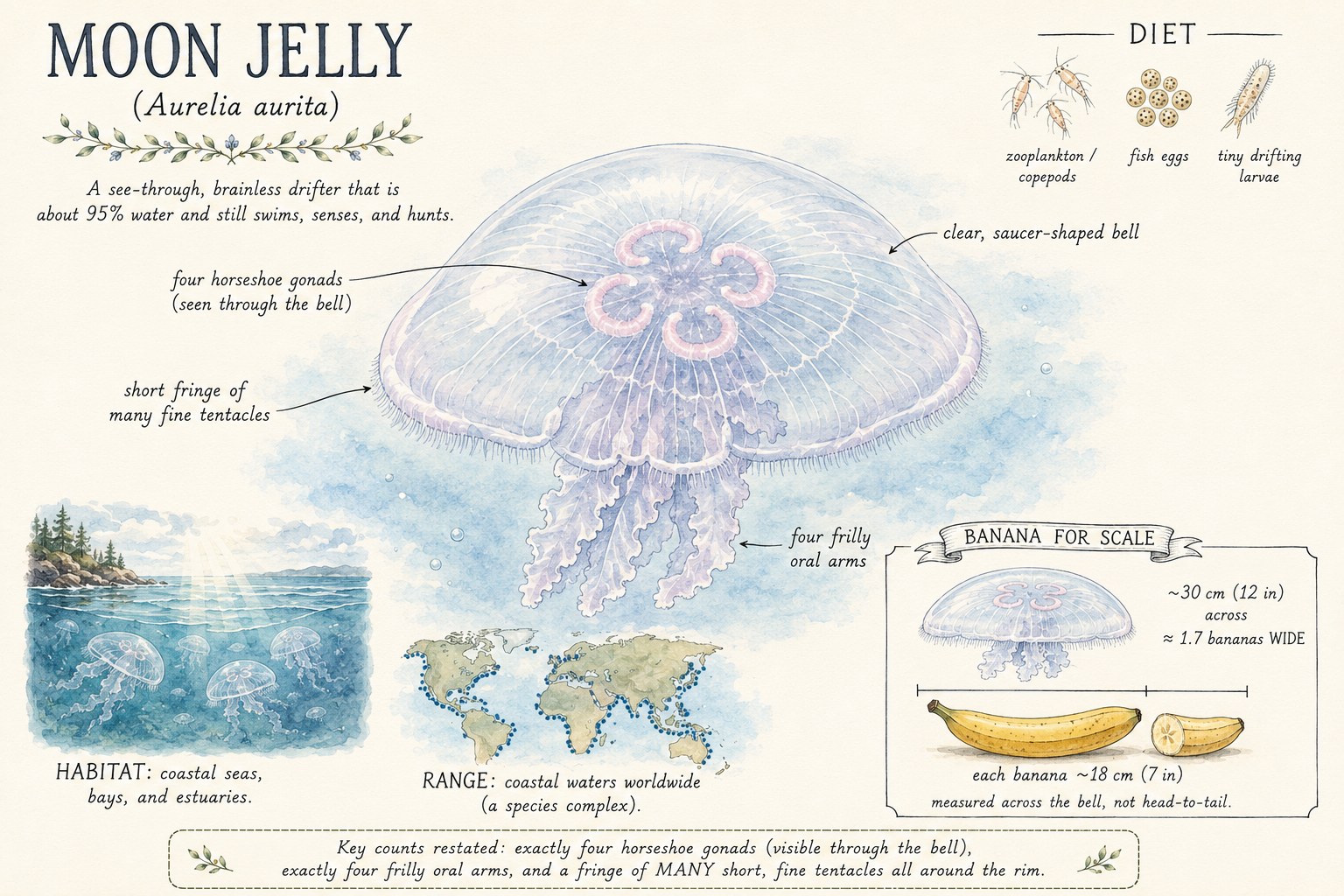
Say hello to the moon jelly. It floats in the sea like a little clear umbrella, and you can see right through it. It is a jellyfish, part of a soft, squishy group of animals called cnidarians. Its body is soft and squishy and almost all water. A moon jelly has no bones. It has no heart. It does not even have a brain. But it can still swim all by itself, opening and closing like a slow, wet flower. Look at the top of its bell. Do you see four little shapes like horseshoes? Those help it make babies. Around the edge hang lots of tiny stringy tentacles, soft as threads. They catch teeny bits of food that float by. A moon jelly can sting, but only a little, and it will not hurt you much. Mostly it just drifts, and glows, and rides the waves wherever they go.
The moon jelly is one of the strangest simple animals in the ocean. It has no brain, no heart, no bones, and not a single drop of blood. Its body is about 95 percent water, which is exactly why you can see straight through it. Instead of breathing with lungs, it lets oxygen soak in directly across its thin skin. To sense the world around it, the jelly relies on eight tiny sense organs spaced evenly around the rim of its bell, called rhopalia (roh-PAY-lee-uh). Each one carries a balance detector and a light detector, so even without a brain, the animal always knows which way is up.
Those four horseshoe shapes you can see through the top of the bell are its gonads, the organs that make eggs or sperm. A short fringe of hair-thin tentacles rings the outer edge, and four frilly arms called oral arms dangle from the center. The tentacles are dotted with microscopic stinging cells that fire into small plankton and stun them. The oral arms then sweep that captured food up toward the mouth, which is tucked underneath the bell. The sting is real, but it is mild, and to most people it feels like a faint tingle at worst.
A moon jelly can even shrink itself. When food becomes scarce, it gets smaller to conserve energy, then grows back once the hunting improves. Most moon jellies live for only about a year.
The moon jelly (Aurelia aurita, aw-REE-lee-uh aw-RY-tuh) is a scyphozoan jellyfish in the family Ulmaridae. The genus name comes from the Latin for golden, and the species name aurita means eared, a nod to the four ear-like oral arms hanging under the bell. It is one of the most familiar jellyfish on Earth, drifting through coastal waters of the Atlantic, Pacific, and Indian oceans, and it tolerates everything from open sea to brackish estuaries.
For an animal with no brain, no heart, and no blood, the moon jelly does a lot. It swims by pulsing its bell, and it monitors its world with eight rhopalia (roh-PAY-lee-uh) set around the bell margin. Each rhopalium holds a statocyst, a little balance organ that works like the fluid in your inner ear, plus light-sensing spots. Oxygen simply diffuses across its thin tissues, since it is roughly 95 percent water and never more than a couple of cells from the sea. Short marginal tentacles studded with stinging cells (nematocysts) catch drifting plankton, and four frilly oral arms carry the catch to the mouth.
The life cycle is where it gets genuinely strange. An adult medusa (meh-DOO-suh), the familiar swimming bell, is only half the story. Fertilized eggs grow into swimming larvae that settle onto a hard surface and become a polyp, a tiny stalked creature anchored to the bottom. That polyp can live for years, and when conditions are right it stacks itself into segments like a pile of plates and buds off baby jellies one at a time, a cloning process called strobilation (stroh-bih-LAY-shun). A single polyp can release many genetically identical young. So the moon jelly you see pulsing past is both an individual and, in a sense, one leaf peeled off a much older clone.
Here is a taxonomy wrinkle worth knowing. For a long time nearly every moon jelly on the planet was filed under the one name Aurelia aurita. DNA studies have since shown that what people casually call the moon jelly is really a species complex, a cluster of at least a dozen and possibly dozens of nearly identical species that can only be told apart by their genes. The classic Aurelia aurita is now understood to be one member of that group, not a single worldwide species.
None of these jellies has been evaluated by the IUCN, so the moon jelly carries no Red List category at all. It is Not Evaluated. In practice it is abundant, and in some places jelly blooms are growing as warming, overfishing, and pollution tip coastal food webs in their favor. A brainless bag of water, it turns out, is very good at hanging on.