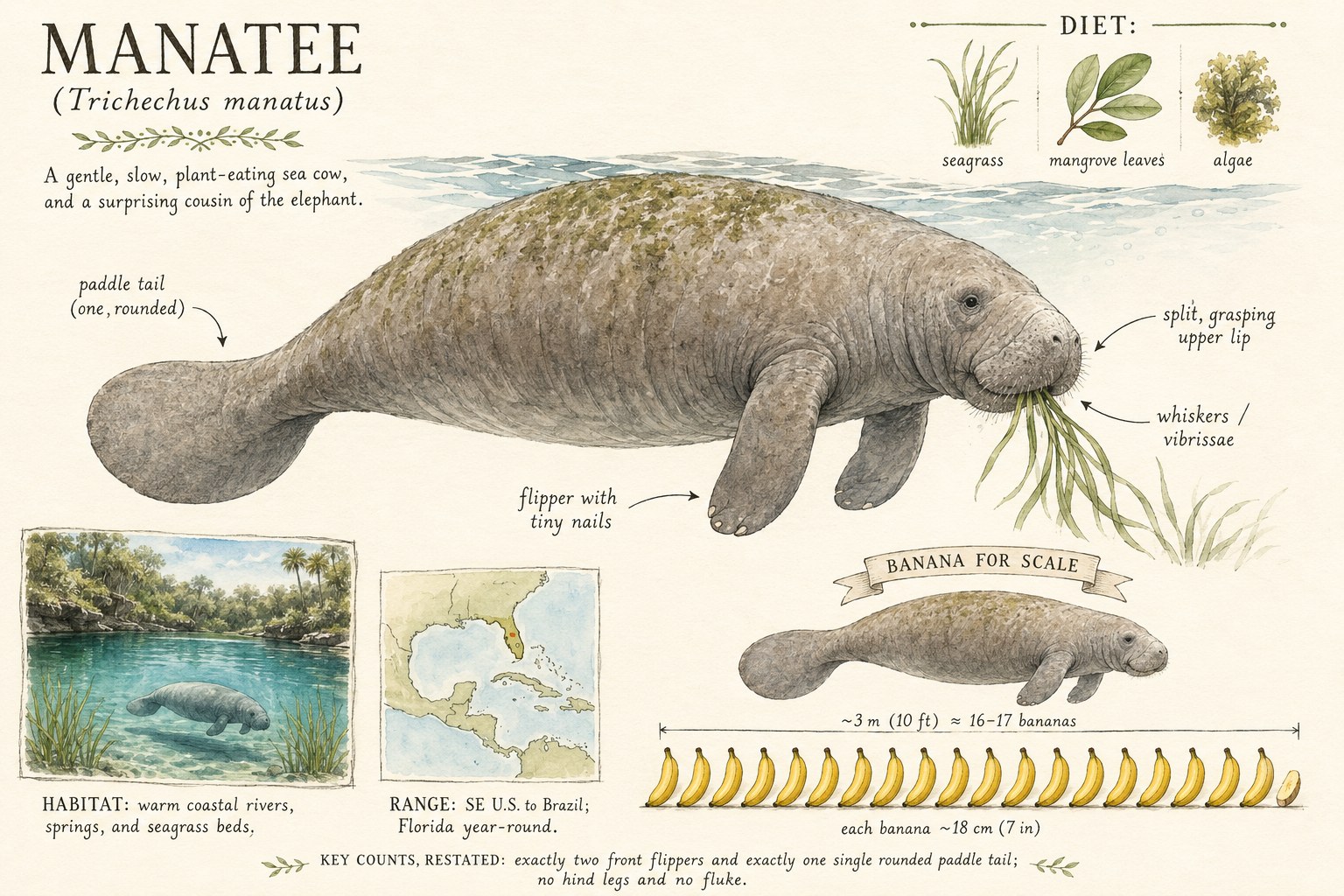
Meet the manatee. Say it like this: MAN-uh-tee. It is big and round and gray, and it swims very, very slowly. It is a mammal, just like us. People call it the sea cow, because it eats grass all day. But this grass grows underwater!
A manatee has no fingers and no claws. It has two flat flippers and a wide flat tail shaped like a paddle. It uses its wrinkly, bendy lips to grab plants and pull them free. Munch, munch, munch. It can eat for eight hours a day.
Here is something sweet. The manatee's closest cousin is not a fish or a whale. It is the elephant! They both have funny teeth that keep growing back your whole life. And a baby manatee holds close to its mom and drinks her milk, just like a baby elephant does.
Manatees are gentle. They have no sharp teeth to bite, and nothing hunts them. They just float, and nibble, and nap in the warm water.
The manatee is a big water mammal that eats only plants. A grown one is usually 9 to 10 feet long, about the length of a small rowboat, and weighs around 1,000 pounds. The really big ones can top 3,500 pounds. Most of that bulk is stomach and gut, because it takes a huge belly to break down all the seagrass a manatee packs away. It eats about a tenth of its own body weight in plants every single day.
For an animal that size, the manatee is surprisingly fussy about temperature. It carries very little body fat and runs on a slow inner engine, so cold water is dangerous for it. Once the water drops below about 68°F (20°C), a manatee can get sick from the cold. That's why manatees in Florida crowd into warm springs and the warm water that pours out of power plants all winter. In summer, when the whole coast warms up, they spread back out. Some swim as far as Texas, and others wander north toward the Carolinas.
Manatees breathe air, the way we do. A resting one comes up for a breath every few minutes, but it can hold that breath for up to 20 minutes when it needs to. And here's a strange family secret. The manatee's closest living relatives are elephants, and you can see the proof in their mouths. Both animals grow "marching molars," back teeth that slowly creep forward, wear down, fall out at the front, and get replaced by fresh ones over and over for life.
The West Indian manatee (Trichechus manatus) belongs to the order Sirenia, a small group of fully aquatic, plant-eating mammals that also includes the dugong. Only four sirenian species are left alive today, and every one of them makes its living grazing underwater. Manatees split from a land-dwelling ancestor more than 50 million years ago, an ancestor they share with elephants, which is why two animals that look nothing alike keep turning up as cousins in the fossil record.
The West Indian manatee comes in two subspecies. The Florida manatee (T. m. latirostris) ranges up the southeastern U.S. coast, while the Antillean manatee (T. m. manatus) lives from the Gulf and Caribbean coast of Mexico down to northeastern Brazil. Manatees move easily between salt, brackish, and fresh water, though they need regular access to freshwater to drink. A muscular, split upper lip does most of the feeding: the two halves move independently, almost like a pair of hands, sweeping seagrass and water plants into the mouth.
Nearly everything about a manatee is tuned for a slow, cheap life. Its body burns energy at a famously low rate, which is part of why water below roughly 68°F is a genuine threat and why the animal has to shelter at warm springs and power-plant outfalls through the Florida winter. It has just six bones in its neck, where almost every other mammal has seven, and its brain is smooth and small for its body size. None of that is a defect. It's simply what you can afford when your food is a meadow that never runs away and nothing is trying to eat you. Adult manatees have no natural predators.
Their real problems are almost all ours. The IUCN lists the West Indian manatee as Vulnerable (assessed 2023), with the Antillean subspecies ranked Endangered, and the population is still projected to decline over the next few decades. In Florida, boat strikes are a leading killer of an animal far too slow to dodge a propeller, and the loss of warm-water refuges and the seagrass beds they feed on piles on more pressure. There is a brighter column in the ledger, though. Decades of protection helped the Florida population climb from fewer than 2,000 in the early 1990s to an estimated 8,350 or more today, a reminder that a gentle, ancient grazer can hold on when people give it room.