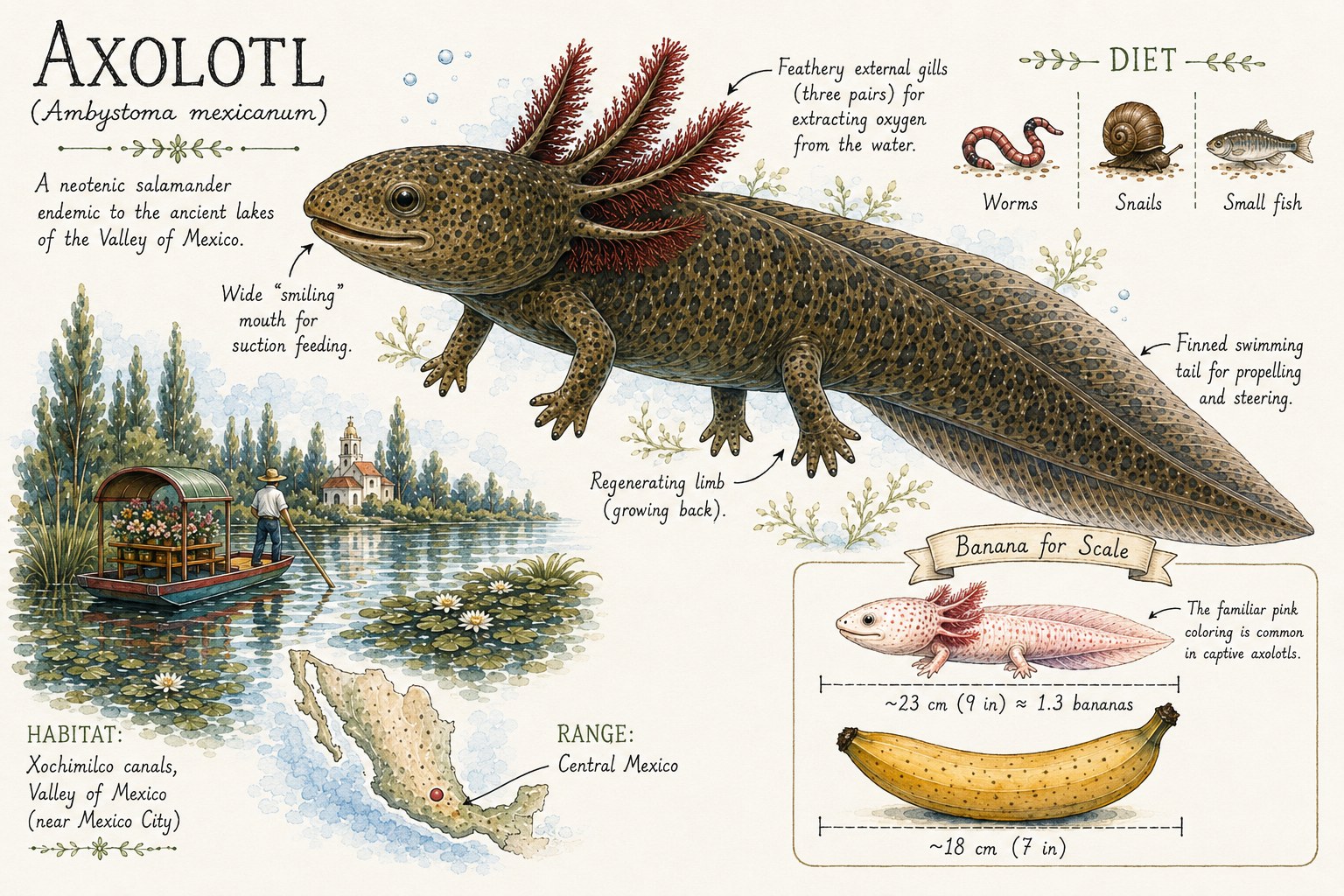
Meet the axolotl (ax-oh-LOT-ul), a little salamander with a great big smile. It is an amphibian, like a frog or a toad. It lives underwater in Mexico, and it has a funny secret: it never grows up. Most baby salamanders grow up and crawl onto land. Not this one. The axolotl keeps its feathery gills, its frilly tail, and its whole baby body, forever. Those fluffy pink gills on its head help it breathe. It waves them around like a fancy hat! When it gets hungry, it opens wide and slurps up worms and snails. And if it loses a leg? It simply grows a brand new one. Sadly, there are not many left in the wild anymore. Their water got too dirty and crowded. But all around Mexico City, people are working hard to help them.
You might think an axolotl is a baby, but it is a full-grown adult that simply kept its baby body. Most salamanders hatch underwater with feathery gills, then lose those gills, grow lungs, and crawl onto land as adults. The axolotl skips that whole change. It keeps its gills, keeps its tail fin, and spends its entire life underwater. Scientists call this neoteny (nee-OT-uh-nee), which means staying young on purpose.
Its most famous trick is regrowing body parts. Lose a leg, and an axolotl grows a perfect new one, with bones, muscles, and nerves, in just a few weeks. It can even repair its own heart and parts of its brain. How? Instead of forming a scar the way we do, it builds a special clump of cells at the wound that slowly rebuilds whatever is missing. And it can do this again and again.
In the wild, axolotls live in only one place on the whole planet: a maze of canals called Xochimilco (so-chee-MEEL-koh), near Mexico City. And they are vanishing fast. The city's dirty water drains into the canals, one of their two ancient lakes was emptied to build on, and people set loose big fish like carp and tilapia that gobble up axolotl eggs and babies. Together, those problems have wiped out almost the entire wild population.
The axolotl's refusal to grow up has a name: paedomorphosis (pee-doh-MOR-fo-sis). It means keeping juvenile traits into adulthood. In most amphibians, a surge of thyroid hormone triggers metamorphosis, the switch from a water-breathing larva into an air-breathing adult. Axolotls still carry the genes for that change. They just almost never set it off, so they mature and breed while staying fully aquatic. Give one a dose of thyroid hormone in a lab, though, and it will slowly morph into a land salamander. The ability was never lost, only switched off.
That same stay-young biology may help explain its other talent. When an axolotl is wounded, it does not scar. It forms a blastema (blas-TEE-muh), a mound of cells that revert to an unspecialized state and then rebuild the exact part that was lost, correctly shaped and fully working. It can regrow limbs, tail, spinal cord, heart tissue, and parts of its brain, over and over. Humans cannot. That is precisely why the axolotl is one of the most studied animals in biology. Cracking its wound response could someday steer medicine toward regrowing human tissue instead of scarring over it.
It belongs to the mole salamander family, Ambystomatidae, and its closest relative is the tiger salamander, which does metamorphose normally. Axolotls evolved in two cool, high-altitude lakes in the Valley of Mexico, Xochimilco and Chalco. There they sat near the top of the food web, ambush hunters that snap their jaws open and suck prey in. Staying aquatic likely paid off in those stable, permanent lakes, where there was little reason to gamble on life ashore.
Today that gamble has backfired. One of those lakes, Chalco, was drained more than a century ago. Xochimilco has shrunk to canals threaded through a city of over twenty million people. The IUCN listed the axolotl as Critically Endangered in 2019, after surveys watched wild densities collapse from roughly 6,000 animals per square kilometer in 1998 to about 35 by 2017, a drop of more than eighty percent in only a few generations. The paradox is hard to believe: hundreds of thousands live safely in labs, classrooms, and home tanks around the world, while the species clings on by a thread in the only wild home it has ever had.