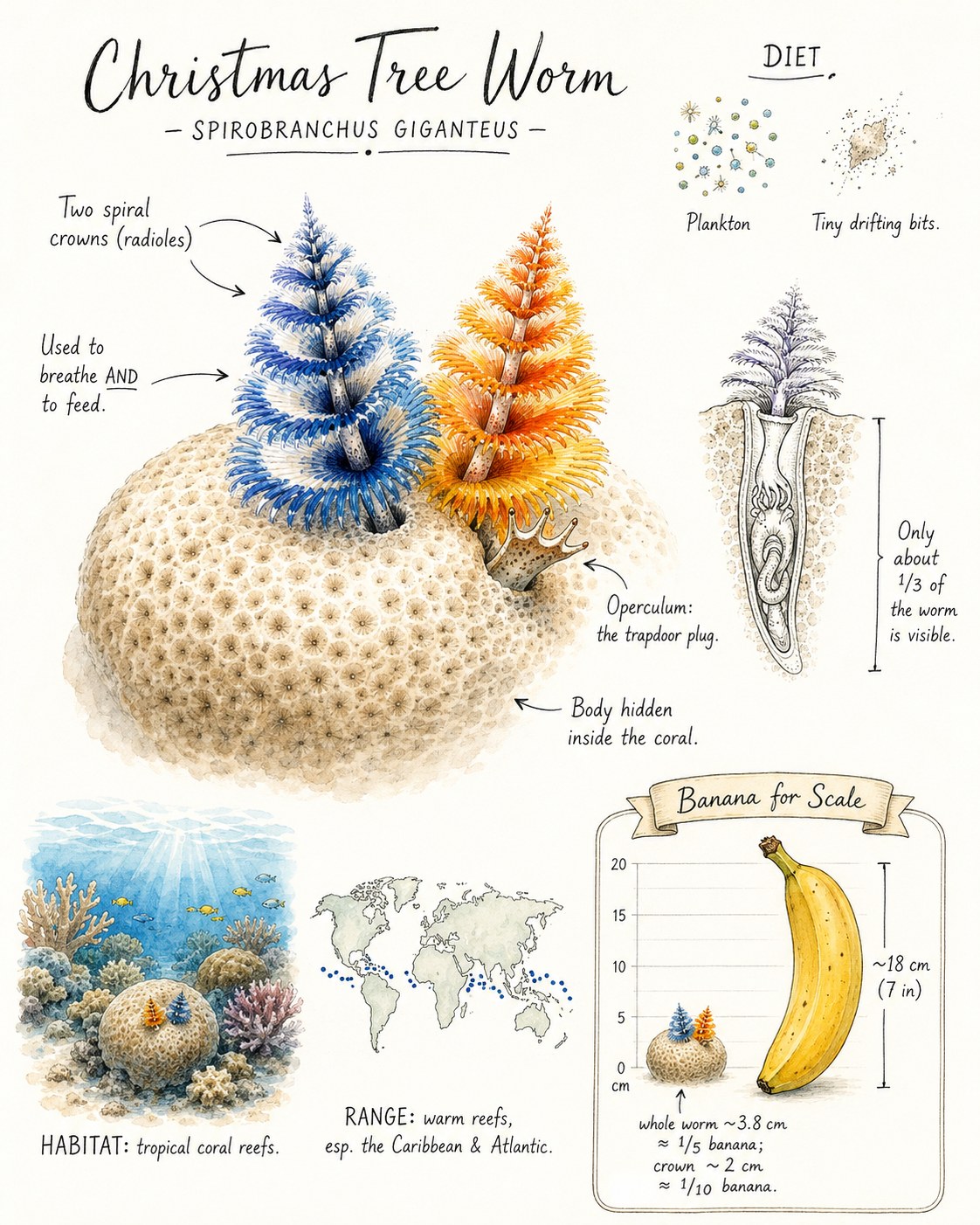
Say hello to the Christmas tree worm! It is not really a tree, and it does not care about Christmas at all. It is a little worm that lives in the warm ocean. It is the kind of worm called an annelid, which means its body is built in soft little rings. It wears two tiny trees right on top of its head. The little trees can be red, or blue, or yellow, or bright pink, and they curl up like fancy party decorations. The worm uses those trees to breathe, and it uses them to catch its food too. When tiny bits of lunch float past in the water, the fluffy trees reach out and grab them. Here is the funny part. Most of the worm stays hidden inside a little tube in the coral, so all you can see are the two colorful trees. If a shadow zooms over the top, WHOOSH! The trees pop back inside, and the worm shuts its little door and waits. When it feels safe again, the two trees come out very slowly, one soft feather at a time. Peekaboo.
You could swim right over a Christmas tree worm and never spot the worm at all. What you would see is two small, colorful spirals poking out of a lump of coral, each shaped like a tiny fir tree. Those spirals are the only part of the animal on display. The rest of its body stays tucked inside a hard tube that the worm drills into living coral.
Each "tree" is a crown of feathery arms called radioles (RAY-dee-oles). The worm puts them to work on two jobs at once. The feathery arms pull oxygen out of the water so the worm can breathe, and rows of tiny hairs sweep floating food, mostly plankton too small to see, down to its mouth. Two chores, one Christmas tree.
Being a nervous little thing is what keeps this worm alive. It can't bite, sting, or swim away, so instead it hides, fast. The moment a shadow falls over it or the water stirs, it snaps both crowns back into its tube and plugs the opening with a built-in trapdoor called an operculum. Wait quietly for a minute or two, and the little trees creep back out, one careful frond at a time.
The Christmas tree worm, Spirobranchus giganteus, is a marine polychaete in the family Serpulidae, the tube-building fan worms. Its name is a decent description of the animal. Spirobranchus means about "spiral gills," and the two spiral crowns really are gills, though they moonlight as feeding gear. Each crown is a whorl of radioles, feather-like tentacles fringed with microscopic cilia. Those cilia beat in coordinated waves, pushing a steady current of water through the crown, and that same current carries phytoplankton and fine particles down grooved channels to the mouth. Breathing and filter feeding happen in one structure, at the same time.
Almost the entire animal stays out of sight. The worm secretes a hard, chalky tube and works it into the skeleton of a living coral, sometimes a good distance down into the coral head. The bright tree that divers photograph is only about a third of the whole worm. Standing guard at the entrance is the operculum, a single radiole modified into a stopper, often tipped with sharp antler-shaped spines. When a shadow crosses overhead, the worm retracts and the operculum seals the tube behind it, quicker than most predators can lunge.
Working out how long one of these worms lives took a clever workaround. Because a young worm settles onto a coral and then stays put for the rest of its life, researchers could date individual worms by counting the annual growth bands in the coral surrounding them. That study found many Christmas tree worms living past ten years, and a few beyond forty, which is a long life for so small an invertebrate.
The name deserves an asterisk. For a long time S. giganteus was treated as one species circling the planet through every tropical sea. Newer work has complicated that picture. The name now applies most confidently to worms from the Caribbean and the wider Atlantic, where the species was first described from Curaçao in 1766, while the near-identical Christmas tree worms of the Indo-Pacific are being sorted into related species. The IUCN has never formally assessed the worm, so it carries no Red List category. It stays common and widespread across warm reefs, and the honest worry is not the worm but the coral it cannot live without.